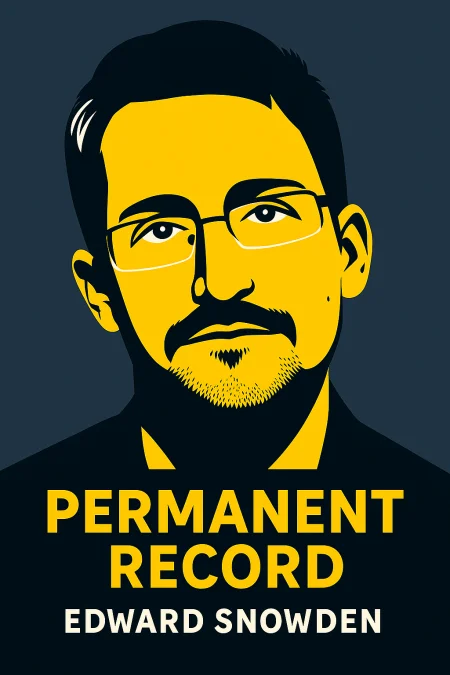
Permanent Record
The long-awaited memoir of infamous whistleblower Edward Snowden
Book Edition Details
Summary
A digital maverick turned moral compass, Edward Snowden catapulted himself into the global spotlight in 2013 when he courageously unmasked the U.S. government's clandestine surveillance machinery. "Permanent Record" peels back the curtain on Snowden's extraordinary journey—from a tech-savvy youth navigating the digital revolution to a pivotal player in the shadowy corridors of intelligence. With raw candor and stirring eloquence, Snowden recounts the gravity of his choices and the convictions that propelled him to risk everything for the sake of transparency. This memoir is not just a revelation of secrets but a poignant reflection on the balance between privacy and power in our interconnected age. Here lies the chronicle of a whistleblower whose bold stand continues to echo across the digital landscape.
Introduction
In the summer of 2013, a young American intelligence contractor made a decision that would forever alter the global conversation about privacy, surveillance, and the balance between security and freedom. Edward Snowden, then twenty-nine years old, sat in a Hong Kong hotel room with classified documents that revealed the unprecedented scope of his government's digital surveillance programs. His choice to share these secrets with journalists would transform him from an anonymous systems administrator into one of the most consequential whistleblowers in modern history. Snowden's story unfolds against the backdrop of America's post-9/11 transformation, when fear and technological capability combined to create surveillance systems that would have been unimaginable to previous generations. Born into a family of government servants, he initially embraced the intelligence community's mission with genuine patriotism. Yet his unique position as a technical expert granted him access to the inner workings of programs that collected vast amounts of data on ordinary citizens worldwide. Through his journey, readers will discover how a committed public servant evolved into a principled dissenter, the personal costs of choosing conscience over career, and the ongoing struggle to preserve democratic values in an age of digital omniscience. His experience illuminates the tension between technological progress and human rights, offering crucial insights into the challenges facing modern democracies in the digital era.
From Government Service Family to Intelligence Community
Edward Snowden's path to becoming one of history's most significant whistleblowers began in the suburbs of Maryland, where he grew up surrounded by the culture of government service. His family embodied the tradition of public duty that has long sustained American institutions. His grandfather served as a Coast Guard rear admiral, his father worked as a warrant officer, and his mother held a position at the National Security Agency. This environment instilled in young Snowden a deep respect for service to country, though it would later create profound internal conflict when he discovered what that service had become. As a teenager in the early days of the internet, Snowden found himself drawn to the democratic promise of cyberspace. The online world of the 1990s felt like a frontier where ideas mattered more than credentials, where anonymity protected free expression, and where information wanted to be free. He spent countless hours exploring bulletin board systems, learning programming languages, and absorbing the hacker ethos that celebrated technical skill, curiosity, and skepticism of authority. This digital education would prove more formative than his formal schooling, which he abandoned early to pursue technical certifications and real-world experience. The September 11 attacks transformed Snowden's worldview and career trajectory. Like many Americans, he felt compelled to serve his country in its moment of crisis. After a brief stint in the Army ended due to injury, he found his way into the intelligence community through the contracting system that had exploded in the post-9/11 security buildup. His technical skills made him valuable to agencies desperate for digital expertise, and he quickly rose through the ranks despite lacking a college degree. Working first for the CIA and later the NSA, Snowden gained an insider's view of America's intelligence apparatus. He helped build the technical infrastructure that enabled global surveillance, initially believing he was protecting his country from terrorist threats. His assignments took him from the underground server rooms of CIA headquarters to diplomatic posts in Geneva and technical centers in Japan. Each role expanded his access and deepened his understanding of how intelligence agencies operated in the digital age, setting the stage for the revelations that would eventually make him a household name.
Discovering the Scope of Mass Surveillance Programs
Snowden's assignment to Geneva marked a crucial phase in his intellectual and moral development. Working under diplomatic cover at the U.S. mission, he witnessed firsthand how American intelligence operations had evolved beyond traditional espionage into something far more comprehensive. The Swiss city, with its concentration of international organizations and financial institutions, served as a laboratory for new forms of digital intelligence gathering that blurred the lines between targeted surveillance and mass data collection. During his time in Geneva, Snowden observed the intelligence community's growing reliance on technical solutions over human intelligence. He saw how the internet's architecture, dominated by American companies and infrastructure, provided unprecedented opportunities for surveillance. The same technologies that connected the world also made it transparent to those with the right access and capabilities. What had once required recruiting human assets and conducting risky operations could now be accomplished through network exploitation and bulk data collection. His subsequent assignment to Japan deepened these concerns while expanding his technical responsibilities. Working at the NSA's Pacific Technical Center, Snowden helped design systems that would ensure the agency never lost collected intelligence, even in the event of catastrophic attacks on its headquarters. His EPICSHELTER program created automated backups that preserved vast quantities of intercepted communications, contributing to the agency's goal of achieving permanent record of global digital activity. It was in Japan that Snowden first encountered classified documents revealing the true scope of American surveillance programs. While researching Chinese cyber capabilities for a briefing, he stumbled upon materials that described surveillance systems remarkably similar to those he knew his own government operated. The realization that America might be conducting against the world what China conducted against its own citizens planted the first seeds of doubt about his work. The technical marvels he had helped create were not just defensive tools protecting America from foreign threats, but offensive capabilities that could be turned against anyone, including American citizens themselves.
The Moral Crisis and Decision to Expose Truth
The period following Snowden's return to the United States in 2011 marked the beginning of his profound moral crisis. Now working as a contractor for Dell while assigned to CIA projects, he found himself living comfortably in suburban Maryland, earning substantial income from his technical expertise. Yet the cognitive dissonance between his comfortable life and his growing knowledge of surveillance abuses created an internal tension that became increasingly difficult to bear. Snowden's access to classified systems allowed him to see the full scope of programs like STELLARWIND, which collected vast quantities of American communications without warrants. He learned how legal language had been twisted to justify mass surveillance, with terms like acquire and obtain redefined to allow indefinite storage of collected data. The technical systems he had helped build were being used not just against foreign adversaries, but to create comprehensive dossiers on ordinary Americans who had committed no crimes. The personal cost of this knowledge was immense. Snowden found himself unable to share his concerns with Lindsay Mills, his longtime partner, despite their close relationship. He watched friends and family enthusiastically adopt new technologies without understanding how those same tools enabled unprecedented surveillance. The disconnect between public rhetoric about privacy and the reality of government data collection created a sense of living in two different worlds simultaneously. As Snowden wrestled with his conscience, he considered various options for addressing what he saw as constitutional violations. He explored internal channels but found them inadequate for systemic abuses. He researched the fate of previous whistleblowers and saw how they had been prosecuted rather than protected. Ultimately, he concluded that the only way to inform the public about programs conducted in their name was to provide evidence to journalists who could verify and contextualize the information. This decision required him to sacrifice his career, his freedom, and his life in America for the principle that citizens in a democracy deserve to know how their government operates.
Exile and Legacy in the Digital Rights Movement
The documents Snowden provided to journalists in 2013 revealed surveillance programs of unprecedented scope and sophistication. From the collection of telephone metadata on millions of Americans to the infiltration of internet communications worldwide, the disclosures showed how digital technologies had enabled forms of surveillance that would have been impossible in previous eras. The revelations sparked global debates about privacy, security, and the proper limits of government power in democratic societies. Snowden's disclosures had immediate and far-reaching consequences. Technology companies strengthened encryption and security measures in response to revelations about government backdoors and data collection. Courts ruled that some surveillance programs violated constitutional protections. International relationships were strained as allies discovered the extent of American digital espionage. Civil liberties organizations gained powerful evidence for legal challenges to surveillance programs, while privacy advocates found new urgency in their work. The personal cost to Snowden was severe. Charged under the Espionage Act, he was forced into exile in Russia, separated from his family and homeland. His sacrifice highlighted the inadequate protections available to whistleblowers who expose government wrongdoing, particularly in the national security arena. Yet his actions also demonstrated the power of individual conscience to challenge institutional power and spark democratic debate about fundamental questions of freedom and security. More than a decade after his revelations, Snowden's impact continues to resonate. His story has influenced a generation of technologists to consider the ethical implications of their work. Privacy has become a mainstream concern rather than a niche issue. The debate over surveillance and civil liberties that he initiated remains active in courts, legislatures, and public discourse. While the surveillance apparatus he exposed continues to operate, it now does so under greater scrutiny and with more public awareness of its capabilities and potential for abuse.
Summary
Edward Snowden's transformation from loyal intelligence contractor to principled whistleblower illustrates the profound moral challenges posed by technological power in democratic societies. His story reveals how individual conscience can serve as a crucial check on institutional authority, even at enormous personal cost. The surveillance programs he exposed represented a fundamental shift in the relationship between citizens and government, enabled by digital technologies that made mass data collection both possible and invisible to those being monitored. Snowden's experience offers vital lessons for anyone grappling with ethical dilemmas in their professional life. His journey demonstrates the importance of questioning authority, even when that authority claims to act in the public interest, and the responsibility that comes with specialized knowledge about systems that affect millions of people. For those working in technology, government, or any field where individual actions can have broad social consequences, his story serves as a reminder that personal integrity sometimes requires difficult choices that challenge institutional loyalty. His legacy continues to shape debates about privacy, transparency, and democratic accountability in an age where the line between protection and oppression can be measured in lines of computer code.
Related Books
Download PDF & EPUB
To save this Black List summary for later, download the free PDF and EPUB. You can print it out, or read offline at your convenience.
By Edward Snowden
