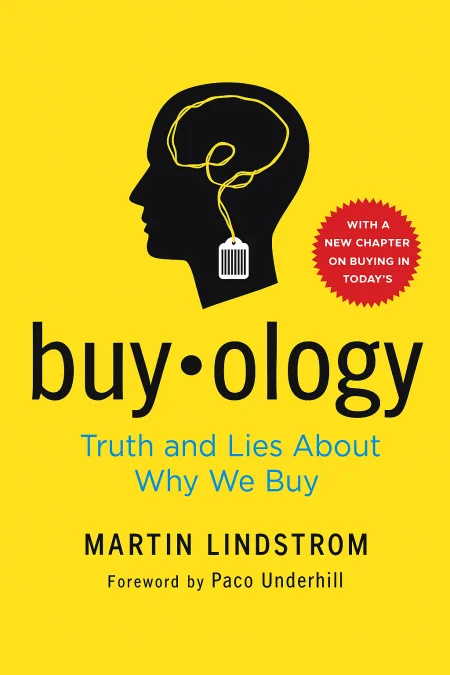
Buyology
Truth and Lies About Why We Buy
byMartin Lindstrom, Paco Underhill
Book Edition Details
Summary
What really persuades us to spend our hard-earned cash? In "BUYOLOGY," Martin Lindstrom unravels the mysterious web of subconscious triggers that influence our buying habits. Drawing from a staggering three-year neuromarketing study involving the brain scans of 2,000 individuals, Lindstrom exposes the surprising forces at play in our consumer choices. From the unexpected allure of cigarette warnings to the primal pull of "cool" brands like iPods, this book challenges conventional wisdom on advertising's effects. Prepare to be shocked as Lindstrom reveals how sensory experiences can stir our desires and how companies mimic religious rituals to win our loyalty. Whether you're fascinated or frustrated by the relentless dance of marketing, "BUYOLOGY" offers an eye-opening exploration of what truly drives us to the checkout line.
Introduction
Every day, we make countless purchasing decisions without truly understanding why. We reach for one brand over another, feel inexplicably drawn to certain products, or find ourselves buying things we never intended to purchase. What if our conscious minds aren't really in control of these choices? What if the real drivers of our buying behavior lie hidden beneath our awareness, operating in the shadowy depths of our subconscious? This fascinating exploration into the intersection of neuroscience and marketing reveals the startling truth about how our brains actually make purchasing decisions. Through groundbreaking brain-scanning experiments involving over 2,000 participants across multiple countries, we discover that up to 90 percent of our consumer behavior is driven by unconscious processes. You'll uncover why warning labels on cigarettes might actually encourage smoking, how mirror neurons make us unconsciously imitate others' purchasing choices, and why the most successful brands tap into the same neural pathways as religious experiences. Most surprisingly, you'll learn that what we say we want and what our brains actually desire are often completely different things.
The Neuroscience Revolution in Marketing Research
Traditional market research has always relied on a fundamental assumption that consumers can accurately report their preferences and motivations. Companies spend billions asking people why they buy certain products, conducting focus groups, and analyzing survey responses. Yet this approach has a critical flaw that neuroscience has now exposed: our conscious minds often have no idea what truly drives our purchasing decisions. When researchers used functional Magnetic Resonance Imaging to scan the brains of consumers, they discovered something remarkable. The same people who claimed in surveys that cigarette warning labels discouraged them from smoking showed completely opposite reactions in their brain scans. The warnings actually activated the nucleus accumbens, the brain's craving center, making them want to smoke more, not less. This revolutionary finding demonstrates why 80 percent of new products fail within three months, despite extensive traditional market research. Our brains make purchasing decisions through rapid, unconscious processes that operate far faster than our conscious reasoning. These decisions happen in milliseconds, driven by emotional responses and ingrained neural patterns that we're completely unaware of. The implications are staggering: every assumption about consumer behavior based on what people say they want may be fundamentally wrong. Brain-scanning technology reveals that successful products trigger activity in specific neural regions associated with reward, memory, and emotional engagement. When consumers view brands they love, their brains light up in patterns nearly identical to those seen during religious experiences. This isn't hyperbole, it's measurable neuroscience. Companies that understand these hidden neural triggers can create products that resonate at a deeper, more powerful level than conscious marketing appeals ever could. The future of marketing lies not in asking consumers what they want, but in observing what their brains actually desire. This shift from conscious reporting to unconscious measurement represents perhaps the most significant advance in understanding human behavior since psychology began studying the mind itself.
Mirror Neurons and Subliminal Advertising Power
Deep within our brains lies a remarkable system that neuroscientists discovered almost by accident. Mirror neurons fire not only when we perform an action, but also when we observe someone else performing that same action. This neural mirroring system means that when we see someone drinking a Coca-Cola or wearing stylish headphones, our brains simulate the experience as if we were doing it ourselves. This isn't just empathy, it's a fundamental mechanism that shapes our desires and purchasing decisions in ways we never realize. The discovery happened in an Italian laboratory studying macaque monkeys. When a graduate student returned from lunch eating an ice cream cone, the monitoring equipment revealed that the monkey's brain activated the same regions as if the monkey itself were eating ice cream, despite not moving or touching anything. This finding revolutionized our understanding of human behavior and explained why we unconsciously copy others' actions, speech patterns, and yes, buying choices. When applied to consumer behavior, mirror neurons reveal why product placement and celebrity endorsements can be so powerful, but also why they often fail. Simply showing a product isn't enough. The key lies in creating authentic scenarios where consumers can mentally experience using the product themselves. This explains why seeing someone genuinely enjoy a product creates desire, while obvious advertising often feels hollow and ineffective. The most successful brands understand this principle intuitively. Apple's marketing rarely shows their products in isolation. Instead, they show people seamlessly integrating technology into their lives, triggering mirror neurons that make us envision ourselves as equally creative and sophisticated. The power lies not in the product features, but in the lifestyle simulation our brains unconsciously perform when exposed to these carefully crafted scenarios.
Religious Branding and Sensory Marketing Science
The human brain processes powerful brands using remarkably similar neural pathways to those activated during religious experiences. Brain scans reveal that exposure to beloved brands like Apple, Ferrari, or Harley-Davidson triggers activity in regions associated with meaning, identity, and transcendence. This isn't coincidence, successful brands deliberately incorporate elements that mirror religious structures: ritual, community, symbols, mystery, and sensory engagement. Consider the pilgrimage-like experience of visiting an Apple store, with its temple-like architecture, reverent atmosphere, and the ritualistic unboxing of products. Or examine how Harley-Davidson creates a sense of brotherhood among riders, complete with gatherings, shared symbols, and initiation rituals for newcomers. These brands succeed because they satisfy fundamental human needs for belonging and meaning that traditionally fell within religion's domain. The science behind this phenomenon extends beyond metaphor into measurable brain activity. When consumers encounter brands that successfully incorporate religious-like elements, their emotional engagement increases dramatically, and they form deeper, more loyal connections. The prefrontal cortex shows patterns associated with higher-order thinking and personal identity, while the limbic system activates regions tied to emotional bonding and memory formation. Sensory engagement amplifies this effect exponentially. Our brains process sensory experiences through multiple pathways simultaneously, creating richer, more memorable brand encounters. The smell of a new car, the sound of a Nokia ringtone, or the tactile feel of an iPhone's interface all trigger complex neural responses that pure visual branding cannot achieve. Companies that understand this multisensory approach create what neuroscientists call "stickier" memories, brands that become neurologically embedded in consumers' minds through repeated sensory reinforcement rather than conscious persuasion.
Predicting Consumer Behavior Through Brain Scanning
Perhaps the most practical application of neuromarketing lies in its ability to predict product success or failure before launch. Traditional market research failed to predict disasters like New Coke, the Segway, or countless other products that tested well but flopped commercially. Brain scanning offers something revolutionary: the ability to measure unconscious reactions that actually predict real-world behavior. When researchers showed consumers a controversial TV game show called Quizmania, the results were telling. On paper, viewers overwhelmingly claimed they disliked the show and would never watch it. However, their brain scans told a completely different story. The steady-state topography readings showed high levels of engagement and attention, despite conscious rejection. When the show eventually aired, it performed exactly as the brain scans predicted, not as the surveys suggested. This predictive power stems from measuring activity in brain regions that process reward, attention, and memory encoding. Products that activate these areas consistently succeed in the marketplace, regardless of what consumers consciously report. The nucleus accumbens signals craving and desire, the prefrontal cortex indicates sustained attention, and the hippocampus suggests information will be encoded into long-term memory. Together, these measurements create a neural signature of commercial success. The implications extend far beyond entertainment. Companies can now test product concepts, advertisements, packaging designs, and even pricing strategies by observing brain responses rather than relying on unreliable consumer feedback. This approach reveals why some campaigns resonate while others fall flat, why certain product features matter more than others, and how subtle changes in presentation can dramatically impact success. Brain scanning doesn't just predict what consumers will buy, it reveals the unconscious mechanisms that drive those purchasing decisions, providing unprecedented insight into the hidden forces that shape human behavior in the marketplace.
Summary
The most profound insight from this neuroscientific exploration is that our purchasing decisions are primarily emotional and unconscious processes, not the rational choices we imagine them to be. Our brains make buying decisions in milliseconds using ancient neural pathways designed for survival, long before our conscious minds construct logical justifications. This revelation fundamentally challenges everything we thought we knew about consumer behavior and suggests that successful marketing must speak to our subconscious desires rather than our rational minds. As brain-scanning technology becomes more sophisticated and accessible, how might this change the relationship between companies and consumers? Will understanding our neural triggers help us make better purchasing decisions, or will it simply make marketing manipulation more effective?
Related Books
Download PDF & EPUB
To save this Black List summary for later, download the free PDF and EPUB. You can print it out, or read offline at your convenience.
By Martin Lindstrom
