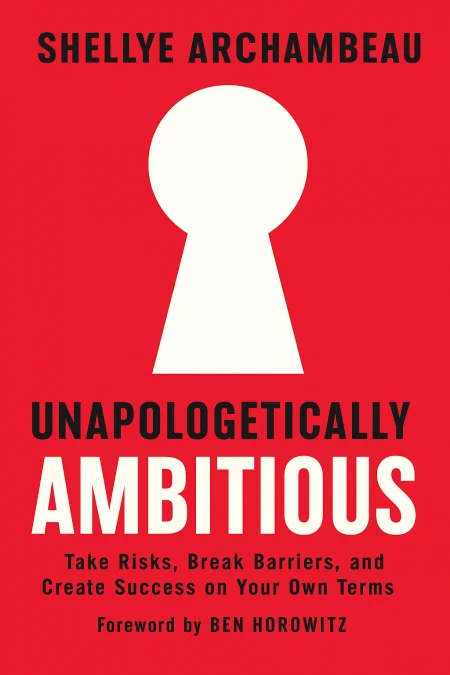
Unapologetically Ambitious
Take Risks, Break Barriers, and Create Success on Your Own Terms
byBen Horowitz, Shellye Archambeau
Book Edition Details
Summary
In a world where ambition is often tempered by expectation, Shellye Archambeau's "Unapologetically Ambitious" stands as a beacon of defiance and determination. From navigating the male-dominated corridors of Silicon Valley as one of its pioneering African American female CEOs, Archambeau reveals the strategic prowess that propelled her to the pinnacle of success. Her narrative intertwines personal trials with professional triumphs, offering readers not just a story, but a playbook for breaking barriers. With insightful anecdotes and actionable strategies, this book transcends the typical leadership manual, inviting readers to challenge norms, redefine ambition, and unapologetically pursue their dreams. Whether you're seeking inspiration or a roadmap to ascend your career ladder, Archambeau's journey offers a compelling guide to striving fearlessly and achieving remarkably.
Introduction
In a sunlit corner office overlooking Highway 101, a phone rings with a call that would change everything. The voice on the other end belongs to Lowell McAdam, CEO of Verizon, a Fortune 15 company, seeking to fill a board position. The woman receiving this call had spent decades preparing for exactly this moment—though the path that led her there was anything but conventional. Born during the height of the Civil Rights Movement, she would grow up as often the only Black face in predominantly white spaces, facing rejection, discrimination, and doubt at every turn. Yet through it all, she held fast to a singular vision: becoming a CEO before the age of forty. What emerges from this remarkable journey is not just the story of breaking barriers, but a masterclass in strategic life planning. From her teenage years, she approached her ambitions with the precision of a chess master, calculating every move decades in advance. She married strategically, chose her career path methodically, and built her network purposefully. Every decision, from the college she attended to the coat she bought, was made with her ultimate goal in mind. Her story reveals how success is rarely accidental—it's the result of careful planning, calculated risks, and an unwavering belief in one's own potential. Readers will discover profound insights into three critical areas: the art of strategic life planning and goal achievement, the navigation of corporate leadership as an outsider, and the integration of ambitious career aspirations with meaningful family relationships. Her experiences offer a blueprint for anyone seeking to create their own luck and achieve success on their own terms.
Early Foundations: Building Resilience and Strategic Thinking
Growing up as one of the few Black students in predominantly white schools during the 1960s and 70s, young Shellye learned early that life would demand both armor and strategy. When classmates would trip her on playgrounds or yell slurs from passing cars, she discovered that survival required more than just thick skin—it demanded the ability to read rooms, understand power dynamics, and never let others define her worth. These early challenges, rather than breaking her spirit, forged the analytical mind that would later serve her in corporate boardrooms. The foundation of her strategic thinking emerged from watching her parents navigate their own challenges with grace and determination. Her mother, a master of household management, could stretch a single IBM salary to cover four children's needs while secretly saving for a horse—a dream she'd harbored for twelve years. Her father, despite lacking a college degree, climbed IBM's ranks through sheer competence and determination. From them, she learned that success wasn't about having the most resources, but about making strategic choices and trade-offs to get what you truly wanted. Her parents' frequent relocations due to IBM transfers became masterclasses in adaptability. With each move—from Washington DC to Boston, Kentucky to Philadelphia, then to California—she learned to quickly assess new environments, find her place within them, and build the relationships necessary to thrive. What could have been destabilizing instead became training in resilience and strategic networking. Each new school meant learning to navigate different social hierarchies, each new neighborhood required building fresh alliances. The lesson that would prove most valuable emerged from her mother's wisdom about choices versus sacrifices. When she complained about her mother always taking the smallest piece of pie, her mother's response was revelatory: "If the pie was what I cared about, I wouldn't have the smallest piece. I have everything I care about." This moment crystallized a philosophy that would guide her entire life—success meant deciding what truly mattered, then making conscious choices to achieve it, rather than settling for whatever circumstances offered.
Corporate Ascent: Navigating IBM and Finding Leadership
Entering IBM as a summer secretary during high school, she recognized immediately that this was more than just a job—it was her laboratory for understanding corporate power. While other temporary workers answered phones and filed papers, she embarked on an ambitious research project, cold-calling executives throughout the company to understand their roles and career paths. This wasn't mere curiosity; it was strategic intelligence gathering, mapping the currents of corporate advancement she would later navigate with precision. Her early career at IBM revealed both the promise and the limitations of working within a corporate giant. She discovered that sales was the traditional pathway to executive leadership and threw herself into that track with characteristic determination. Yet she also encountered the subtle and not-so-subtle barriers that would define much of her corporate journey. When she was mysteriously removed from the gifted and talented program despite passing the test, when she was passed over for meetings with the CEO despite superior performance, she learned to read the coded messages of institutional bias. The turning point came when her progress stalled despite excellent performance reviews and clear advancement goals. Rather than accepting the status quo, she employed a strategy that would become her trademark: she quit to get the job she wanted. By securing an external offer, she forced IBM's hand, demonstrating that sometimes you must be willing to walk away to get what you deserve. This calculated risk paid off with the promotion she had been seeking, teaching her that passive waiting rarely yields results in corporate environments. Her international assignment to Japan proved transformative, not just for her career trajectory but for her understanding of cultural intelligence. While other American executives struggled with the hierarchical nature of Japanese business culture, she thrived by recognizing similarities to her own experiences as an outsider. Her decision to have presentation slides translated into Japanese—the first American executive to do so—revealed her instinctive understanding that respect must be earned through genuine effort to connect across cultural divides. This ability to find common ground in difference would become one of her greatest leadership assets.
Silicon Valley CEO: Risk, Reinvention and Success
The transition from IBM's structured corporate environment to Silicon Valley's entrepreneurial chaos required complete reinvention, but she approached it with the same strategic mindset that had served her throughout her career. When the dot-com bubble burst and left hundreds of experienced executives competing for limited CEO positions, she recognized that traditional advantages—established networks, insider connections—would work against her. Instead, she searched for opportunities where her outsider status might actually be an asset. Taking the helm of Zaplet, a struggling company with significant investor backing, represented the ultimate calculated risk. The company was hemorrhaging money and had lost credibility in the market, but it offered something invaluable: a chance to prove herself at the highest level while working with top-tier venture capital firms. She knew that success in this role would open doors that might otherwise remain forever closed to someone who didn't fit the typical Silicon Valley CEO profile. The transformation of Zaplet into MetricStream showcased her ability to find opportunity within crisis. Rather than trying to save a failing business model, she stepped back to identify genuine market problems that the company's technology could solve. Her discovery of the compliance management opportunity revealed the kind of strategic thinking that separates successful entrepreneurs from those who merely execute existing plans. She wasn't just running a company; she was creating an entirely new market category. The 2008 financial crisis presented the ultimate test of her leadership philosophy. With the company down to less than two million dollars in cash and facing potential bankruptcy, she made the decision that defined her leadership style: she worked without salary for a year, rallying her team around the motto "Never say die." This wasn't mere survival; it was a demonstration that true leadership means taking personal responsibility for organizational success. The subsequent growth of MetricStream into an industry leader validated not just her business acumen, but her belief that with the right strategy and unwavering commitment, even the most challenging circumstances can be transformed into opportunities for growth.
Legacy and Life Integration: Leading Beyond the Corner Office
The measure of truly successful leaders often lies not in their peak achievements, but in how they integrate all aspects of their lives while maintaining their core values. Throughout her CEO tenure, she challenged the prevailing notion of work-life balance, instead pioneering an approach of conscious life integration. Rather than compartmentalizing roles as mother, wife, and executive, she found ways to bring her whole self to each situation, whether that meant taking calls from her children during business meetings or having her husband help cater company events. Her approach to marriage and family defied conventional expectations while serving her larger goals. The partnership she built with her husband was based on explicit agreements about roles, expectations, and trade-offs. When her career required increased travel and responsibility, he stepped into the role of primary caretaker without either of them viewing this as sacrifice. Instead, they framed these decisions as strategic choices in service of their shared vision for their family's future. The challenges that emerged—her husband's cancer diagnosis, the normal struggles of raising children while building a career, the delicate balance of ambition and presence—were met with the same strategic thinking she applied to business problems. When her husband was diagnosed with incurable cancer, they chose to live life fully in the present rather than being paralyzed by an uncertain future. This meant taking trips they had postponed, having conversations they might have delayed, and approaching each day as a gift rather than a burden. Her transition from CEO to what she calls "Phase II" of her career demonstrates how strategic planning can extend beyond traditional career milestones. By preparing financially and professionally for this transition years in advance, she was able to step into a portfolio of board positions, advisory roles, and speaking engagements that allowed for greater flexibility while still making meaningful contributions. Her current role as a mentor, board member, and advocate for diversity in leadership represents not retirement, but evolution—the application of decades of hard-won wisdom to the challenge of creating opportunities for the next generation of leaders who, like her, might not fit traditional molds but possess unlimited potential.
Summary
The story of this remarkable leader ultimately teaches us that extraordinary success is rarely the result of extraordinary circumstances, but rather the product of extraordinary intentionality applied to ordinary moments. Her journey from a shy child facing discrimination to a Silicon Valley CEO demonstrates that while we cannot control the circumstances we're born into, we have tremendous power to shape the trajectory of our lives through strategic thinking, calculated risk-taking, and unwavering commitment to our goals. Her most profound insight—that we must be unapologetically ambitious about creating the lives we want rather than accepting the lives we're offered—challenges us to move beyond passive hoping to active planning and execution. For anyone feeling constrained by their current circumstances or uncertain about their ability to achieve ambitious goals, her example offers both inspiration and practical guidance. The key lies not in waiting for perfect conditions or ideal opportunities, but in making strategic choices every day that align with our long-term vision, building the networks and skills that will serve us when opportunities arise, and never allowing others to define the limits of our potential. Success, as she demonstrates, is ultimately about deciding what we want from life and then having the courage and discipline to pursue it with strategic precision and unwavering determination.
Related Books
Download PDF & EPUB
To save this Black List summary for later, download the free PDF and EPUB. You can print it out, or read offline at your convenience.
By Ben Horowitz
