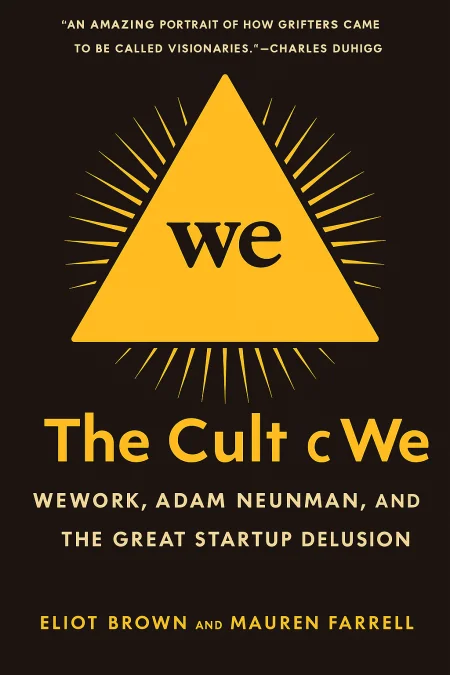
The Cult of We
WeWork, Adam Neumann, and the Great Startup Delusion
byEliot Brown, Maureen Farrell
Book Edition Details
Summary
The rise of WeWork wasn't just a business venture—it was a modern fable of ambition and excess, spun by Adam Neumann, a figure whose charisma was as towering as his six-foot-five frame. In the gleaming corridors of Silicon Valley, Neumann's promise to reshape workspaces into utopian hubs for the digital age captured imaginations and billions of dollars. Yet, beneath the façade of this $47 billion startup lay a chaotic scramble for capital and credibility, fueled by grand visions of schools, cities, and even Martian colonies. As Neumann's empire teetered, Wall Street Journal reporters Eliot Brown and Maureen Farrell peel back the layers of delusion and hubris that ensnared not just a company, but an entire financial ecosystem. "The Cult of We" is a riveting exposé that asks how dreams so grand could unravel so spectacularly, and what this means for the future of innovation.
Introduction
In the gleaming towers of Manhattan and the startup incubators of Silicon Valley, few stories capture the intoxicating blend of ambition, delusion, and spectacular collapse quite like the WeWork saga. This is the tale of how a charismatic Israeli entrepreneur named Adam Neumann transformed a simple office-sharing concept into a $47 billion unicorn, only to watch it crash back to earth in one of the most dramatic corporate implosions in modern history. What makes this story particularly fascinating is not just the scale of the failure, but how it reveals the fundamental dysfunction that had infected the venture capital ecosystem by the late 2010s. The WeWork phenomenon exposes three critical aspects of our modern economy that every business leader and investor must understand. First, it demonstrates how the venture capital industry transformed from a conservative, profit-focused discipline into a speculation machine willing to pour billions into companies that had never turned a profit. The story reveals how mutual funds, sovereign wealth funds, and traditional investors abandoned basic due diligence in favor of narrative-driven investing, creating a dangerous feedback loop where losses were celebrated as long as growth continued. Second, it illustrates the power of charismatic leadership when unchecked by proper governance, showing how a single founder can convince some of the world's smartest investors to overlook fundamental financial realities through sheer force of personality and vision. This account is essential reading for entrepreneurs seeking to understand the difference between sustainable growth and reckless expansion, investors looking to avoid the next WeWork-style disaster, and anyone curious about the forces that shape our modern economy. The lessons from this spectacular rise and fall remain painfully relevant as similar dynamics continue to play out across industries from electric vehicles to cryptocurrency, making this cautionary tale both a gripping business thriller and a practical guide for navigating today's investment landscape.
From Shared Office Vision to Unicorn Delusion (2008-2016)
The WeWork story began in the aftermath of the 2008 financial crisis, when traditional office leasing was struggling and a new generation of entrepreneurs was seeking flexible workspace solutions. Adam Neumann, a six-foot-five former Israeli naval officer with dyslexia and boundless charisma, had failed at multiple ventures including a baby clothing business before partnering with architect Miguel McKelvey to create their first co-working space in Brooklyn. Their initial location at 154 Grand Street was spartan but filled quickly with freelancers, small businesses, and creative professionals hungry for community and affordable office space. What set Neumann apart wasn't his business model, which closely resembled established serviced office companies like Regus, but his extraordinary ability to reframe mundane real estate transactions as a revolutionary vision of human connection. He positioned WeWork not as a landlord but as a "physical social network" that would foster collaboration, creativity, and entrepreneurship on a global scale. This wasn't just about desks and conference rooms; it was about building a movement that would "elevate the world's consciousness" and transform how people worked and lived. Neumann's infectious enthusiasm and rock-star persona made him a magnetic figure in New York's startup scene, attracting both tenants and investors with equal ease. The timing proved perfect as multiple cultural and economic trends converged in WeWork's favor. The rise of freelance work, the sharing economy pioneered by companies like Airbnb and Uber, and millennial preferences for flexibility over ownership created unprecedented demand for flexible workspace solutions. WeWork's aesthetic, featuring glass walls, modern furniture, free beer, and inspirational quotes, resonated powerfully with a generation that valued experiences over possessions and community over corporate hierarchy. By 2014, the company had expanded to multiple cities and caught the attention of major investors, including Benchmark Capital and JPMorgan Chase, who saw in Neumann's vision the potential for something much larger than traditional real estate. The early success established a dangerous pattern that would define WeWork's trajectory: rapid expansion fueled by ever-larger funding rounds, with each new investment validating Neumann's belief that he was building something unprecedented. The company's valuation soared from millions to billions, creating a feedback loop where success bred confidence, confidence attracted capital, and capital enabled even more ambitious dreams. This foundation would support WeWork's meteoric rise but also contain the seeds of its eventual destruction.
SoftBank's Billions and the Growth-at-All-Costs Mania (2017-2018)
The arrival of Masayoshi Son and SoftBank's Vision Fund marked a dramatic acceleration in WeWork's growth trajectory and the beginning of its transformation from ambitious startup to reckless juggernaut. Son, the Japanese billionaire who had made his fortune betting on the internet's early pioneers, saw in Neumann a kindred spirit, a visionary founder who thought in terms of decades rather than quarters. When they first met in 2017, their twelve-minute encounter resulted in Son committing over $4 billion to WeWork, one of the largest startup investments ever made. Son famously challenged Neumann to think bigger and be "crazier," advice that would prove prophetic in the worst possible way. SoftBank's massive investment fundamentally changed WeWork's DNA and unleashed Neumann's most grandiose impulses. Suddenly flush with more cash than most countries' GDP, the company embarked on a global expansion spree that prioritized speed over sustainability. New locations opened at breakneck pace across continents, while Neumann's ambitions expanded far beyond office space to encompass residential living through WeLive, education through WeGrow elementary school, and even a wave pool manufacturing company. The company's losses grew in lockstep with its revenue, but Son's philosophy of "growth at all costs" made traditional concerns about profitability seem almost quaint. This period revealed the dangerous dynamics that emerge when unlimited capital meets unchecked ambition and minimal oversight. Neumann, emboldened by Son's backing and his own growing celebrity status, began to see himself not just as a CEO but as a world-changing visionary comparable to Steve Jobs or Mark Zuckerberg. WeWork's corporate culture became increasingly cult-like, featuring lavish parties, inspirational retreats, and a workforce that genuinely believed they were part of a mission to transform human consciousness. The company developed creative metrics like "community-adjusted EBITDA" that excluded major costs to show artificial profits, obscuring the reality that WeWork was burning through cash at an unprecedented rate of over $1 million per day. The SoftBank partnership also demonstrated how the modern venture capital ecosystem had evolved into something resembling a casino, where sovereign wealth funds and pension money was deployed based on gut instincts rather than rigorous financial analysis. Son's willingness to write billion-dollar checks based on brief meetings and grand visions created a new template for startup investing that prioritized compelling narratives over sustainable business models. This approach would ultimately prove disastrous for investors, but for a brief moment, it made WeWork appear unstoppable and validated every excess as the necessary price of building the future.
Public Market Reality Check and the Great Unraveling (2019)
By 2019, WeWork's insatiable appetite for capital forced the company toward an initial public offering, a process that would expose the vast chasm between private market fantasy and public market reality. The company's S-1 filing, released in August 2019, was intended to showcase WeWork's revolutionary potential to a broader investor base but instead revealed a corporate governance nightmare that shocked even seasoned Wall Street observers. The document exposed how Adam Neumann had structured the company to give himself unprecedented control through twenty-to-one voting rights while personally profiting from numerous transactions with WeWork, including the infamous sale of the trademark to the word "We" for nearly six million dollars. The public's reaction was swift and merciless as the WeWork mystique crumbled under scrutiny from investors who actually cared about making money rather than chasing growth stories. Financial commentators, potential institutional investors, and social media users alike mocked WeWork's new-age corporate language, staggering losses of over $1.6 billion annually, and blatant conflicts of interest that enriched Neumann at shareholders' expense. The company that had once been celebrated as a technology disruptor was suddenly exposed as a real estate business with tech company valuations and startup-style governance that would never survive in the public markets. As WeWork's expected valuation plummeted from nearly $50 billion to potentially less than $10 billion, the company found itself trapped in a death spiral that threatened its very survival. The IPO had been structured to unlock billions in additional debt financing that WeWork desperately needed to continue operations, but without a successful public offering, the company faced an immediate cash crunch. Neumann's increasingly erratic attempts to salvage the situation through investor meetings and last-minute governance concessions only highlighted how disconnected he had become from basic business realities, while his former allies on Wall Street began to distance themselves from the toxic situation. The final act came in September 2019, when WeWork's board of directors, led by the same early investors who had long enabled Neumann's excesses, finally forced him to resign as CEO. The man who had once proclaimed himself both "Mark and Sheryl," referring to Facebook's founder and COO, was suddenly persona non grata in the very ecosystem that had elevated him to billionaire status. SoftBank, desperate to salvage its massive investment, orchestrated a bailout package worth $9.5 billion that valued WeWork at just $8 billion while paying Neumann nearly $200 million to walk away from the mess he had created. The speed and magnitude of the collapse sent shockwaves through Silicon Valley and marked the end of an era of unchecked founder worship and growth-at-any-cost investing.
Lessons from Silicon Valley's Most Spectacular Corporate Failure
The WeWork debacle serves as a masterclass in how charismatic leadership, unchecked growth ambitions, and financial engineering can create the illusion of revolutionary success while masking fundamental business problems that eventually prove fatal. At its core, the story reveals how an entire ecosystem of supposedly sophisticated investors, from venture capitalists to mutual fund managers to sovereign wealth funds, abandoned basic due diligence principles in favor of narrative-driven investing that prioritized compelling stories over sustainable economics. The cult of the founder, which had produced genuine successes like Apple and Facebook, had metastasized into a dangerous system where vision mattered more than viability and where massive losses were celebrated as necessary investments in future market dominance. The collapse exposed the perilous feedback loops that emerge when private markets become disconnected from economic reality and traditional valuation metrics. WeWork's ever-rising valuations created a self-reinforcing cycle where each funding round validated the previous one, making it increasingly difficult for anyone within the system to question the underlying assumptions without appearing to lack vision or courage. The company's ability to attract top-tier investors like SoftBank and Fidelity became circular proof of its potential, while its growing losses were consistently dismissed as the inevitable cost of disrupting entrenched industries and building global scale. Perhaps most importantly, the WeWork story demonstrates how quickly perceived value can evaporate when built on unstable foundations rather than genuine economic fundamentals. The same network effects and social proof that had propelled the company's meteoric rise, including prestigious investors, fawning media coverage, and cultural cachet, actually accelerated its fall once the narrative shifted and public market investors applied traditional scrutiny. The lesson for future entrepreneurs and investors is clear: sustainable businesses require more than compelling stories and charismatic leaders; they need sound unit economics, responsible corporate governance, and a clear path to profitability that doesn't depend on perpetual access to cheap capital and greater-fool investing.
Summary
The WeWork phenomenon represents a perfect storm of modern capitalism's excesses, where the pursuit of exponential growth and unicorn valuations collided with the immutable reality of basic business fundamentals. The central contradiction that drove the entire saga was the attempt to apply software company valuations and growth expectations to a fundamentally physical, capital-intensive real estate business that could never achieve the margins or scalability of true technology platforms. This fundamental mismatch between perception and reality was sustained for years by a financial ecosystem that had become addicted to narrative-driven investing and the intoxicating promise of discovering the next transformational technology company that would reshape entire industries. The story offers profound and immediately applicable lessons for navigating today's economy, where similar dynamics continue to play out across industries from electric vehicles to cryptocurrency to artificial intelligence. First, investors and entrepreneurs must maintain healthy skepticism toward any business model that requires perpetual capital infusions to survive, regardless of how compelling the vision or charismatic the leadership, as sustainable competitive advantages cannot be built on subsidized growth forever. Second, the critical importance of robust corporate governance cannot be overstated, as even the most brilliant and visionary founders need meaningful checks and balances to prevent their ambitions from ultimately destroying the very companies they seek to build. The ultimate irony of WeWork's rise and fall is that the company's core insight about the future of work, that people increasingly value flexibility, community, and well-designed workspaces over traditional corporate environments, was fundamentally sound and prescient. Had Neumann and his backers focused on building a sustainable, profitable business around this genuine market need rather than chasing unicorn valuations and world-changing rhetoric, WeWork might have become a successful, if unremarkable, real estate and services company. Instead, it became the defining cautionary tale about the dangers of mistaking vision for reality and growth for genuine progress in an economy increasingly dominated by financial engineering rather than the patient work of creating lasting value for customers and society.
Related Books
Download PDF & EPUB
To save this Black List summary for later, download the free PDF and EPUB. You can print it out, or read offline at your convenience.
By Eliot Brown
