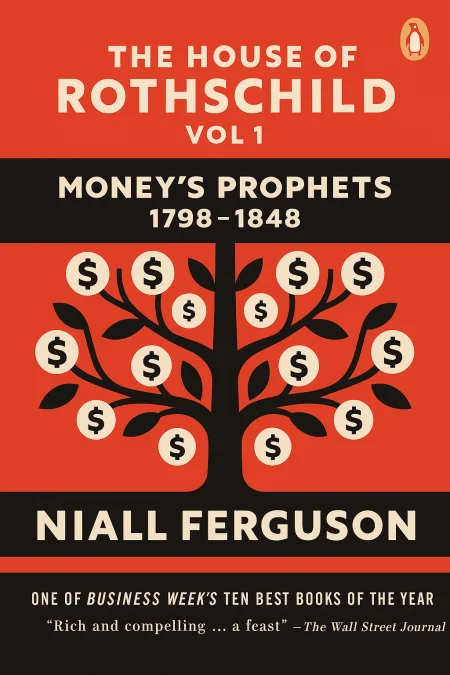
The House of Rothschild
Money’s Prophets 1798–1848
Book Edition Details
Summary
When whispers of power and untold wealth echo through history, the Rothschild family stands at the forefront—a dynasty enshrouded in mystery and influence. Niall Ferguson, an acclaimed historian, artfully unveils the hidden intricacies of this legendary family’s rise from the shadows of the Frankfurt ghetto to the pinnacle of global finance. With a masterful blend of narrative and scholarship, Ferguson illuminates the strategic alliances and enduring unity that fueled their ascent, casting light on their profound impact on European politics and Jewish communities. 'The House of Rothschild' transcends mere biography; it's a riveting exploration of ambition, faith, and the extraordinary legacy of a family that shaped an era.
Introduction
In the cramped confines of Frankfurt's Jewish quarter in 1798, where medieval walls still confined thousands behind locked gates each night, few could have imagined that a coin dealer's five sons would soon hold the financial fate of European empires in their hands. As Napoleon's armies swept across the continent, transforming ancient kingdoms and creating new nations overnight, the Rothschild brothers were quietly building something unprecedented: a financial network that would prove more durable than any military conquest and more influential than most royal dynasties. This extraordinary transformation illuminates three fundamental questions that shaped the modern world: How did private financial networks emerge as powers capable of influencing the rise and fall of governments? What role did information and communication play in creating the first truly global economy? And how did a family of religious outsiders navigate the treacherous currents of European politics to become indispensable to the very establishment that had once excluded them? The Rothschild story reveals the hidden mechanics of how money, politics, and information intertwined during Europe's most turbulent half-century. This tale will captivate anyone fascinated by the intersection of finance and politics, the dynamics of family enterprise across generations, or the broader transformation of Europe from feudalism to capitalism. It offers profound insights into how financial markets actually operate, how political power really functions, and how individual ambition can reshape the destiny of nations.
From Ghetto to Global Network: The Napoleonic Opportunity (1798-1815)
The foundation of the Rothschild empire began in the most unlikely circumstances, as Europe convulsed under the impact of revolutionary France and Napoleon's relentless military campaigns. Mayer Amschel Rothschild, operating from his cramped house in Frankfurt's Judengasse, had built a modest business serving Prince William of Hesse-Kassel, one of Europe's wealthiest rulers. When Napoleon's armies forced the Prince into exile, this relationship became the catalyst for an extraordinary transformation that would reshape international finance. The breakthrough came through Mayer Amschel's strategic decision to dispatch his five sons across Europe's major financial centers. Nathan established himself in London's textile trade, James ventured to Paris, Carl headed to Naples, Salomon settled in Vienna, while Amschel remained in Frankfurt. This network proved invaluable as the Napoleonic Wars created unprecedented demand for international financial services, particularly the British government's desperate need to transfer millions of pounds to armies fighting across the continent. Nathan Rothschild's operations in London became the family's engine of growth during this chaotic period. While traditional banking houses struggled with wartime disruptions, the Rothschilds developed innovative methods for moving money across enemy lines, converting currencies, and delivering funds where conventional systems failed. Their superior courier network could deliver crucial information days before official government dispatches, giving them decisive advantages in both financial markets and political intelligence. The period culminating in Napoleon's defeat at Waterloo in 1815 established the Rothschilds as Europe's premier international bankers. Their success stemmed not from speculation or luck, but from their unique ability to maintain operations across multiple countries simultaneously, gather information with unprecedented speed, and execute complex financial transactions that others deemed impossible. As Europe emerged from two decades of warfare, the family had positioned itself perfectly to finance the peace that would follow.
Building Financial Empire: European Reconstruction and Conservative Alliance (1816-1829)
The post-Napoleonic era presented the Rothschilds with their greatest opportunity: financing Europe's reconstruction and managing the massive reparations imposed on defeated France. The brothers transformed this challenge into the foundation of their financial empire, handling the 700 million francs that France owed to the Allied powers while earning enormous profits and cementing their reputation as Europe's financial architects. This period witnessed the perfection of their multinational structure, with each brother specializing in his region while maintaining constant communication through an elaborate intelligence network. James in Paris cultivated the restored Bourbon monarchy, Salomon in Vienna became indispensable to Metternich's conservative alliance, Nathan dominated London's capital markets, Carl managed Mediterranean operations, and Amschel coordinated German affairs. Their success lay not merely in their capital, but in their unmatched ability to gather and act on information faster than any competitor. The brothers understood that their prosperity depended on European stability, leading them to become ardent advocates for conservative governance and international peace. When revolutionary movements threatened established order across the continent, the Rothschilds often found themselves financing the forces of reaction. This alignment with conservative powers brought them enormous wealth but also growing criticism from liberal and nationalist movements that viewed them as symbols of an oppressive international system. By the late 1820s, the Rothschild network had evolved from a family business into something resembling a private central bank for Europe. They could influence exchange rates, facilitate international trade, and affect government policies through their control of credit. Yet this very prominence created new vulnerabilities, as their success made them targets for those who felt excluded from or threatened by the emerging capitalist order.
Peak Power and Revolutionary Crisis: Market Dominance Under Attack (1830-1848)
The July Revolution of 1830 in France marked both the zenith of Rothschild influence and the beginning of their greatest trials. James Rothschild's swift adaptation to Louis-Philippe's new regime demonstrated the family's political agility, but the revolutionary decade that followed would test their power as never before. As liberal and nationalist movements swept across Europe, the Rothschilds found themselves increasingly identified with the conservative establishment that revolutionaries sought to overthrow. The family's expansion into railway construction during the 1830s and early 1840s showcased both the opportunities and perils of industrial capitalism. James's involvement in French railway development, particularly the Northern Railway connecting Paris to Belgium, generated enormous profits while exposing the Rothschilds to new forms of public scrutiny and criticism. Railway accidents, labor disputes, and construction controversies made their role as capitalist entrepreneurs more visible and controversial than their previous work in government finance. The Rothschilds' influence reached its peak during the Eastern Crisis of 1840, when James successfully maneuvered to bring down the bellicose French minister Adolphe Thiers, demonstrating that the family could effectively veto policies they deemed threatening to European peace. Their intervention in international affairs, whether diplomatic or humanitarian, reinforced both their power and their notoriety among critics who saw sinister manipulation in every Rothschild action. The revolutionary year of 1848 brought the entire system to the brink of collapse. As monarchies toppled across Europe and radical movements demanded fundamental social transformation, the Rothschilds found themselves targeted not just as symbols of financial capitalism, but as representatives of an entire social order under attack. The crash in government bond prices wiped out much of their paper wealth, while revolutionary governments threatened to nationalize their investments. Only the ultimate failure of the revolutions, combined with crucial support from their diversified international operations, allowed the family to survive what James called the worst crisis they had ever faced.
Summary
The Rothschild ascent from 1798 to 1848 illuminates the central tension of the modern era: the conflict between the globalizing forces of capitalism and the localizing impulses of nationalism and democracy. Their rise from Frankfurt's Jewish quarter to European financial dominance demonstrates how individual enterprise could transcend traditional barriers of religion, nationality, and class, yet their experience also reveals how such success inevitably generates its own opposition. The very efficiency and international character that made them indispensable to European governments also made them perfect targets for those who felt displaced by rapid economic change. This history offers profound insights for our contemporary world, where global financial networks again face populist challenges and where tensions between international integration and local identity remain unresolved. The Rothschild experience suggests that financial innovation and political stability are inextricably linked, that private networks can sometimes achieve what governments cannot, but also that such power carries enormous risks when it lacks democratic legitimacy and public understanding. For today's leaders in business and politics, the Rothschild story provides crucial lessons about operating in an interconnected world. Success requires building trust across cultural and national boundaries, but private power must be exercised with constant attention to public perception and social responsibility. Even the most sophisticated systems remain vulnerable to fundamental human needs for dignity, representation, and local control. The enduring challenge remains balancing the benefits of global integration with the legitimate concerns of those who feel powerless in the face of distant, incomprehensible forces.
Related Books
Download PDF & EPUB
To save this Black List summary for later, download the free PDF and EPUB. You can print it out, or read offline at your convenience.
By Niall Ferguson
