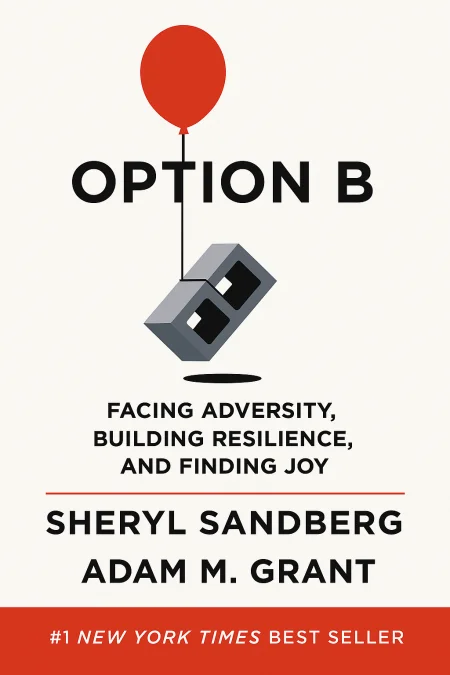
Option B
Facing Adversity, Building Resilience, and Finding Joy
bySheryl Sandberg, Adam M. Grant
Book Edition Details
Summary
Life's unexpected turns often leave us grappling with the aftermath, and in "Option B," Sheryl Sandberg and Adam Grant delve into this raw, universal struggle. After the sudden loss of her husband, Sandberg confronts a profound void, one that challenges her very essence of joy and resilience. Yet, from the depths of personal sorrow, a narrative of strength emerges, crafted through Sandberg’s heartfelt reflections and Grant’s illuminating research on human perseverance. This book transcends individual grief, weaving together stories of those who have faced unimaginable adversities—from illness to war—and have discovered their own path to healing. As Sandberg shares her journey from devastation to rediscovery, she offers a poignant guide to nurturing resilience within ourselves and our communities. "Option B" is not just a testament to survival; it's an invitation to find deeper meaning and joy in the face of life's relentless challenges.
Introduction
When life shatters unexpectedly, we find ourselves in territories we never imagined we'd have to navigate. Consider the moment when a vibrant executive receives a phone call that changes everything, or when a thriving family suddenly faces an empty chair at the dinner table. These moments don't just happen to other people—they happen to all of us in different forms and at different times. The question isn't whether we'll face adversity, but how we'll respond when it arrives. This exploration into human resilience reveals something profound: while we cannot always control what happens to us, we can influence how we recover and grow from life's most challenging moments. Through a compelling blend of personal narrative and scientific research, we discover that resilience isn't a trait we're simply born with or without—it's a capacity we can develop and strengthen. The stories shared here illuminate not just the depths of human suffering, but the remarkable heights of human recovery and growth. Whether you're currently facing a crisis or simply want to build your emotional reserves for whatever lies ahead, this journey offers practical wisdom wrapped in the warmth of shared human experience.
From the Void to Finding Light Again
The gym floor felt cold against the touch, and in that moment, everything changed. A family vacation in Mexico became the setting for an unthinkable tragedy when a husband and father collapsed during what should have been a routine workout. The desperate CPR attempts, the frantic ambulance ride, the sterile hospital room where hope finally died—these scenes replay with haunting clarity for those left behind. In the aftermath, a widow found herself drowning in what she called "the void," a vast emptiness that seemed to swallow every breath and thought. The void felt permanent, all-consuming. Simple tasks became monumental challenges. Returning to work meant sitting through meetings while images of loss flashed unbidden through consciousness. Bedtime became a march toward the starkest reminder of absence—an empty space where partnership once lived. Friends and colleagues watched helplessly as someone who had been a pillar of strength seemed to dissolve before their eyes. The professional achievements, the confident public persona, the carefully constructed life—all of it felt meaningless in the face of such devastating loss. Yet within this darkness, something unexpected began to emerge. Through the fog of grief came small moments of recognition—children still needed care, work still demanded attention, and somehow, breath still came. The void that seemed bottomless revealed, gradually, that it had edges. People could touch bottom and begin to kick toward the surface. This isn't to minimize the depths of suffering or suggest that recovery follows a neat timeline, but rather to illuminate a truth that only becomes visible through experience: even in our darkest moments, the human spirit retains the capacity to find light again.
The Three P's and Self-Compassion Journey
A young woman walked into a support group carrying shame so heavy it seemed to bend her shoulders. She had been brutally assaulted by someone she trusted, and in the aftermath, she found herself trapped not just by the trauma itself, but by three destructive thought patterns. She believed the attack was somehow her fault—if only she hadn't offered that ride, if only she had been more careful, if only she had seen the warning signs. She was convinced this violation would poison every aspect of her life, making her forever damaged and unable to trust again. And she felt certain the pain would never end, that she would carry this darkness for the rest of her days. These patterns—personalization, pervasiveness, and permanence—form what psychologists call the three P's, and they have the power to transform a single traumatic event into a lifetime of suffering. Personalization makes us believe we are entirely responsible for our misfortune. Pervasiveness convinces us that because one area of our life is damaged, everything is ruined. Permanence whispers that pain will last forever, that healing is impossible, that we are forever changed for the worse. These thought patterns don't just apply to major traumas—they can turn ordinary setbacks into sources of lasting misery. The journey toward healing began when this young woman learned to challenge each of these beliefs systematically. She discovered that offering help to a colleague wasn't a character flaw but an act of kindness exploited by someone with evil intentions. She recognized that while the assault had deeply affected her, her relationships with family, her academic achievements, and her capacity for joy remained intact. Most importantly, she began to understand that intense pain, no matter how overwhelming, shifts and changes over time. This process of reframing doesn't erase suffering, but it prevents suffering from defining and controlling our entire existence. Through this lens, we see that resilience isn't about avoiding pain, but about refusing to let pain have the final word.
Post-Traumatic Growth and Taking Back Joy
In a small town where everyone knew everyone, a father received the kind of diagnosis that stops time. His teenage son had a rare and fatal form of epilepsy, and medical science offered no hope for a cure. As a physician himself, the father understood exactly what this meant—he would watch his child's condition deteriorate, helpless to apply his professional skills to the one case that mattered most. The months that followed tested every belief he held about fairness, purpose, and the meaning of medical training. When his son died, the father found himself questioning whether his career had any value at all if he couldn't save the person who mattered most. But something remarkable happened in the aftermath of this devastating loss. Instead of abandoning his medical background, the father dove deeper into understanding how people recover from trauma. He discovered research on post-traumatic growth—the counterintuitive finding that some people don't just bounce back from tragedy, they actually grow stronger. This wasn't about finding silver linings or pretending that loss was somehow "worth it." Rather, it was about recognizing that profound difficulties can crack us open in ways that ultimately expand our capacity for strength, meaning, and connection. The father's grief transformed into a mission. He created therapeutic programs for other bereaved parents, helping them find what he called "co-destiny"—the idea that their children's legacy could continue through the good work done in their memory. His personal devastation became a source of professional innovation and community healing. He learned to hold two truths simultaneously: his son's death was a tragedy he wouldn't wish on anyone, and it had also revealed reserves of compassion and purpose he never knew he possessed. This paradox lies at the heart of post-traumatic growth—not that suffering is good, but that humans have a remarkable capacity to forge meaning from their deepest wounds and use that meaning to light the way for others walking similar paths.
Building Resilience Together in Community
High in the Andes Mountains, thirty-three survivors of a plane crash faced an impossible choice. Their supplies had run out, rescue attempts had been called off, and winter was closing in around the wreckage of their aircraft. Among them were young rugby players, barely out of their teens, who had to make decisions no human should ever face. The easy path would have been to succumb to despair, to wait for death in the frozen wilderness. Instead, they made a different choice—they decided to save themselves, together. What sustained them through seventy-two days of unimaginable hardship wasn't individual heroism, but collective resilience. They created rituals that bound them together: shared prayers, collaborative planning sessions, and evening conversations where they imagined their futures after rescue. When some members of the group learned that search efforts had been abandoned, they made a conscious decision not to share this information immediately, recognizing that hope needed to be managed carefully to keep the community intact. They assigned roles, shared resources, and made the most difficult decisions democratically. The two strongest survivors eventually undertook a treacherous journey across mountain peaks to find help, but they could only attempt this because the entire group had worked together to create the conditions for their success. They had fashioned makeshift equipment, pooled their knowledge, and maintained the social bonds that gave individual effort meaning. When rescue finally came, all remaining survivors were brought home—not because they were individually superhuman, but because they had created something larger than themselves. Their story illuminates a profound truth about human resilience: while we often think of strength as a personal quality, our greatest capacity for survival and growth emerges through connection with others. In our own lives, the communities we build before crisis strikes become the resources we draw upon when everything falls apart. Whether in families navigating loss, organizations facing failure, or societies confronting injustice, the threads we weave between ourselves become the safety net that catches us when we fall and the launching pad that helps us soar again.
Summary
The most profound lesson embedded in these stories is that resilience isn't a destination we reach, but a capacity we cultivate throughout our lives. Like the widow who learned to challenge thoughts that trapped her in permanent despair, like the assault survivor who refused to let trauma define her entire existence, and like the bereaved father who transformed personal devastation into community healing, we all possess the ability to write new chapters even when previous ones end in ways we never anticipated. The path forward requires both individual courage and collective support. We must learn to treat ourselves with the same compassion we would offer a dear friend, challenging the harsh internal voices that blame us for circumstances beyond our control or convince us that pain will last forever. Simultaneously, we must invest in the relationships and communities that will catch us when we fall and celebrate with us when we rise. Most importantly, we must remember that taking back joy isn't selfish or disloyal to our losses—it's the most powerful way to honor what we've survived and to prepare for whatever comes next. These stories remind us that while we cannot choose our circumstances, we can always choose our response. In that choice lies our power, our hope, and our humanity. The light we find in darkness doesn't erase the shadows, but it proves that even in the deepest night, dawn eventually comes.
Related Books
Download PDF & EPUB
To save this Black List summary for later, download the free PDF and EPUB. You can print it out, or read offline at your convenience.
By Sheryl Sandberg
