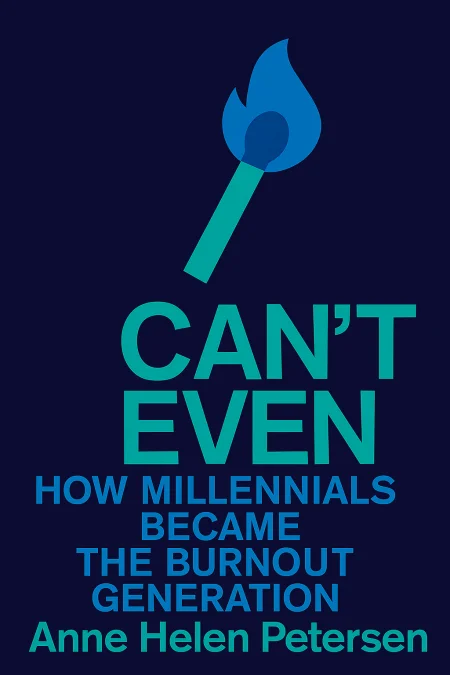
Can't Even
How Millennials Became the Burnout Generation
Book Edition Details
Summary
In a world where ambition often morphs into exhaustion, Anne Helen Petersen's "Can’t Even" offers a striking portrait of a generation on the brink. The millennial plight isn't just a narrative of laziness but a nuanced tale of societal betrayal, relentless performance pressures, and the crushing weight of economic instability. With incisive wit and unwavering empathy, Petersen delves into the soul of burnout culture, dissecting the impact of unyielding capitalism and digital demands on daily life. Through poignant interviews and sharp analysis, she crafts a compelling defense for those labeled as entitled, exposing the invisible chains that bind them. "Can’t Even" is not just a book; it’s a rallying cry for understanding and change, demanding attention from anyone willing to listen to the unheard struggles of an embattled generation.
Introduction
Millennial burnout represents more than individual exhaustion—it signals a fundamental breakdown in the social contract that promised education and hard work would lead to prosperity and stability. The generation raised on meritocratic ideals now faces unprecedented economic precarity, despite being the most educated in history. Traditional markers of adulthood—homeownership, stable employment, family formation—remain increasingly elusive, creating a pervasive sense of failure that compounds the exhaustion. This generational crisis stems from the collision between inherited expectations and transformed economic realities. The very institutions that shaped millennial childhoods—from competitive schooling to digital connectivity—now perpetuate cycles of overwork and anxiety. The phenomenon extends beyond personal struggles to encompass systemic changes in labor markets, parenting cultures, and technological mediation of daily life. Understanding millennial burnout requires examining how broader cultural and economic forces create impossible standards while removing the structural supports that once made middle-class stability achievable. The analysis reveals how individual experiences of inadequacy mask collective symptoms of societal dysfunction, where working harder becomes both the prescribed solution and the perpetuating cause of widespread exhaustion.
The Structural Origins of Millennial Burnout
Millennial burnout originates in the economic transformations that began reshaping American society during the 1970s and 1980s, precisely when many millennial parents came of age. The postwar "Great Compression" that had expanded middle-class prosperity through strong unions, corporate pensions, and government investment began unraveling under economic pressures and shifting ideological commitments to free-market solutions. Baby Boomer parents, experiencing their own economic anxiety as traditional career paths disappeared, responded by intensifying their children's preparation for an increasingly competitive landscape. This "concerted cultivation" approach transformed childhood from unstructured play into resume-building activities, creating mini-adults trained to optimize every aspect of their development for future economic success. The irony lies in how the generation that criticized their own parents' conformity ultimately imposed even more rigid performance standards on their children. Boomer anxieties about downward mobility translated into hypervigilant parenting that taught millennials to treat leisure as waste and to measure self-worth through productivity metrics. These early patterns established the psychological groundwork for adult burnout, where the inability to achieve promised stability despite following prescribed formulas creates a devastating sense of personal failure. The structural economic shifts that made middle-class security less attainable were masked by narratives emphasizing individual effort and optimization.
How Work Became Weaponized Against Workers
The modern workplace reflects a fundamental realignment of power that began with the "fissuring" of traditional employment relationships. Companies systematically shed direct employment responsibilities through subcontracting, temporary staffing, and gig economy arrangements, while maintaining control over work standards and outcomes. This transformation allowed employers to reduce costs and risks while intensifying performance demands on remaining workers. Consulting culture, originating in elite firms like McKinsey, popularized ruthless efficiency models that treated human labor as disposable expense rather than valuable asset. The consultants who implemented these changes throughout corporate America carried with them extreme overwork ethics that redefined professional dedication as willingness to sacrifice health, relationships, and personal boundaries for employment. Wall Street's influence further normalized destructive work patterns by making stock price appreciation the primary measure of corporate success. Investment banking culture, with its eighteen-hour days and competitive exhaustion, became the template for "elite" work across industries. Free meals and transportation weren't employee benefits but strategies to eliminate barriers to constant availability. The resultant workplace demands total commitment while offering minimal security. Workers compete not just with colleagues but with algorithms designed to extract maximum productivity while providing just enough compensation to prevent departure. This arrangement systematically transfers risk from corporations to individuals while maintaining the fiction that career success depends on personal merit rather than structural position.
Technology's Role in Expanding Work Beyond Boundaries
Digital technologies promised efficiency and liberation but instead became instruments of intensified surveillance and expanded labor extraction. Smartphones eliminated the boundary between work and personal time by making every moment potentially productive, while social media created unpaid labor in the form of personal brand management and network maintenance. The attention economy transforms human consciousness into a commodity, deliberately engineering addiction to maximize engagement time. Features like infinite scroll, push notifications, and algorithmic content curation create compulsive usage patterns that fragment attention and exhaust mental resources. What appears as personal choice reflects sophisticated manipulation designed to capture and monetize human awareness. Communication platforms like Slack create the illusion of collaborative efficiency while actually increasing the total volume of workplace interaction. Remote work tools don't reduce working hours but expand them into previously protected personal time. The performance of being available and engaged becomes as important as actual productivity, creating new forms of emotional labor. These technological systems exploit human psychological vulnerabilities while presenting themselves as neutral tools. The resulting digital exhaustion compounds physical burnout, creating a pervasive sense that rest and solitude have become impossible luxuries. The promise of technological liberation reveals itself as a sophisticated form of voluntary servitude.
The Parenting Trap and Societal Solutions
Contemporary parenting culture exemplifies how systemic problems get reframed as individual inadequacies. The absence of comprehensive childcare, parental leave policies, and flexible work arrangements forces parents to create private solutions for public failures. Middle-class parents respond by intensifying their personal efforts, creating competitive martyrdom that further isolates families from collective action. Mothers bear disproportionate costs of this arrangement, performing what amounts to two full-time jobs while maintaining the fiction that gender equality has been achieved. The "mental load" of household management remains largely invisible and uncompensated, even in ostensibly progressive partnerships. This inequality gets reinforced through social pressure that frames maternal exhaustion as natural rather than structural. The economic insecurity that drives intensive parenting creates additional stress as families attempt to reproduce middle-class status through increasingly expensive activities and educational investments. Birthday parties become displays of economic anxiety; playdates function as class networking; academic achievement carries the weight of preventing downward mobility. Solutions require acknowledging that parental burnout reflects societal organizational failures rather than individual inadequacy. Comprehensive childcare, genuine workplace flexibility, and equitable domestic labor distribution would address root causes rather than managing symptoms. The current system's sustainability depends on continued willingness of parents, especially mothers, to absorb impossible demands without collective resistance.
Summary
Millennial burnout reveals how economic inequality and institutional breakdown get disguised as personal failings, creating a generation trapped between inherited expectations and transformed realities. The phenomenon demonstrates that individual optimization cannot solve structural problems—working harder within broken systems only perpetuates the conditions that create exhaustion. Recognition of burnout as a collective symptom rather than personal weakness opens possibilities for solidarity and systematic change that could benefit not just millennials but all generations navigating increasingly precarious economic conditions.
Related Books
Download PDF & EPUB
To save this Black List summary for later, download the free PDF and EPUB. You can print it out, or read offline at your convenience.
By Anne Helen Petersen
