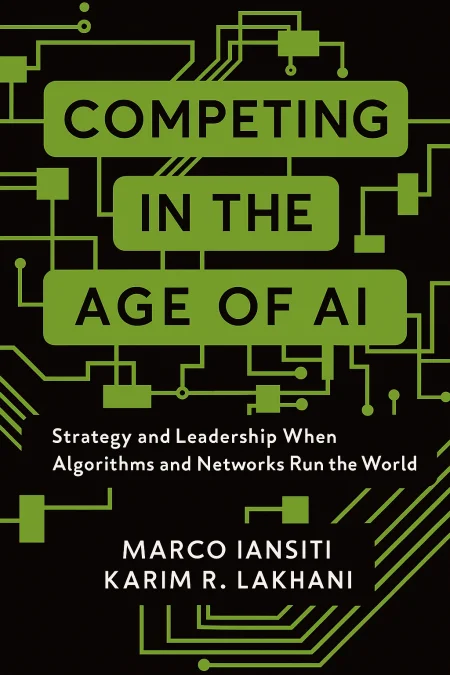
Competing in the Age of AI
Strategy and Leadership When Algorithms and Networks Run the World
byMarco Iansiti, Karim R. Lakhani
Book Edition Details
Summary
In an era where algorithms forge the frontier of business, "Competing in the Age of AI" offers a blueprint for survival and supremacy. Marco Iansiti and Karim R. Lakhani dismantle the shackles of traditional enterprise, revealing a landscape where artificial intelligence obliterates old boundaries. Witness how giants like Amazon and Airbnb redefine scale and scope, shattering industry confines and inviting a new wave of strategic innovation. This isn't just a tale of technological triumph but a manifesto for leaders poised on the brink of a digital metamorphosis. As firms collide in a dance of analog and digital, the stakes rise—restructuring competition, reshaping economies, and rewriting the rules of success. Unveil the promise and peril of AI, as this compelling narrative maps out the dawn of a new strategic epoch.
Introduction
Why are some companies achieving unprecedented growth while others with decades of experience are struggling to survive? The business world is witnessing a fundamental transformation that goes beyond simple technological adoption. Traditional companies built on human-centered operations are colliding with a new breed of firms powered by artificial intelligence, data analytics, and digital networks. These AI-driven organizations operate under completely different rules, removing age-old constraints on scale, scope, and learning that have limited business growth for centuries. This book presents a comprehensive framework for understanding how artificial intelligence is reshaping the very nature of firms and competition. The authors reveal that the most successful organizations today are not just using AI as a tool, but have restructured their entire operating models around data-driven decision making. They introduce the concept of the "AI factory" as the new core of business operations, explain how digital networks create unprecedented value through network effects, and demonstrate why traditional industry boundaries are dissolving. The work addresses critical questions about strategic positioning in networked markets, the organizational transformation required to compete effectively, and the ethical responsibilities that come with wielding AI-powered influence at scale.
The AI Factory: Data-Driven Decision Engine
At the heart of every successful digital organization lies what can be understood as an "AI factory" - a systematic approach to industrializing decision-making through data, algorithms, and continuous learning. Just as the Industrial Revolution transformed manufacturing from individual craftsmanship to mass production, the AI revolution is transforming business operations from human-centered processes to algorithm-driven systems. This factory represents a fundamental shift in how organizations create and deliver value. The AI factory operates through four interconnected components that work together in a virtuous cycle. The data pipeline systematically gathers, processes, and integrates information from multiple sources, creating a comprehensive view of customers, operations, and market conditions. Algorithm development transforms this data into predictive insights and automated decisions, using machine learning techniques to continuously improve accuracy and effectiveness. An experimentation platform validates these algorithms through rigorous testing, ensuring that changes actually produce the intended results rather than spurious correlations. Finally, robust software infrastructure connects all these elements, making insights available across the organization while maintaining security and governance. Consider Netflix as a prime example of this factory in action. The company processes viewing behavior from millions of users, analyzing everything from pause patterns to device preferences. These data points feed algorithms that personalize content recommendations, optimize streaming quality, and even influence decisions about which original series to produce. Every interaction generates new data that improves the system, creating a self-reinforcing cycle where more users lead to better recommendations, which attract more users. This is fundamentally different from traditional media companies that rely on broad demographic assumptions and intuitive content decisions. The AI factory enables Netflix to treat entertainment as a data science problem, systematically optimizing for engagement and satisfaction at a scale impossible through human judgment alone.
Digital Operating Architecture: Breaking Traditional Constraints
Traditional organizations evolved into specialized, siloed structures out of necessity - managing complexity by dividing work into separate, largely autonomous units. This approach worked well for centuries, enabling companies like Ford and General Motors to achieve unprecedented scale through standardization and specialization. However, these same organizational boundaries that once drove efficiency now create bottlenecks that limit growth, innovation, and responsiveness. Digital operating architecture represents a fundamental rethinking of how organizations should be structured in an age of artificial intelligence. The key insight is that digital systems can communicate and coordinate at virtually zero marginal cost, eliminating the need for the organizational boundaries that once reduced complexity. Unlike human workers who require clear hierarchies and limited interaction points to function effectively, digital processes can be infinitely connected and coordinated through well-designed interfaces. This enables a shift from siloed, function-specific systems to integrated, data-centric platforms that can serve multiple purposes simultaneously. Amazon's transformation illustrates this architectural shift in practice. In 2002, CEO Jeff Bezos mandated that all internal teams communicate only through software interfaces, effectively forcing the company to rebuild its operations as a connected digital platform. This seemingly technical decision had profound organizational implications. Instead of separate teams for books, electronics, and other product categories maintaining their own customer databases and recommendation systems, Amazon created shared services that could be leveraged across all business units. The same customer data and algorithmic capabilities that power book recommendations can instantly be applied to suggest movies, clothing, or any other product. This architectural approach allows Amazon to enter new markets rapidly, scale operations without traditional bottlenecks, and create synergies between seemingly unrelated business areas - advantages that would be impossible under a traditional siloed structure.
Strategic Networks: Value Creation and Capture
In the digital age, competitive advantage increasingly depends not on controlling isolated resources or capabilities, but on understanding and leveraging the complex networks that connect businesses, customers, and entire industries. Network effects occur when the value of a product or service increases as more people use it, creating powerful dynamics that can lead to winner-take-all markets. However, the strategic implications go far beyond simple network effects to encompass learning effects, data accumulation, and the ability to bridge previously separate economic networks. The framework for network analysis involves mapping the various connections a business maintains and understanding how each network contributes to value creation and capture. Some networks exhibit direct effects where users value the presence of other users, like social media platforms or communication systems. Others create indirect effects where different types of users value each other, such as the relationship between app developers and smartphone users. The strength and structure of these effects determine how defensible a market position becomes and how profits are distributed among participants. Understanding network clusters reveals why some seemingly powerful platforms struggle with profitability while others dominate their markets. Uber operates in locally clustered networks where drivers in Boston provide no value to riders in San Francisco, making the service vulnerable to local competitors and limiting network effects. In contrast, Airbnb benefits from global network effects since travelers care about accommodations in cities they visit, not their home markets. This structural difference explains why Airbnb can maintain higher margins and stronger competitive positions despite both companies facilitating connections between service providers and consumers. The most sophisticated digital firms excel at network bridging - connecting previously separate networks to create new value and capture opportunities. Google bridges search users with advertisers, enabling free services for users while generating billions in advertising revenue. Alibaba connects e-commerce activity with financial services, using transaction data to offer loans and investment products that traditional banks couldn't provide. These bridging strategies demonstrate how digital firms can transcend traditional industry boundaries, creating business models that would be impossible without network-based thinking and AI-powered coordination.
Leadership in Digital Transformation
Leading in the age of AI requires more than understanding technology - it demands a fundamental rethinking of management practices, organizational culture, and strategic decision-making. Digital transformation is not about adding AI tools to existing processes, but about rebuilding the organization around data-driven operations while navigating unprecedented ethical and societal responsibilities. This transformation challenges leaders to balance enormous opportunities with equally significant risks and responsibilities. The transformation begins with architectural clarity and unwavering commitment. Leaders must articulate what the future operating model will look like and maintain dedication to that vision even when it threatens existing power structures and capabilities. Microsoft's transformation under Satya Nadella illustrates this principle - the company committed fully to cloud computing and AI, restructuring its entire business model and organizational culture around these capabilities rather than treating them as supplements to existing products. However, technical transformation alone is insufficient. Digital organizations wield unprecedented power to influence markets, shape public opinion, and impact society through their algorithmic decisions. With great capability comes great responsibility for the broader ecosystem effects of business decisions. When Facebook's algorithms amplify misinformation or when AI hiring systems exhibit bias, the consequences extend far beyond individual companies to affect democratic processes and social equity. Leaders must therefore develop multidisciplinary governance approaches that consider not just business outcomes but societal impacts. The most challenging aspect of digital leadership may be accepting that individual firm success increasingly depends on collective ecosystem health. Unlike industrial-age businesses that could optimize primarily for their own performance, digital firms operate in highly interconnected networks where their success depends on the overall health of the systems they participate in. This requires a shift from zero-sum competitive thinking to a more nuanced understanding of how to create shared value while maintaining competitive advantages. Leaders who can master this balance - driving transformation within their organizations while contributing to healthy digital ecosystems - will define the next era of business success.
Summary
The age of artificial intelligence is not about robots replacing humans, but about organizations restructuring themselves around data-driven decision making to remove constraints that have limited business growth for centuries. Companies that master AI factories, digital operating architectures, and network-based strategy will not only outperform traditional competitors but will reshape entire industries and economic systems. As these new organizational models become dominant, they create both unprecedented opportunities for innovation and value creation, and equally significant responsibilities for maintaining healthy, equitable, and sustainable economic ecosystems. The leaders who can navigate both the technical and societal dimensions of this transformation will shape the future of business and society itself.
Related Books
Download PDF & EPUB
To save this Black List summary for later, download the free PDF and EPUB. You can print it out, or read offline at your convenience.
By Marco Iansiti
