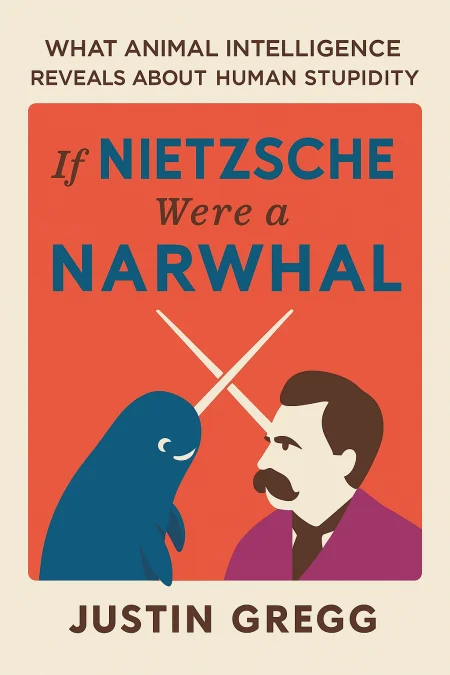
If Nietzsche Were a Narwhal
What Animal Intelligence Reveals about Human Stupidity
Book Edition Details
Summary
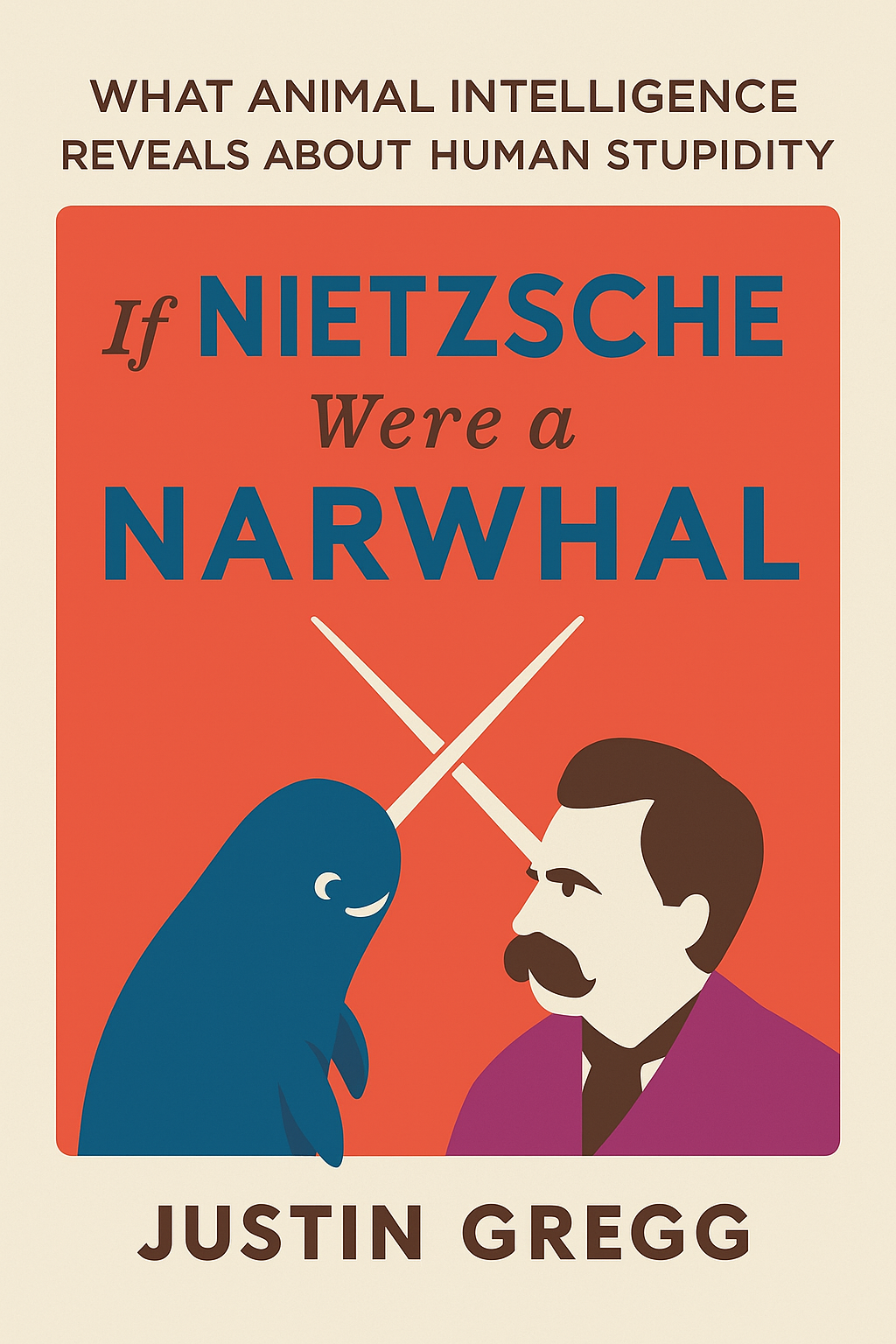
In a world where human intelligence is often hailed as the pinnacle of evolution, Justin Gregg flips the script with a clever, thought-provoking exploration in "If Nietzsche Were a Narwhal." What if our much-vaunted intellect is more of a burden than a boon? Gregg dives into this fascinating paradox, comparing our cerebral might with the humble brilliance of animals that thrive without it. From stock-savvy cats to cancer-detecting pigeons, each page unveils a story that challenges our preconceptions about intelligence and success. With humor and insight, Gregg invites readers to reconsider whether our cognitive gifts truly set us apart—or set us back—in the grand scheme of life on Earth. This book is a witty, mind-expanding romp that redefines what it means to be "smart."
Introduction
Human intelligence has long been celebrated as the pinnacle of evolutionary achievement, separating us from all other species on Earth. Yet this assumption deserves rigorous examination. What if our cognitive abilities, rather than representing pure progress, actually carry hidden costs that we rarely acknowledge? Through a comparative lens that places human cognition alongside animal thinking patterns, a provocative argument emerges: the very traits we consider most exceptional may be evolutionary liabilities rather than advantages. This investigation employs an unconventional approach, examining human cognitive abilities not in isolation but against the backdrop of how other species successfully navigate existence. By analyzing our capacity for causal reasoning, language, moral thinking, and future planning, we can identify a pattern of cognitive trade-offs that challenges conventional wisdom. The analysis reveals how abilities like death awareness, complex moral reasoning, and long-term thinking create unique psychological burdens while potentially undermining our species' survival prospects. Rather than assuming human intelligence represents optimal design, this exploration invites readers to consider whether simpler minds might actually be better adapted for sustainable existence.
The Paradox of Human Cognitive Exceptionalism
Humans distinguish themselves through "why specialist" thinking—an obsessive drive to understand causal relationships that sets us apart from other animals. While most creatures navigate the world through associative learning and immediate responses to environmental cues, humans constantly seek deeper explanations for phenomena around them. This cognitive orientation emerged relatively recently in evolutionary terms, with evidence of sophisticated causal thinking appearing only around 40,000 years ago in cave paintings and symbolic art. The archaeological record reveals a puzzling timeline: anatomically modern humans existed for roughly 200,000 years before displaying the technological and cultural innovations we associate with advanced intelligence. This delay suggests that our capacity for complex reasoning, while eventually transformative, was not immediately advantageous from a survival perspective. Early humans lived much like their chimpanzee cousins, suggesting that basic associative learning and instinctual responses were sufficient for survival. Contemporary examples illustrate how causal reasoning can lead to both remarkable achievements and spectacular failures. The same cognitive processes that enable scientific breakthroughs also generate elaborate but incorrect theories, from medieval medicine's humoral theory to modern investment strategies that perform no better than random chance. When we examine success stories in areas like stock trading, we often find that simple, unconscious decision-making processes perform as well as sophisticated analytical approaches. The evidence suggests that while causal reasoning enables uniquely human accomplishments, it represents a high-risk cognitive strategy. Most animal species thrive using simpler mental tools, raising fundamental questions about whether our celebrated intellectual abilities actually provide the advantages we assume they do.
Why Specialist Thinking and Its Evolutionary Costs
The human drive to understand causation creates what can be termed "prognostic myopia"—a cognitive blind spot where our ability to envision long-term consequences fails to generate appropriate emotional responses to guide decision-making. This paradox emerges from the intersection of advanced cognitive abilities with ancient motivational systems designed for immediate survival needs. While humans can intellectually understand future scenarios, our emotional and decision-making systems remain calibrated for present-moment concerns. Daily life provides countless examples of this disconnect. People routinely make choices they know will have negative future consequences—staying up late despite knowing they will be tired, procrastinating on important tasks, or consuming resources unsustainably. The same mental architecture that enables sophisticated planning also creates scenarios where immediate impulses override long-term rational considerations. Psychological research confirms that unconscious biases and heuristics often drive decisions even when conscious analysis suggests different choices. This cognitive mismatch becomes particularly dangerous when scaled up to species-level challenges. Human technological capabilities can generate solutions with consequences extending far beyond our evolved capacity to feel concern about them. The development of fossil fuel technologies exemplifies this pattern: immediate benefits in terms of energy and convenience override abstract concerns about climate effects decades in the future, even when the scientific understanding is clear. The fundamental problem lies in our decision-making architecture, which pairs unprecedented foresight abilities with emotional systems that cannot fully process long-term consequences. This creates a systematic bias toward short-term thinking despite our intellectual capacity for long-term analysis, potentially explaining why uniquely human problems like climate change prove so difficult to address effectively.
The Dark Side of Advanced Consciousness
Human consciousness extends beyond basic awareness to encompass complex forms of self-reflection that generate unique psychological burdens. Unlike other animals, humans possess "death wisdom"—the ability to contemplate our own mortality and its implications. This awareness emerges through the combination of mental time travel, episodic foresight, and theory of mind, creating a form of existential knowledge that appears absent in other species. While some animals demonstrate limited planning abilities and basic death recognition, they lack the cognitive architecture necessary for full mortality salience. A chimpanzee might understand that others can die and even plan for immediate future scenarios, but cannot envision its own inevitable death or contemplate the existential implications of mortality. This limitation, rather than representing a cognitive deficit, may actually constitute a form of protection against the psychological costs of death awareness. The emergence of death wisdom in human evolution required accompanying psychological defense mechanisms. The ability to contemplate one's own mortality would be paralyzing without corresponding capacities for denial and compartmentalization. This suggests that death awareness emerged not as an isolated beneficial trait, but as part of a complex cognitive package that includes both expanded intellectual abilities and necessary psychological coping mechanisms. Contemporary human experience demonstrates both the creative potential and psychological costs of death wisdom. Awareness of mortality drives many of humanity's greatest cultural achievements—art, philosophy, religion, and science all emerge partly from attempts to create meaning in the face of death. However, this same awareness contributes to anxiety, depression, and existential suffering that appear unique to our species, raising questions about whether the trade-offs involved actually enhance overall well-being.
Animal Wisdom vs Human Intelligence
The comparison between human moral reasoning and animal social norms reveals a troubling pattern where increased cognitive sophistication often produces worse outcomes in terms of suffering and conflict. Most animal species operate through implicit behavioral norms that maintain social cohesion while minimizing violence and destruction. These systems, while less intellectually complex than human moral frameworks, generally produce more stable and less harmful social arrangements. Human moral thinking transforms these basic social norms into elaborate ethical systems that can justify extreme violence and oppression. The same cognitive abilities that enable sophisticated moral reasoning also make possible the rationalization of genocide, slavery, and systematic persecution based on abstract ideological differences. Historical examples demonstrate how advanced moral and philosophical thinking has been used to justify behaviors that simpler normative systems would prohibit. Animal societies, while not free from conflict and violence, lack the cognitive apparatus necessary for systematic persecution or ideologically driven mass violence. A pack of wolves might fight over territory or resources, but they cannot conceive of and execute genocidal campaigns based on abstract beliefs about racial or religious differences. The limitations of animal cognition thus serve as natural constraints on the scale and systematic nature of violence. This analysis reveals a fundamental paradox: the cognitive abilities that enable humans to conceptualize ideals like justice and universal rights also make possible unprecedented levels of cruelty and destruction. While animal societies operate within biological constraints that limit systematic violence, human societies can transcend these constraints in ways that often increase rather than decrease overall suffering.
Summary
The investigation into human cognitive abilities reveals a fundamental paradox: the very traits we celebrate as evidence of our species' superiority may actually represent evolutionary liabilities that threaten our long-term survival. Human intelligence, rather than constituting unqualified progress, involves a series of trade-offs that create unique vulnerabilities and blind spots. Our capacity for causal reasoning generates both remarkable achievements and dangerous delusions, while our awareness of mortality and ability to construct complex moral systems often increase rather than decrease suffering in the world. The evidence suggests that simpler minds, operating through basic associative learning and immediate response systems, may be better adapted for sustainable existence than our celebrated but problematic intellectual abilities. This perspective challenges readers to reconsider fundamental assumptions about cognitive evolution and the value of human exceptionalism.
Related Books
Download PDF & EPUB
To save this Black List summary for later, download the free PDF and EPUB. You can print it out, or read offline at your convenience.
By Justin Gregg
