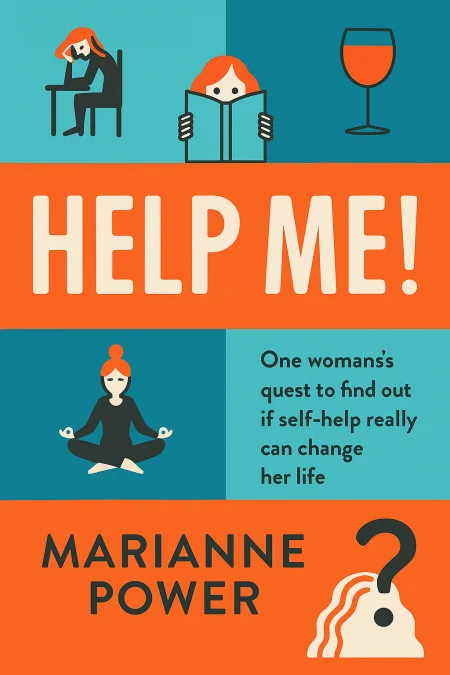
Help Me!
One Woman's Quest to Find Out If Self-Help Really Can Change Her Life
Book Edition Details
Summary
In the dizzying maze of self-help promises, Marianne Power's life felt more like a chaotic jumble than a serene journey to self-discovery. Her shelves groaned under the weight of countless guides, each claiming to hold the key to a flawless existence—an existence free from the clutches of debt, anxiety, and endless Netflix marathons. Tired of the chasm between her dreams and reality, Marianne embarked on a bold experiment: twelve months, twelve self-help books, and an unwavering commitment to live by their every word. Yet, as her quest for perfection spiraled into a whirlwind of comical mishaps and unforeseen epiphanies, Marianne grappled with a startling revelation: Can self-help truly mend a life, or is the pursuit of the perfect self a wild goose chase? "Help Me!" is a candid, riotously funny account of one woman's journey through the eccentric world of self-improvement, challenging the notion of self-help with a refreshing blend of wit and wisdom.
Introduction
At thirty-six, Marianne Power found herself trapped in a familiar cycle of Sunday morning regrets and existential questioning, watching friends advance through life's milestones while she remained frozen in patterns that had defined her for over a decade. Despite a successful freelance journalism career that afforded her interesting assignments and financial independence, she felt profoundly disconnected from any sense of purpose or direction. Her shelves groaned under the weight of countless self-help books, each promising transformation yet delivering only temporary inspiration before reality reasserted itself. Power's decision to stop merely reading about change and start actively implementing every piece of advice she encountered launched her into an extraordinary year-long experiment that would test the very foundations of the modern self-improvement industry. Her journey reveals the seductive appeal of quick fixes and perfect solutions while simultaneously exposing the deeper psychological patterns that keep us trapped in cycles of dissatisfaction. Through her unflinching honesty about financial chaos, romantic failures, and the gap between aspiration and action, she illuminates universal struggles with self-worth, perfectionism, and the courage required for authentic transformation. Her story offers profound insights into the difference between changing ourselves to become worthy of love and learning to love ourselves exactly as we are. Readers will discover how vulnerability becomes a pathway to genuine connection, why the pursuit of perfection often leads to isolation, and how the most profound transformations emerge not from following external prescriptions but from developing the courage to face our deepest fears about ourselves. Her experience serves as both a cautionary tale about the dangers of self-help addiction and an inspiring testament to the possibility of authentic self-acceptance.
Breaking Free: From Fear to Bold Action
Power's transformation began with a radical shift from passive consumption to active implementation, starting with Susan Jeffers' foundational principle of feeling the fear and doing it anyway. Her first challenge required confronting one fear every day for an entire month, beginning with a terrifying New Year's Day swim in London's icy Hampstead Ponds. What started as a simple exercise quickly escalated into increasingly bold confrontations with decades of accumulated anxieties and self-imposed limitations. The early experiments revealed how much of her life had been constrained by the anticipation of embarrassment rather than actual danger. From parallel parking to public speaking, from chatting with strangers on the London Underground to performing stand-up comedy, Power discovered that her imagination had been far more creative in conjuring disasters than reality proved capable of delivering. Each small act of courage built momentum, creating a positive feedback loop that began to reshape her fundamental relationship with discomfort and possibility. Her exploration of rejection therapy proved particularly transformative, forcing her to deliberately seek situations where others might say no to her requests. By asking for free coffee, requesting to join strangers at restaurants, and eventually approaching an attractive man she'd been admiring from afar, she uncovered a startling truth about human nature. Most people were far kinder and more open than her fears had suggested, and the crushing rejections she'd spent years avoiding often transformed into unexpected connections and opportunities. The breakthrough moment came when she realized she had been rejecting herself by default for years, never giving others the chance to accept or decline her authentic self. This insight extended far beyond romantic encounters to encompass career opportunities, friendships, and life experiences she'd avoided pursuing. The month of fear-facing established a foundation of bold action that would prove essential for navigating the more complex challenges ahead, teaching her that courage was not the absence of fear but the willingness to act despite its presence.
The Dark Side: Isolation and Self-Help Addiction
As Power progressed through different philosophical approaches, her journey revealed the shadow side of relentless self-improvement. Her experiment with manifestation thinking and positive psychology created unrealistic expectations about the power of thoughts to shape reality, leading to financial irresponsibility as she convinced herself that visualization alone would solve practical problems. The pursuit of constant optimization began to consume her daily life, replacing spontaneous joy with calculated attempts to maximize every experience. The middle months of her experiment brought increasing isolation from friends and family who couldn't understand her dramatic personality shifts and spiritual superiority complex. Her relationship with her best friend Sarah deteriorated as Power became convinced she was evolving beyond the understanding of those around her, dismissing their concerns as evidence of their own limitations. The very books that promised happiness seemed to be making her more critical, more disconnected from simple pleasures, and paradoxically more miserable despite her theoretical progress. Perhaps most troubling was Power's growing addiction to the self-help process itself, where each new book became a fix promising that the next method would finally deliver the transformation she sought. The constant analysis of her thoughts, feelings, and behaviors created a prison of self-obsession that made her less self-aware rather than more. Her productivity plummeted as she spent more time reading about life than actually living it, and her financial situation deteriorated as she invested in courses and retreats she couldn't afford. The breaking point came during an exercise requiring her to imagine her own funeral, which revealed the depth of her self-loathing and the possibility that her quest for improvement was actually making her a worse person. Friends and family in her visualization expressed anger and disappointment rather than love and admiration, forcing her to confront the gap between her self-improvement goals and her actual impact on others. This moment of brutal honesty marked the beginning of a different kind of transformation, one that would require questioning everything she thought she knew about happiness and success.
Breakthrough: Vulnerability and Authentic Connection
The turning point in Power's journey came not through another technique or system, but through genuine human connection and radical vulnerability during an intensive therapeutic retreat. Being forced to share her deepest fears and shame with complete strangers terrified her, yet the experience of admitting she had never been in love and believed herself fundamentally unlovable became the key that unlocked her prison of isolation. Rather than the rejection and judgment she expected, she found acceptance, understanding, and the profound realization that her struggles were universal rather than unique. This breakthrough led her to explore the revolutionary concept that vulnerability, not strength, was the pathway to authentic connection with others. The reconciliation with her friend Sarah became a masterclass in the power of admitting fault and asking for forgiveness without trying to justify or explain away her behavior. Through these experiences, Power began to understand that her lifelong patterns of perfectionism and people-pleasing had actually prevented the very connections she craved most desperately. Learning to observe her thoughts rather than being consumed by them allowed Power to recognize the voice of her inner critic as noise rather than truth. The simple practice of present-moment awareness began to dissolve years of anxiety about the future and regret about the past, revealing that happiness was not something to be achieved through effort but something to be experienced in the ordinary moments of daily life. This shift from doing to being represented a fundamental change in her approach to personal growth. The courage to show up as her imperfect, struggling self paradoxically made her more lovable rather than less, challenging everything she had believed about worthiness and acceptance. Her willingness to be seen in her messiness and uncertainty created space for others to do the same, transforming her relationships from performances of adequacy into genuine exchanges of humanity. This discovery that authenticity was more attractive than perfection would prove to be the foundation for all future growth and connection.
True Transformation: Learning to Love Herself
The culmination of Power's journey came through the radical practice of self-love, beginning with the terrifying exercise of standing naked before a mirror and declaring love and approval for herself exactly as she was. This final challenge represented the complete reversal of her original goal, shifting from changing herself to become worthy of love to loving herself as the foundation for any meaningful change. The practice forced her to confront decades of self-criticism and perfectionism that had driven her relentless pursuit of improvement. Her exploration of self-compassion revealed that the harsh inner voice she had mistaken for motivation was actually the primary obstacle to genuine growth and happiness. Learning to speak to herself with the same kindness she would offer a good friend began to heal wounds that no amount of external achievement could touch. This shift from self-improvement to self-acceptance marked not just the end of her experiment but the beginning of a fundamentally different relationship with herself and others. The realization that she had been enough all along, exactly as she was, dissolved the anxiety and striving that had characterized her entire adult life. Instead of constantly measuring herself against impossible standards or comparing her progress to others, she began to appreciate her unique journey and inherent worth. This acceptance didn't lead to complacency but rather to a more sustainable and joyful approach to growth that honored her humanity rather than trying to transcend it. Power's final insights centered on the understanding that love was not something to be earned through achievement or behavior but something to be claimed as a birthright. The year of experimentation had taught her that external validation, no matter how abundant, could never fill the void created by self-rejection. Only by learning to be her own source of approval and compassion could she create the foundation for genuine happiness and meaningful relationships with others.
Summary
Marianne Power's courageous year-long experiment reveals that the greatest transformation comes not from trying to fix ourselves but from learning to accept and love who we already are, exactly as we are in this moment. Her journey demonstrates that while self-help approaches can provide valuable insights and tools, real change happens through authentic human connection, vulnerability, and the willingness to face our deepest fears about our own worthiness. The path to genuine happiness lies not in the relentless pursuit of perfection but in the radical acceptance of our imperfect, beautifully human selves. Power's story offers profound lessons for anyone seeking personal growth: that the courage to be vulnerable and authentic with others is far more transformative than any technique or method, and that true self-love requires embracing our flaws rather than eliminating them. Her experience reminds us that we are already enough, that the love and connection we seek from others must first be cultivated within ourselves, and that the most meaningful changes emerge from self-compassion rather than self-criticism. This journey will particularly resonate with anyone who has felt trapped by their own expectations of perfection, struggled with the gap between self-help promises and real-life results, or wondered whether genuine transformation is possible without losing their authentic self in the process.
Related Books
Download PDF & EPUB
To save this Black List summary for later, download the free PDF and EPUB. You can print it out, or read offline at your convenience.
By Marianne Power
