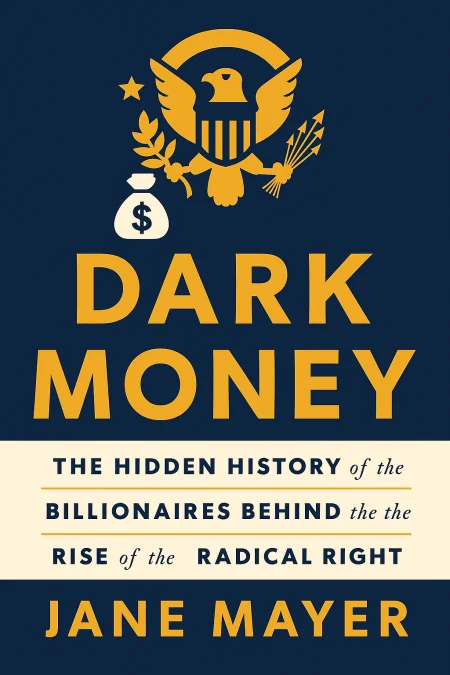
Dark Money
The Hidden History of the Billionaires Behind the Rise of the Radical Right
Book Edition Details
Summary
Amidst the corridors of power and influence, an unseen force orchestrates a grand design reshaping American democracy. "Dark Money" unveils the shadowy strategies of a secretive alliance of ultra-wealthy libertarians whose radical vision quietly redefines governance. Jane Mayer meticulously exposes the clandestine flow of billions from corporate titans like the Koch brothers, weaving through think tanks and political campaigns, manipulating everything from environmental policy to judicial appointments. With a narrative as gripping as a thriller, Mayer's investigation reveals the unsettling truth: a hidden oligarchy is steering the nation towards a future dictated not by the electorate, but by a select few. Prepare to be riveted—and outraged.
Introduction
In the winter of 2009, while Barack Obama celebrated his historic inauguration before millions of Americans, a very different gathering was taking place in a luxury resort in the California desert. There, some of the nation's wealthiest conservatives were quietly plotting to nullify the results of the recent election. This wasn't ordinary political opposition—it was the culmination of a decades-long campaign to fundamentally reshape American democracy itself. This story reveals how a small network of billionaire families transformed the very nature of political power in America by weaponizing philanthropy, manufacturing grassroots movements, and building a shadow political infrastructure that operates largely beyond public view. Through patient investigation spanning from the 1930s to the present day, we discover how inherited fortunes became political weapons and how tax-deductible donations funded a radical transformation of the American political landscape. The tale exposes the hidden machinery behind seemingly spontaneous political movements and shows how a handful of ultra-wealthy donors didn't just influence elections—they fundamentally altered how Americans think about government, taxes, and corporate power. For anyone seeking to understand the invisible forces shaping contemporary politics, this investigation offers essential insights into how democracy can be quietly undermined by those with the deepest pockets and the most extreme ideologies. Whether you're a concerned citizen puzzled by increasingly polarized politics, a student trying to comprehend modern political dynamics, or simply someone who believes in transparent governance, this account provides crucial knowledge about the hidden history that continues to shape our political present.
The Foundations of Influence: Conservative Infrastructure Building (1970s-1990s)
The transformation of American politics began not with elections or campaigns, but with a quiet revolution in the world of ideas. During the turbulent 1970s, as social movements challenged traditional power structures and economic stagflation threatened established business interests, a handful of wealthy industrialists recognized that lasting political change required more than just campaign contributions—it demanded the construction of an entirely new intellectual infrastructure. The pivotal moment came with Lewis Powell's explosive 1971 memorandum to the U.S. Chamber of Commerce, which warned that the American free enterprise system was under coordinated assault from environmental activists, consumer advocates, and civil rights leaders. Powell, who would later join the Supreme Court, outlined a comprehensive blueprint for corporate America to fight back through education, media, politics, and the courts. This wasn't merely about winning the next election, but about fundamentally changing how Americans thought about the role of government and business in society. The early pioneers understood something profound: ideas have consequences that compound over generations. Richard Mellon Scaife, heir to banking and oil fortunes, began systematically funding conservative think tanks like the Heritage Foundation and publications that could provide intellectual ammunition for free-market policies. John M. Olin, whose chemical fortune was built on environmentally destructive practices, poured millions into academic programs designed to train a new generation of conservative intellectuals. The Bradley Foundation focused on dismantling the theoretical foundations of the welfare state through scholarly research and policy advocacy. These philanthropists created an entirely new model of strategic giving that differed fundamentally from traditional charity. Rather than addressing immediate social needs, their approach was designed to achieve long-term ideological transformation. They funded law schools to train conservative judges, supported economists who challenged Keynesian orthodoxy, and created media outlets to amplify their message. By the 1990s, this patient investment in ideas had begun to shift political discourse rightward, creating the intellectual foundation for even more dramatic changes to come.
Manufacturing Grassroots: The Tea Party Revolution and Astroturf Politics (2009-2012)
The election of Barack Obama in 2008 triggered what appeared to be a spontaneous eruption of grassroots conservative activism across America. The Tea Party movement seemed to emerge from nowhere, complete with colonial costumes, populist rhetoric, and sophisticated organizational capabilities. In reality, this apparent grassroots revolution was largely the product of the donor network that had been building for decades, now mobilized in response to what they perceived as an existential threat to their interests. The movement's public origins trace to Rick Santelli's February 2009 rant on CNBC, when he called for a "tea party" to protest government assistance for struggling homeowners. Within hours, websites were registered, social media campaigns launched, and protest events organized across multiple states. This lightning-fast response wasn't the work of angry citizens spontaneously organizing, but of professional political operatives funded by billionaire donors who recognized an opportunity to channel genuine economic anxiety toward their preferred policy solutions. The Tea Party's genius lay in its ability to present plutocratic priorities as populist demands. Opposition to financial regulation became support for free markets and individual liberty. Resistance to healthcare reform became defense against government tyranny. Tax cuts for the wealthy became relief for small businesses and job creators. The movement's rhetoric was carefully crafted through focus groups and polling to appeal to middle-class anxieties while advancing an agenda that primarily benefited the ultra-wealthy donors funding the entire operation behind the scenes. The electoral impact was immediate and devastating for Democrats. The 2010 midterm elections saw Republicans gain control of the House of Representatives and numerous state governments, many supported by dark money groups that spent unprecedented sums on advertising and voter mobilization. The success demonstrated that with sufficient funding and professional expertise, it was possible to manufacture the appearance of authentic grassroots support for almost any political position, regardless of its actual popularity with the general public. This revelation would fundamentally alter American politics for years to come.
Total Political Warfare: State Capture and Democratic Transformation (2013-2016)
By Obama's second term, the conservative donor network had evolved from an influence operation into something resembling a parallel political party with its own infrastructure, priorities, and electoral machinery. With assets in the hundreds of millions and a sophisticated network spanning think tanks, advocacy groups, legal organizations, and media outlets, this shadow system was capable of sustained political warfare on multiple fronts simultaneously. The focus shifted strategically from merely influencing federal policy to systematically capturing state and local governments where change could be implemented more easily and with less public scrutiny. Through organizations like the American Legislative Exchange Council, corporate-backed model legislation was introduced in statehouses across the country, creating a coordinated national campaign disguised as local initiatives. Voting restrictions, environmental deregulation, tax cuts for the wealthy, and attacks on labor unions became standard Republican priorities regardless of local conditions or public opinion. The network's influence extended deep into the federal judiciary through decades of investment in organizations like the Federalist Society, which had been quietly grooming conservative legal talent and developing constitutional theories that would benefit corporate interests. The Supreme Court's Citizens United decision, which removed limits on corporate political spending, represented the culmination of a decades-long legal strategy funded by the same donors who would benefit most from unlimited political expenditures. Perhaps most significantly, this period witnessed the complete ideological transformation of the Republican Party from a traditional conservative organization into something more closely resembling the libertarian vision that had motivated the original billionaire donors. Climate change denial became party orthodoxy despite overwhelming scientific consensus. Opposition to any tax increases, even on the wealthy, became a litmus test for candidates. The fundamental role of government in addressing social problems was systematically questioned and undermined. What had begun as the eccentric views of a few ultra-wealthy individuals had become the governing philosophy of one of America's two major political parties, demonstrating the extraordinary power of patient, systematic investment in political infrastructure.
Summary
The transformation of American politics over the past five decades represents one of the most successful influence campaigns in modern democratic history. A small group of ideologically motivated billionaires, driven by a combination of libertarian conviction and economic self-interest, systematically constructed a parallel political infrastructure capable of reshaping public opinion, policy debates, and electoral outcomes. Their remarkable success stemmed not from winning individual campaigns, but from fundamentally changing the terms of political discourse itself. The central tension revealed by this hidden history is the growing conflict between democratic equality and extreme economic inequality. As wealth became increasingly concentrated among a tiny elite, that elite gained the financial resources necessary to amplify their political voice far beyond what their numbers would suggest in a genuinely democratic system. The result has been a form of oligarchy disguised as democracy, where the policy preferences of a few dozen wealthy families often override the expressed interests and needs of millions of ordinary citizens. This history offers crucial lessons for anyone concerned about the future of democratic governance. First, citizens must recognize that the appearance of grassroots political movements can be manufactured by those with sufficient funding and professional expertise. Second, democratic institutions are far more fragile than they appear and require active, informed defense against manipulation by concentrated wealth. Third, transparency in political funding is essential—voters cannot make informed choices when the true sources of political messages are hidden behind layers of nonprofit organizations. Finally, preserving meaningful democracy requires creating institutions that amplify the voices of ordinary citizens rather than just the wealthy, ensuring that government serves the broader public interest rather than the narrow priorities of those who can afford to purchase political influence.
Related Books
Download PDF & EPUB
To save this Black List summary for later, download the free PDF and EPUB. You can print it out, or read offline at your convenience.
By Jane Mayer
