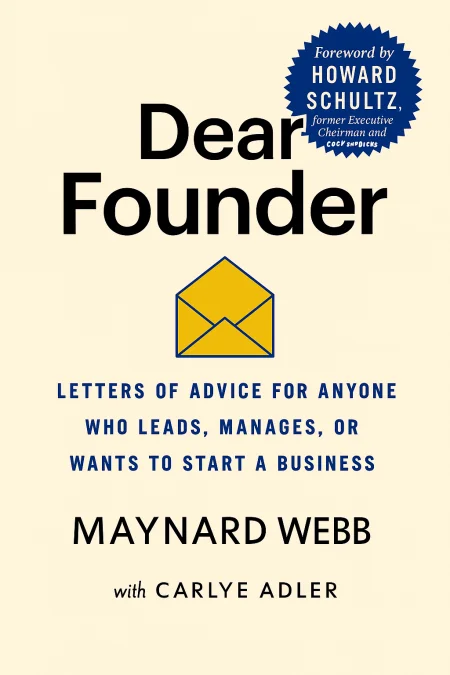
Dear Founder
Letters of Advice for Anyone Who Leads, Manages, or Wants to Start a Business
Book Edition Details
Summary
What if you could unlock the blueprint for entrepreneurial triumph from a seasoned mastermind? In "Dear Founder," Maynard Webb delivers an electrifying collection of over eighty letters brimming with wisdom and practical advice. From the bustling corridors of eBay to the strategic echelons of Salesforce, Webb distills decades of experience into a treasure trove of insights for aspiring business moguls. Whether you're nurturing a nascent startup or steering a growing enterprise, these candid missives offer guidance on everything from securing pivotal funding to sculpting a dynamic company culture. This isn't just a book; it's your personal mentor in print, urging you to transcend the ordinary and craft a legacy of innovation and success.
Introduction
When Marc Benioff called Maynard Webb at midnight to help save Salesforce from a critical system failure, Webb didn't hesitate. He knew that behind every entrepreneurial triumph lies countless moments of crisis, doubt, and seemingly impossible decisions. This wasn't just about fixing servers; it was about preserving the dreams of a founder who dared to reimagine how business software could work. As a seasoned executive who has guided companies from garage startups to global giants, Webb understands the unique isolation that comes with leadership. Whether you're a first-time founder staring at an empty bank account, a CEO navigating board conflicts, or an executive wrestling with scaling challenges, the path forward often feels unclear and lonely. The weight of responsibility for employees, investors, and customers can be overwhelming. This collection of wisdom emerges from decades of real-world experience helping entrepreneurs transform bold visions into lasting enterprises. Each insight has been forged in the crucible of actual business challenges, from the euphoria of successful funding rounds to the agony of missing quarterly targets. The goal isn't to provide easy answers, but to offer the kind of seasoned perspective that can illuminate the way forward when the path seems darkest. For anyone who leads, manages, or dreams of building something meaningful, these lessons serve as both compass and companion on the entrepreneurial journey.
From Idea to Reality: Starting and Funding Your Venture
The journey begins with a simple but profound question that Webb poses to every aspiring entrepreneur: "Really? Why do you want to do this?" It's not meant to discourage, but to ensure founders understand what they're truly signing up for. When one entrepreneur confessed he was starting a company because it seemed like "the cool thing to do," Webb knew trouble lay ahead. Entrepreneurship isn't a lifestyle choice or a path to easy wealth—it's a calling that demands everything you have and then some more. Webb recalls watching founders of GOAT sleep in their car while raising seed funding, not because they had to, but because every dollar saved could be reinvested in their vision of revolutionizing sneaker commerce. This wasn't romantic startup mythology; it was the raw reality of what commitment looks like when you're building something from nothing. The founders who succeed aren't necessarily the smartest or most privileged—they're the ones willing to endure years of uncertainty because they can't imagine doing anything else. The funding landscape presents its own labyrinth of challenges and opportunities. Webb has seen companies navigate from desperate funding droughts to embarrassments of investment riches, sometimes within months of each other. When everyone wants to invest, founders often make the mistake of optimizing purely for valuation, forgetting that choosing the wrong investor is like entering a bad marriage with no possibility of divorce. Conversely, when funding is scarce, the temptation to accept any terms can be equally destructive. The art lies not in avoiding these extremes, but in maintaining clarity about your ultimate destination while remaining flexible about the path. The founders who build lasting companies understand that early decisions about co-founders, investors, and company culture create ripple effects that compound over years. What appears to be tactical choices in the moment—whom to hire, how much to raise, what values to establish—ultimately determine whether you're building a sustainable enterprise or merely an elaborate house of cards.
Growing Pains: Management Challenges and Personal Leadership Tests
The transition from scrappy startup to functioning organization reveals leadership gaps that can't be solved with good intentions alone. Webb learned this lesson painfully when an executive at one of his portfolio companies insisted on holding one-on-one meetings at midnight, creating a toxic environment despite delivering strong results. The executive's defense was simple: "I hear you, I just choose to do things differently." This wasn't a skills issue—it was a character issue that ultimately led to their departure. Leadership challenges intensify as companies grow because the informal systems that worked with five people become chaos with fifty. Webb discovered this firsthand at eBay when what started as a collaborative culture began fragmenting into competing fiefdoms. The engineering team focused solely on shipping features fast, while operations prioritized system stability, creating constant friction. The solution required rewriting everyone's goals so that ops shared delivery targets while engineering shared uptime responsibilities. The loneliness of leadership becomes particularly acute during crisis moments. Webb remembers having to call Meg Whitman in the middle of the night whenever eBay's systems failed, knowing her surgeon husband would answer expecting a medical emergency. "No one's dying, just my site," became his standard opening line. These calls weren't just about technical problems—they were about taking full ownership of bad news and demonstrating that leadership means being accountable when things go wrong. The founders who navigate these growing pains successfully learn to distinguish between problems that require their personal intervention and those that need systematic solutions. Building a company isn't just about having great ideas or securing funding—it's about developing the judgment to know when to fight and when to delegate, when to stick to your vision and when to adapt. The most successful leaders create environments where problems surface early and teams feel empowered to solve them, rather than cultures where issues are hidden until they become crises.
Scaling Up: Operational Excellence and Organizational Mastery
When eBay's search functionality began crumbling under explosive growth, Webb faced a choice that would define his approach to scaling: accept the limitations or bet everything on building something better. The conventional wisdom suggested buying a solution from Google or Yahoo!, but neither company understood eBay's unique challenges. Instead, Webb empowered his team to build a custom search engine in six months—a project that should have taken eighteen. The result wasn't just better technology; it was proof that organizations can achieve the impossible when they combine clear vision with operational discipline. Scaling transforms every aspect of a business, often in counterintuitive ways. Processes that seemed bureaucratic at ten employees become essential survival tools at one hundred. Webb learned this lesson when a company's beloved informal culture began breaking down as rapid growth created confusion and miscommunication. The solution wasn't to abandon the culture but to codify the values and behaviors that made it special. What seemed like bureaucracy to some employees was actually the scaffolding that allowed the culture to scale. The most dangerous phase of scaling occurs when companies achieve initial success but haven't yet built sustainable systems. Webb calls this the "tweener" trap—no longer a scrappy startup but not yet an efficient organization. Companies get stuck here when they confuse activity with progress, celebrating being busy rather than being effective. The breakthrough comes when leaders learn to measure themselves against world-class standards rather than their own past performance. Operational excellence isn't about perfecting processes—it's about building organizational capabilities that can handle exponential growth without losing the essence of what made the company special in the first place. The companies that successfully navigate this transition understand that scaling is ultimately about people and culture, not systems and processes. When every team member understands not just what to do but why it matters, the organization develops the resilience and adaptability to handle whatever challenges growth brings.
Building Legacy: Creating Companies That Endure Beyond Founders
The ultimate test of entrepreneurship isn't building a successful company—it's creating something that can thrive long after its founders have moved on. Webb witnessed this challenge firsthand when he realized that his early career successes were too dependent on his personal involvement. When he left Quantum, many talented employees followed him, which seemed flattering but actually represented a failure of institutional building. True success means creating organizations that become stronger over time, not weaker. The transition from founder-dependent startup to enduring institution requires a fundamental shift in mindset. Webb learned this from watching legendary leaders like Bill Hewlett and David Packard create a culture at HP that continued to guide the company decades after their active involvement ended. Their fingerprints remained not through micromanagement but through values and principles that became part of the organizational DNA. The paradox of legacy-building is that it requires founders to gradually make themselves less essential while remaining deeply committed to the mission. This means developing systems that can function without constant oversight, building leadership teams that can make decisions independently, and creating cultures that can adapt to changing circumstances while maintaining core values. The most successful founders learn to measure their impact not by how indispensable they become, but by how well the organization performs in their absence. Building a company to last also means accepting that the skills that launched the enterprise may not be the same ones needed to sustain it. Webb has seen brilliant visionaries struggle with operational details, charismatic leaders fail at institutional building, and innovative founders resist the structure needed for scale. The wisdom lies in recognizing these transitions and either adapting or gracefully passing the torch to others better suited for the next phase of growth.
Summary
The entrepreneurial journey reveals a profound truth about human potential and organizational excellence. Through countless stories of late-night crisis calls, impossible deadlines, and moments when everything seemed lost, we see that building something lasting requires more than brilliant ideas or perfect timing. It demands the courage to take full ownership of outcomes, the wisdom to build systems that can scale beyond individual capabilities, and the humility to put the mission ahead of personal ego. The founders who create companies that truly matter understand that success isn't measured by personal wealth or recognition, but by the positive impact their organizations have on employees, customers, and society long after the founders themselves have moved on. In a world that desperately needs innovative solutions to complex challenges, the greatest gift entrepreneurs can give is not just their ideas, but their commitment to building institutions worthy of those ideas—companies that embody the highest aspirations of human collaboration and continue to make the world better for generations to come.
Related Books
Download PDF & EPUB
To save this Black List summary for later, download the free PDF and EPUB. You can print it out, or read offline at your convenience.
By Maynard Webb
