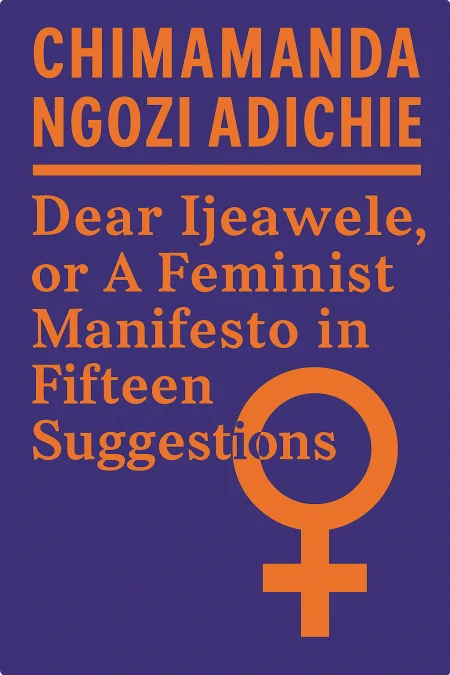
Dear Ijeawele, or A Feminist Manifesto in Fifteen Suggestions
Empower yourself, empower your daughter
Book Edition Details
Summary
A heartfelt exchange between friends blooms into a manifesto for modern feminism in Chimamanda Ngozi Adichie's "Dear Ijeawele." When asked by a cherished friend how to nurture a feminist daughter, Adichie responds with fifteen transformative principles, deftly weaving wisdom with wit. This vibrant guide challenges gender norms with humor and clarity—urging young girls to embrace helicopters alongside dolls, and to dissect societal myths around gender roles. In these pages, every suggestion is a thread in a rich tapestry of empowerment, designed to inspire a new dialogue about womanhood in the contemporary world. Capturing the essence of feminist discourse with both urgency and grace, this book is a beacon for those daring to raise strong, independent women today.
Introduction
Modern child-rearing practices remain deeply entrenched in gender stereotypes that limit human potential before it can fully develop. This epistolary manifesto challenges parents to reconsider fundamental assumptions about raising children, particularly daughters, in a world where equality remains more aspiration than reality. The work employs a deeply personal yet universally applicable framework, presenting practical wisdom through intimate correspondence that bridges theoretical feminism with daily parenting decisions. The letter format creates an unusually compelling vehicle for examining how societal conditioning begins in infancy and perpetuates through seemingly innocent choices about clothes, toys, language, and expectations. Rather than abstract theorizing, the approach demonstrates how philosophical principles translate into concrete actions, from rejecting gendered toy sections to questioning why marriage remains positioned as women's primary achievement. The conversational tone masks sophisticated analysis of power dynamics, cultural traditions, and the subtle mechanisms through which inequality reproduces itself across generations. Readers encounter a systematic dismantling of conventional wisdom about gender roles, supported by both logical reasoning and lived experience. The progression from foundational principles to specific applications creates a comprehensive blueprint for parents seeking to raise children free from limiting assumptions while acknowledging the complex realities of operating within existing social structures.
The Foundation: Core Feminist Principles for Child-Rearing
Two fundamental tools anchor all feminist child-rearing decisions, providing clarity amid cultural confusion about gender equality. The first tool establishes an unshakeable premise: every individual matters equally, without qualification or condition. This principle transcends circumstantial considerations and refuses compromise with systems that assign different values based on gender. The second tool offers a practical test for evaluating any situation: reversing circumstances to determine whether the same standards apply regardless of gender reveals hidden biases and double standards. These tools expose the inadequacy of what the work terms "Feminism Lite" - conditional equality that maintains male superiority while expecting benevolent treatment of women. This hollow approach perpetuates dependence on male approval rather than establishing genuine equality. The language of "allowing" women to succeed reveals underlying power imbalances that authentic feminism must reject entirely. True equality means mothers need not apologize for working, fathers participate fully in child care without special praise, and domestic responsibilities distribute according to capability rather than gender. The foundation requires parents themselves to embody full personhood rather than defining themselves solely through parental roles. Motherhood represents one aspect of identity, not its entirety, and children benefit from observing parents who pursue meaningful work and personal fulfillment. This modeling demonstrates that caring for children and maintaining individual identity are complementary rather than competing priorities. Establishing this foundation means rejecting societal pressure to conform to traditional expectations while creating space for children to develop authentic selves. The work emphasizes that both parents must actively participate in child-rearing, sharing responsibilities equally and refusing to treat fathers as helpers in primarily maternal territory.
Dismantling Gender Constructs: From Roles to Language to Identity
Gender roles emerge from cultural invention rather than biological necessity, and recognizing this distinction becomes crucial for raising children free from artificial limitations. The arbitrary nature of gendered expectations becomes apparent when examining how early society begins segregating children through clothing colors, toy preferences, and behavioral standards. Pink and blue distinctions serve marketing purposes rather than reflecting any meaningful differences between male and female infants, yet these early categorizations establish patterns that persist throughout life. Toy sections organized by gender rather than type reveal how society shapes interests and abilities before children can develop natural preferences. Active toys predominantly marketed to boys encourage exploration and problem-solving, while passive toys directed toward girls emphasize appearance and care-giving. This early channeling restricts the full range of human potential and creates artificial boundaries around acceptable behavior and interests. Language carries particular power in perpetuating gender assumptions, requiring careful attention to the messages embedded in everyday speech. Referring to fathers as "babysitting" their own children implies parenting belongs primarily to mothers, while phrases about girls needing to behave "like ladies" attach moral significance to gender conformity. The work advocates for conscious language choices that reflect equality rather than reinforce hierarchies. The deconstruction of gender roles extends to challenging biological determinism used to justify social arrangements. While acknowledging real physical differences between males and females, the work exposes how societies selectively apply biological arguments to support existing power structures rather than creating arrangements that truly reflect natural capabilities and inclinations.
Beyond Traditional Frameworks: Marriage, Sexuality, and Relationships
Marriage occupies disproportionate space in women's socialization, creating imbalanced relationships where the institution matters more to one partner than the other. This disparity produces dynamics where women sacrifice more to maintain relationships that men treat as optional rather than central to their identity. The emphasis on marriage as female achievement rather than mutual partnership perpetuates inequality from the relationship's foundation. Sexuality becomes entangled with shame through cultural mechanisms designed to control women's bodies and choices. The work advocates for separating sexuality from moral evaluation, presenting it instead as a natural aspect of human experience requiring honest discussion rather than whispered warnings. This approach helps children develop healthy relationships with their own bodies and desires while maintaining appropriate boundaries and safety awareness. The traditional framework linking women's value to marital status creates problematic expectations around name changes, social roles, and personal sacrifice. These conventions, while presented as natural or traditional, actually represent recent historical developments serving particular power structures rather than universal human needs. Questioning why women alone face pressure to alter their identities upon marriage reveals the gendered nature of supposedly neutral institutions. Relationships thrive when both partners contribute according to capability rather than gender-assigned roles, and when financial responsibilities distribute based on resources rather than assumptions about male provision. The work challenges both partners to examine inherited expectations about relationship dynamics and create arrangements that honor both individuals' autonomy and mutual commitment.
Creating Inclusive Future: Difference, Dignity, and Human Equality
Human diversity represents reality rather than deviation from some imagined standard, requiring educational approaches that normalize difference without creating hierarchies of value. Teaching children to recognize and respect various ways of living prepares them for successful navigation of an interconnected world while developing their capacity for empathy and understanding. The work distinguishes between accepting difference and avoiding judgment altogether, advocating instead for informed opinions based on humanitarian principles rather than inherited prejudices. This approach encourages children to develop strong values while remaining open to perspectives that differ from their own experience. The goal involves creating individuals capable of both conviction and flexibility. Understanding oppression requires avoiding the trap of romanticizing those who suffer injustice, recognizing that dignity belongs to all humans regardless of their personal qualities. This nuanced perspective prevents the development of patronizing attitudes while maintaining commitment to justice and equality. Acknowledging that women can perpetuate misogyny just as some men support feminism creates more sophisticated understanding of how social systems operate. The inclusive future depends on raising children who can appreciate both individual uniqueness and shared humanity, who understand that different paths through life can coexist without threatening their own choices. This preparation involves exposing children to diverse role models, challenging narrow definitions of success and beauty, and creating environments where various expressions of human potential receive validation and support.
Summary
Feminist child-rearing ultimately concerns itself with expanding human possibility rather than limiting it, creating conditions where children can discover and develop their authentic selves without artificial constraints based on gender. The systematic approach presented here transforms abstract principles into practical daily decisions, demonstrating how parents can actively resist societal conditioning while preparing children to navigate and ultimately transform existing structures. This work succeeds in making feminism accessible and actionable for parents committed to raising children who understand their equal worth and responsibility to create more just relationships and communities.
Related Books
Download PDF & EPUB
To save this Black List summary for later, download the free PDF and EPUB. You can print it out, or read offline at your convenience.
By Chimamanda Ngozi Adichie
