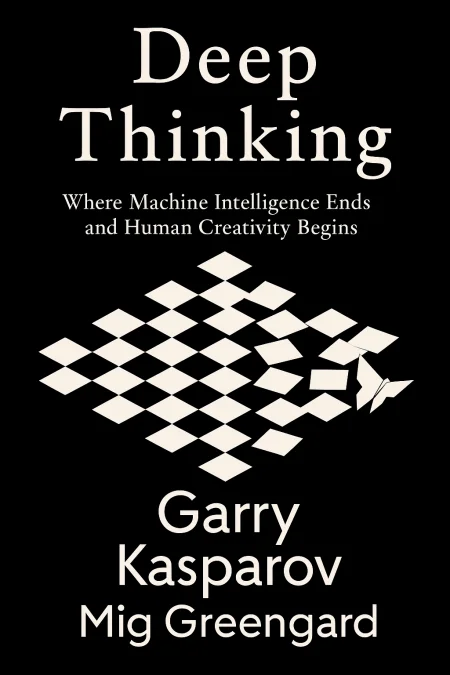
Deep Thinking
Where Artificial Intelligence Ends and Human Creativity Begins
byGarry Kasparov, Mig Greengard
Book Edition Details
Summary
In the electrifying clash between human genius and machine precision, Garry Kasparov faced an adversary unlike any other: IBM's Deep Blue. As the chessboard transformed into a battleground of neurons versus algorithms, Kasparov navigated the enigmatic realm of artificial intelligence with the world as his audience. "Deep Thinking" invites you to witness this iconic encounter through the eyes of a grandmaster, unraveling the intricate dance of strategy and innovation. This isn’t just a tale of competition; it's a journey into the heart of cognitive evolution. With foresight and optimism, Kasparov challenges the fears surrounding AI, envisioning a future where human ingenuity collaborates with technological marvels to transcend the ordinary. Prepare to rethink what it means to be intelligent.
Introduction
The confrontation between human chess mastery and artificial intelligence represents far more than a technological milestone—it illuminates fundamental questions about the nature of intelligence itself and humanity's evolving relationship with its own creations. Through the strategic complexity of chess, we witness how different forms of cognition process information, make decisions, and solve problems under pressure. The encounters between world champions and supercomputers reveal not just the capabilities of artificial minds, but the irreplaceable qualities that distinguish human thinking from mechanical calculation. This exploration moves beyond the simplistic narrative of man versus machine to examine deeper patterns of technological disruption and human adaptation. The chess laboratory provides unique insights into how expertise evolves when confronted with superior artificial capabilities, and how competition can transform into collaboration. The analysis traces the journey from adversarial encounters to symbiotic partnerships, revealing principles that extend far beyond the sixty-four squares to illuminate our broader relationship with intelligent machines. The investigation employs a systematic examination of technological evolution, competitive dynamics, and collaborative possibilities to understand how human and artificial intelligence might complement rather than merely compete with each other. By analyzing the strategic, psychological, and philosophical dimensions of these encounters, we gain perspective on how to navigate similar transitions across all domains where human expertise meets computational power.
The Evolution of Machine Chess: Brute Force Over Human-Like Intelligence
The development of chess-playing machines reveals a fundamental divergence between two approaches to artificial intelligence: creating systems that think like humans versus systems that simply outperform humans through computational superiority. Early pioneers believed that mastering chess would unlock the secrets of human cognition, leading to machines that would replicate the pattern recognition and strategic intuition of grandmasters. Instead, the path to chess supremacy followed an entirely different trajectory, one that prioritized raw computational power over elegant reasoning. The theoretical foundations established by Claude Shannon distinguished between exhaustive search methods and selective intelligence that would mirror human decision-making processes. While researchers initially favored the sophisticated approach, hoping to create truly intelligent machines, the relentless advancement of processing power gradually vindicated brute force methodology. Each doubling of computational speed translated directly into deeper search capabilities, and deeper search consistently produced stronger play, regardless of the underlying sophistication of the evaluation algorithms. This evolution exposed a crucial insight about artificial intelligence development: superior performance often emerges through methods entirely alien to human thinking. Chess machines achieved grandmaster strength not by understanding strategic principles or developing intuitive pattern recognition, but by calculating millions of positions per second with mechanical precision. The alpha-beta pruning technique allowed programs to discard unpromising variations efficiently, while specialized hardware designs maximized the speed of chess-specific calculations. The transformation from experimental curiosity to world-championship contender required fundamental advances in search algorithms, opening databases, and evaluation functions. These developments culminated in machines capable of seeing tactical combinations that would require human masters hours of analysis to fully comprehend, demonstrating that intelligence might be less mysterious and more mechanizable than previously imagined.
Deep Blue's Victory: Asymmetric Competition and Questionable Fairness
The 1997 confrontation between world champion Garry Kasparov and IBM's Deep Blue supercomputer represented a watershed moment in human-machine competition, yet the circumstances surrounding this historic encounter raise significant questions about fairness and scientific validity. While Deep Blue's victory was undoubtedly a remarkable technical achievement, the conditions created asymmetries that extended far beyond the inherent differences between human and machine cognition, fundamentally altering the nature of the competition itself. The most significant advantage lay in information access and preparation methodology. Kasparov faced an opponent whose capabilities remained largely opaque, having seen no games from the upgraded system, while IBM's team could study thousands of the champion's games and tailor their machine's opening repertoire specifically for this matchup. Between games, Deep Blue's programming could be adjusted and its evaluation functions refined based on observed weaknesses, while Kasparov remained fundamentally unchanged. The machine benefited from a team of grandmasters providing strategic guidance while operating with perfect memory and unlimited stamina. These structural asymmetries were compounded by unprecedented psychological pressures. Kasparov confronted not merely a chess-playing machine, but the full resources of IBM's corporate and technical infrastructure. The burden of defending humanity's intellectual supremacy, combined with the opacity of his opponent's decision-making process, created mental challenges that no machine experiences. Technical problems during games affected only the human player, introducing distraction and uncertainty that further tilted the competitive balance. The controversy surrounding specific moves and alleged irregularities in Deep Blue's play highlights deeper issues about transparency and reproducibility in human-machine competition. The machine's occasional inexplicable moves and the team's reluctance to provide detailed analysis logs raised questions about the scientific validity of the results. While these concerns may not invalidate Deep Blue's ultimate victory, they underscore the complexity of staging meaningful contests between fundamentally different types of intelligence operating under inherently unequal conditions.
Collaborative Intelligence: Human-Machine Partnership Transcends Individual Capabilities
The most significant breakthrough in chess intelligence emerged not from the defeat of human champions, but from the discovery that human-machine partnerships could achieve levels of performance superior to either humans or machines operating independently. This collaborative approach, pioneered in Advanced Chess formats, revealed that the synthesis of human strategic insight and machine tactical precision created a form of hybrid intelligence more powerful than its individual components, fundamentally redefining the relationship between human and artificial minds. Human players contributed irreplaceable qualities to these partnerships: pattern recognition developed through years of experience, strategic intuition that could guide computational search in productive directions, and the ability to recognize when positions required unconventional approaches that defied programmed evaluation criteria. Machines provided perfect tactical calculation, immunity to emotional pressure, and the capacity to evaluate millions of positions without fatigue or error. The combination of these complementary strengths produced chess of unprecedented quality and depth. The effectiveness of human-machine collaboration depended critically on process design and interface sophistication. The most successful partnerships were not necessarily those with the strongest human players or the most powerful computers, but those with the most refined methods for combining human and machine capabilities. Skilled operators learned to coach their silicon partners, directing computational resources toward promising variations while avoiding over-reliance on machine evaluations that might miss subtle positional factors. This collaborative model demonstrated that the synthesis of different forms of intelligence could transcend the limitations of either component alone. Rather than viewing artificial intelligence as a replacement for human capability, the partnership approach revealed possibilities for augmentation that preserved human agency while leveraging machine strengths. The key insight was that effective collaboration required maintaining human strategic control while benefiting from artificial intelligence's computational advantages, creating a division of cognitive labor that maximized the unique contributions of both forms of intelligence.
Beyond Chess: AI as Human Augmentation Rather Than Replacement
The evolution of human-machine relationships in chess provides a compelling framework for understanding how artificial intelligence might transform human capability across all domains of knowledge work. The pattern that emerged—initial human dominance, followed by competitive parity, machine superiority, and finally collaborative synthesis—offers a roadmap for managing similar transitions in fields from medicine to scientific research to creative endeavors, suggesting that the future lies not in replacement but in thoughtful augmentation. The chess experience demonstrates that human uniqueness need not be threatened by superior machine capability. As computers assumed responsibility for tactical calculation and position evaluation, human players were freed to focus on higher-level strategic concepts, creative preparation, and psychological aspects of competition. Rather than diminishing human chess, machines elevated it by removing the burden of error-prone calculation and enabling deeper exploration of strategic possibilities that were previously inaccessible due to computational limitations. This augmentation model suggests that the future of human intelligence lies not in competing with machines at tasks they perform better, but in developing uniquely human capabilities that complement artificial intelligence. Creativity, judgment, ethical reasoning, and the ability to find meaning and purpose in complex situations remain distinctly human contributions that become more valuable, not less, in an age of artificial minds. The challenge involves learning to leverage machine capabilities while preserving and developing these irreplaceable human qualities. The implications extend beyond individual enhancement to societal transformation. Just as chess databases and engines democratized access to master-level instruction, artificial intelligence has the potential to democratize expertise across many fields. The critical factor is ensuring that technological augmentation serves to expand human potential rather than replace human agency, creating tools that amplify our capabilities while preserving our essential humanity and maintaining meaningful human control over important decisions.
Summary
The encounter between human and machine intelligence in chess reveals that the most profound advances emerge not from competition but from collaboration, demonstrating that artificial intelligence serves best as an amplifier of human potential rather than a replacement for human capability. The chess laboratory shows that when we move beyond adversarial narratives and embrace augmentation possibilities, intelligent machines become tools for expanding rather than diminishing human achievement. The collaborative model that emerged from these encounters offers a blueprint for a future where technology serves to enhance human creativity, judgment, and purpose, creating partnerships that achieve results impossible for either human or artificial intelligence alone while preserving the essential qualities that make us uniquely human.
Related Books
Download PDF & EPUB
To save this Black List summary for later, download the free PDF and EPUB. You can print it out, or read offline at your convenience.
By Garry Kasparov
