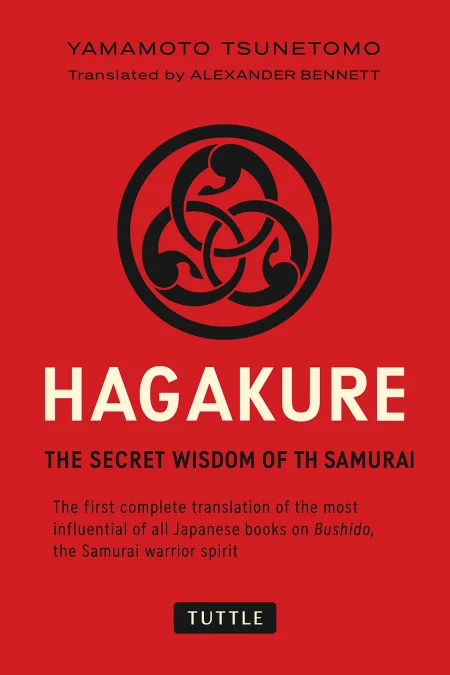
Hagakure
The Secret Wisdom of the Samurai
byYamamoto Tsunetomo, Alexander Bennett
Book Edition Details
Summary
In the shadowy embrace of ancient Japan, "Hagakure" unveils the enigmatic heart of the samurai, captured with poignant clarity by Yamamoto Tsunetomo over three centuries ago. This isn’t merely a text; it’s a living testament to a warrior’s ethos, meticulously preserved and now reinvigorated by Alex Bennett’s masterful translation. For the first time, readers are offered the complete essence of the first two books and the most genuine excerpts from the third, bridging cultural chasms with insightful annotations. It is a philosophical tapestry woven with threads of honor, death, and unyielding loyalty. Bennett breathes new life into this iconic chronicle, making it accessible and enthralling for a modern audience. Embark on a journey into the soul of the samurai, where wisdom whispers through the ages, challenging you to live with integrity and valor.
Introduction
In the quiet halls of an eighteenth-century monastery, a former samurai named Yamamoto Tsunetomo shared his most intimate reflections on the warrior's path with a young scribe. These conversations, recorded between 1710 and 1716, would become one of history's most penetrating examinations of honor, duty, and the meaning of authentic existence. What emerges is not merely a chronicle of martial traditions, but a profound meditation on how an entire social class navigated the treacherous waters between obsolescence and transformation. The narrative reveals three fundamental tensions that shaped samurai existence across centuries: the conflict between individual glory and collective loyalty, the challenge of maintaining warrior identity during extended peace, and the delicate balance between absolute devotion and moral independence. Through intimate portraits of men who chose death over dishonor, masters who demanded impossible loyalty, and warriors who struggled to find purpose in a world that no longer required their swords, readers encounter timeless questions about duty, sacrifice, and the courage to live according to one's deepest convictions. This exploration speaks to anyone fascinated by the intersection of personal values and social change, offering insights that transcend cultural boundaries. The samurai's struggle to preserve meaning while adapting to new realities mirrors our own challenges in maintaining authentic purpose amid rapid transformation, making their ancient wisdom surprisingly relevant to contemporary life.
Warrior Culture and the Rise of Bushido (9th-16th Century)
The samurai emerged from the wild frontier provinces of eastern Japan as professional warriors bound to aristocratic families through ties of mutual obligation and shared danger. Unlike temporary soldiers or court officials assigned military duties, these men made violence their calling and honor their obsession. From the ninth century onward, they forged a distinctive culture centered on martial excellence, personal reputation, and loyalty bonds tested in the crucible of constant warfare. Early warrior codes, known as "the way of the bow and arrow," emphasized individual valor and the relentless pursuit of fame through combat prowess. Warriors competed fiercely for recognition, viewing each battle as an opportunity to enhance their lineage's standing and secure their family's future. Death in combat was not merely acceptable but often preferable to a life tainted by cowardice or failure. The battlefield became a stage where men could achieve a form of immortality through glorious deeds that would be remembered and celebrated for generations. The Warring States period marked both the apex and the crisis of this warrior culture. As rival warlords struggled for supremacy across a fractured landscape, loyalty became a precious commodity in a market of shifting alliances. Yesterday's sworn brother might become tomorrow's mortal enemy, and survival often depended on the ability to navigate treacherous political currents. This instability paradoxically strengthened the warrior's attachment to personal honor as the one constant in an uncertain world, leading to increasingly elaborate codes of conduct that distinguished true samurai from mere soldiers of fortune. The unification of Japan under successive military leaders brought this age of endemic warfare to an abrupt conclusion. The samurai, having defined themselves through violence for over seven centuries, suddenly confronted a world that no longer needed their primary skill. This transition would force a fundamental reimagining of warrior identity, setting the stage for the philosophical innovations that would define the peaceful Edo period.
Peaceful Transformation: Samurai in the Tokugawa Era (1603-1867)
The establishment of Tokugawa rule in 1603 created an unprecedented challenge for the samurai class. How could warriors justify their privileged position atop the social hierarchy when there were no more wars to fight? The answer lay in a remarkable transformation from fighters into administrators, from battlefield heroes into moral exemplars and loyal bureaucrats who served as the backbone of a complex governmental system. Confucian scholars provided intellectual justification for this evolution, arguing that samurai served as ethical leaders for society through their dedication to duty and cultivation of virtue. The warrior's role shifted from taking lives to preserving social order, from seeking personal glory to embodying selfless service to their lords and domains. This philosophical revolution required samurai to find honor in administrative paperwork rather than swordplay, in diplomatic negotiations rather than cavalry charges, fundamentally altering the meaning of martial valor. Yet this peaceful existence created profound internal tensions within the warrior class. Many older samurai observed with dismay how younger generations seemed to lose the spiritual intensity that had defined their ancestors. Without the immediate prospect of death to focus their minds and purify their intentions, many warriors became indistinguishable from the merchants and bureaucrats they were supposed to lead. The absence of mortal danger had, in their view, softened the warrior spirit and corrupted the purity of purpose that made samurai truly exceptional. The concept of death remained central to samurai identity even in peacetime, but it took new forms that preserved the essential relationship between mortality and meaning. Ritual suicide for loyalty, dramatic acts of revenge, and the idealization of self-sacrifice all served as outlets for the death-focused energy that could no longer be expended on battlefields. These powerful gestures ensured that the samurai spirit survived even as its original context disappeared, creating a bridge between the warrior past and the administrative present.
The Philosophy of Death and Absolute Loyalty
At the philosophical heart of samurai culture lay a profound paradox that Yamamoto Tsunetomo expressed in his most famous declaration: "The Way of the warrior is to be found in dying." This was not a morbid fascination with suicide but a sophisticated meditation on how the complete acceptance of mortality could liberate one to live with perfect authenticity and unwavering purpose in service to something greater than oneself. Tsunetomo taught that by "constantly living as though already a corpse," a warrior could transcend the fears and calculations that paralyzed ordinary people. When death held no terror, a samurai could act with absolute sincerity, uncompromised by concerns for personal safety, advancement, or comfort. This psychological state, which he called "single-minded resolve," enabled warriors to serve their lords with complete devotion, speak truth regardless of consequences, and maintain their honor even when facing overwhelming odds or impossible choices. The relationship between lord and retainer embodied this philosophy of ultimate sacrifice in its purest form. Tsunetomo compared ideal service to "secret love" that burns so intensely it can never be fully expressed or requited. A true samurai loved his lord beyond reason, beyond justice, and beyond life itself. This devotion was not blind obedience but a conscious choice to surrender individual will in service of something transcendent, creating a spiritual bond that death itself could not sever. The practice of following one's lord in death through ritual suicide represented the logical extreme of this philosophy. Though eventually banned by the Tokugawa government as wasteful and disruptive, the ideal persisted as the ultimate measure of loyalty and devotion. Tsunetomo himself, denied the opportunity to commit such an act when his master died, chose instead to "die" socially by becoming a monk, demonstrating that the warrior's relationship with death could take many forms while maintaining its essential spiritual meaning.
Legacy and Modern Interpretations of the Warrior Code
The samurai class officially ended with the Meiji Restoration of 1868, but their ideals experienced a remarkable resurrection during Japan's modern nationalist period. Military leaders and intellectuals rediscovered texts like the conversations of Yamamoto Tsunetomo, transforming the intensely personal loyalty of individual retainers into patriotic devotion to the emperor and state. This reinterpretation would have profound and ultimately tragic consequences, culminating in the kamikaze attacks of World War II and the militaristic excesses that led to national catastrophe. The postwar period brought intense criticism of bushido as a dangerous tool of militaristic propaganda that had led Japan into disaster. Many Japanese rejected the warrior code as fundamentally incompatible with democratic values, international cooperation, and peaceful coexistence. Yet the underlying questions that drove samurai philosophy, questions of purpose, loyalty, and authentic living, proved remarkably persistent and continued to resonate in various forms throughout Japanese society and beyond. Modern readers encounter the samurai legacy through multiple interpretive lenses, each revealing different aspects of its enduring relevance. Some find in the warrior's absolute devotion a model for professional excellence and organizational loyalty that can be applied to business management and personal development. Others discover in the samurai's aesthetic sensibility and acceptance of impermanence a path to personal fulfillment and spiritual growth that transcends its original martial context. The continuing fascination with samurai culture reflects deeper human needs that transcend cultural and temporal boundaries. In an age of rapid change, uncertain loyalties, and shifting values, the warrior's commitment to unchanging principles offers both inspiration and cautionary tale. The samurai's historical struggle to maintain meaning and identity in a fundamentally transformed world mirrors our own contemporary challenges in navigating modernity while preserving what we hold most sacred and essential to human flourishing.
Summary
The central tension running through samurai history was the perpetual conflict between individual honor and social stability, between the warrior's need for authentic self-expression and society's demand for order and predictability. From their origins as frontier fighters to their transformation into peaceful administrators, samurai grappled with the fundamental question of how to live meaningfully when the world seemed to have moved beyond their core values and traditional purposes. This historical struggle offers profound insights that remain relevant for contemporary life and leadership. The samurai experience demonstrates that identity crises are rarely purely personal problems but often reflect broader social transformations that require both individual adaptation and collective wisdom to navigate successfully. Their emphasis on preparation for death, properly understood, teaches us to live with greater intentionality and moral courage, making decisions based on our deepest values rather than immediate fears, social pressures, or material considerations. Their model of service, stripped of its feudal context, suggests that finding something greater than ourselves to serve remains essential for human flourishing and authentic purpose. The samurai legacy ultimately challenges us to examine our own loyalties and commitments with equal rigor and honesty, to ask whether we are living with the same intensity and purposefulness that characterized the warrior at his finest moments, and to consider what we would be willing to sacrifice for as a measure of what we are truly living for in our daily existence.
Related Books
Download PDF & EPUB
To save this Black List summary for later, download the free PDF and EPUB. You can print it out, or read offline at your convenience.
By Yamamoto Tsunetomo
