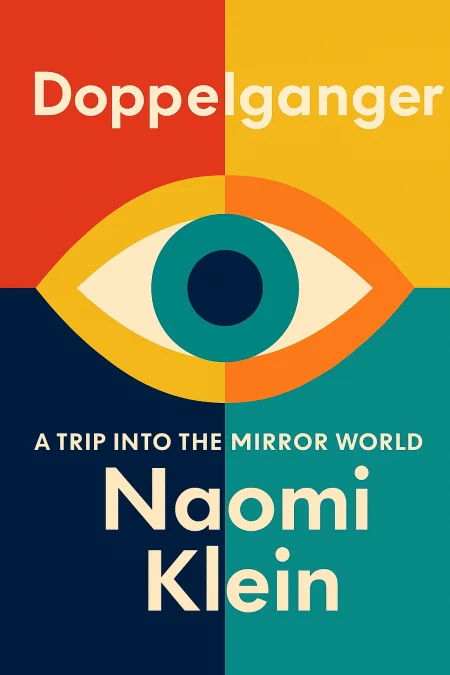
Doppelganger
A Trip into the Mirror World
Book Edition Details
Summary
In a world swirling with digital reflections and ideological doubles, Naomi Klein confronts a peculiar identity crisis: mistaken for Naomi Wolf, a polar opposite in the realm of ideas. This eerie encounter becomes a lens through which Klein examines the fractured landscape of our time—where social media avatars blur reality and conspiracy theories undermine truth. Through a deft mix of memoir and sharp analysis, Klein invites readers on an intellectual odyssey that challenges us to navigate a culture rife with division and duplicity. With wit and wisdom, she explores whether we can shed these disorienting mirrors and strive for a collective politics of care. This isn’t just a story of mistaken identity; it’s a rallying cry for clarity in a chaotic world, daring us to redefine who we are amid the noise.
Introduction
The phenomenon of digital identity confusion has evolved into something far more sinister than mere cases of mistaken recognition online. In our hyperconnected age, the proliferation of digital doubles—carefully curated personas, AI-generated avatars, and ideological mirror images—reveals fundamental fractures in how contemporary societies construct truth, meaning, and collective identity. These doubles function not merely as reflections of ourselves but as weapons in an information war that threatens the very foundations of democratic discourse. The investigation employs a uniquely personal methodology, using individual experiences of identity confusion as a lens through which to examine broader patterns of political manipulation and social fragmentation. This approach reveals how seemingly private struggles with authentic self-expression connect to larger battles over authority, truth, and power in the digital age. The analysis traces the evolution from personal branding culture through conspiracy thinking to far-right political mobilization, demonstrating how each stage builds upon the psychological vulnerabilities created by the previous one. The journey ahead illuminates the sophisticated mechanisms by which legitimate grievances become weaponized, how historical patterns of scapegoating adapt to digital environments, and why individual solutions prove inadequate against systemic manipulation. Understanding these dynamics becomes crucial for anyone seeking to navigate an information landscape where reality itself has become contested terrain, and where the stakes extend far beyond personal confusion to encompass the future of democratic society.
Digital Identity Crisis: How Personal Branding Creates Vulnerable Doubles
The contemporary imperative to function as one's own brand has fundamentally altered the relationship between authentic selfhood and public presentation. Personal branding transforms every aspect of human experience into potential content, forcing individuals to view their own lives through the lens of audience engagement and algorithmic optimization. This commodification creates an inevitable tension between genuine self-expression and the market-driven need for consistent, marketable identity, generating what amounts to our first and most intimate doppelganger—the branded self that must be maintained regardless of personal growth or contradiction. Digital platforms amplify this splitting through algorithmic systems designed to maximize engagement rather than promote authentic communication. The architecture of social media rewards attention-grabbing behavior while punishing nuanced or complex expression, creating feedback loops where digital personas begin to shape offline identities. Users find themselves trapped in performance cycles where the demands of maintaining online relevance influence real-world decision-making, leading to a form of identity fragmentation that mirrors broader social divisions. The psychological toll manifests in various forms of anxiety and disconnection, as individuals must simultaneously maintain authentic relationships while performing for invisible audiences. This split consciousness creates vulnerability to external manipulation, as the gap between person and persona widens to accommodate market demands. When personal brands collide or become confused, the resulting crisis extends beyond embarrassment into questions of ownership, control, and authenticity that reveal the precarious nature of commodified identity. The proliferation of artificial intelligence and deepfake technologies has accelerated these dynamics, making it increasingly difficult to distinguish between authentic human expression and machine-generated content. Political figures now campaign using AI versions of themselves, while grief tech companies promise to create chatbot versions of deceased loved ones. This technological doubling creates conditions where identity confusion becomes not merely possible but inevitable, laying the groundwork for more sophisticated forms of manipulation and control.
The Mirror World: How Conspiracy Culture Weaponizes Legitimate Fears
Conspiracy theories function as alternative epistemological systems that emerge when traditional sources of authority and shared truth break down. The contemporary conspiracy landscape differs markedly from historical precedents in its velocity, reach, and integration with mainstream political discourse. Digital platforms accelerate the spread of conspiratorial thinking while algorithmic recommendation systems create echo chambers that reinforce and radicalize existing beliefs, transforming isolated suspicions into comprehensive alternative realities. The Mirror World operates through a sophisticated process of inversion, where established facts become systematically reversed to create coherent but distorted explanations for complex phenomena. Public health measures become tyranny, scientific consensus becomes manipulation, and democratic institutions become instruments of oppression. This inversion process allows conspiracy theorists to maintain their worldview in the face of contradictory evidence by reinterpreting challenges as confirmation of the conspiracy's power and sophistication. The effectiveness of conspiracy narratives lies not in their factual accuracy but in their emotional resonance with people experiencing genuine powerlessness and institutional abandonment. Concerns about pharmaceutical profiteering, technological surveillance, and government secrecy are entirely rational given documented histories of corporate malfeasance and state overreach. However, these legitimate fears become weaponized through attention economy dynamics that reward increasingly sensational content capable of cutting through information overload. The weaponization process involves taking progressive critiques of power structures and inverting them into reactionary narratives that blame marginalized groups rather than systemic inequalities. Anti-corporate sentiment becomes antisemitic conspiracy theories about global cabals, concerns about surveillance become opposition to public health measures, and environmental awareness becomes ecofascist fantasies about population reduction. This inversion makes it difficult for progressive movements to articulate their own critiques without being associated with extremist positions, effectively neutralizing legitimate opposition to concentrated power.
Historical Patterns: How Projection Politics Enable Authoritarian Movements
The phenomenon of political doubling has deep historical roots, manifesting most clearly in the projection of collective anxieties onto racialized others who serve as repositories for a society's disavowed characteristics. Antisemitic conspiracy theories exemplify this dynamic, consistently portraying Jewish people as simultaneously capitalist and communist, rootless and clannish, weak and dangerously powerful—contradictions that reveal more about the psychological needs of the conspirators than about their targets. These projection patterns create the psychological conditions necessary for systematic persecution while allowing perpetrators to maintain their self-image as defenders of civilization. The colonial project represents perhaps the most systematic deployment of doppelganger politics, where Indigenous populations were simultaneously rendered invisible through legal fictions like terra nullius and hypervisible as obstacles to progress. This double movement of erasure and demonization created the ideological framework necessary for genocide while maintaining colonizers' moral self-conception. The Nazi regime perfected these techniques, applying colonial methods of dehumanization to European populations while positioning themselves as victims defending against existential threats. Contemporary far-right movements employ similar strategies, projecting their own authoritarian tendencies onto democratic institutions, their own violence onto their victims, and their own manipulation of information onto mainstream media. This projection serves multiple psychological and political functions: it provides relief from cognitive dissonance, justifies preemptive aggression against perceived threats, and creates moral frameworks within which extreme actions appear defensive rather than aggressive. The historical pattern reveals that such projection intensifies during periods of social upheaval when existing hierarchies become unstable. The escalation from projection to violence follows predictable patterns that can be interrupted through recognition and collective action. Understanding these dynamics becomes crucial for identifying early warning signs and developing effective responses before doppelganger politics achieves institutional power. The historical record demonstrates that such movements succeed not through popular support but through the fragmentation of opposition and the capture of state apparatus, making early intervention essential for democratic preservation.
Collective Liberation: Why Individual Solutions Cannot Break Mirror World Logic
Escaping the Mirror World requires more than individual enlightenment, fact-checking, or personal brand optimization; it demands structural changes that address the material conditions enabling conspiratorial thinking and the technological infrastructure amplifying it. The solution lies not in perfecting our resistance to misinformation but in building collective alternatives that provide the community, meaning, and agency that conspiracy theories promise but cannot deliver. Individual approaches fail because they cannot address the systemic forces that make conspiratorial thinking psychologically necessary for millions of people. Democratic renewal must begin with recognizing information systems as public goods requiring democratic oversight rather than private commodities to be exploited for profit. This means developing alternative social media platforms governed by community needs rather than engagement metrics, supporting independent journalism that serves public rather than corporate interests, and creating educational systems that teach critical thinking as collaborative rather than individual skill. The privatization of digital infrastructure has created the conditions for manipulation and must be reversed through collective action. The path forward requires embracing what might be called "unselfing"—a deliberate movement away from the hyperindividualism that makes us vulnerable to both personal branding culture and conspiratorial thinking. This involves recognizing our fundamental interdependence, acknowledging collective responsibility for shared problems, and building movements capable of addressing systemic rather than merely personal challenges. The climate crisis, economic inequality, and democratic backsliding require responses that transcend the fragmented, competitive individualism characterizing both neoliberal capitalism and its conspiratorial mirror image. Successful resistance to doppelganger politics has historically emerged through solidarity across difference, through movements that unite people around shared material interests rather than shared identities or beliefs. Breaking free from the Mirror World ultimately means choosing collective liberation over individual optimization, shared truth over private reality, and democratic participation over conspiratorial spectatorship. This transformation requires mass movements that do not yet exist but whose creation becomes increasingly urgent as the stakes of our digital confusion continue to escalate.
Summary
The proliferation of digital doubles reveals profound instabilities in contemporary identity, truth, and community that extend far beyond individual confusion to encompass threats to democratic society itself. Personal branding culture creates psychological vulnerabilities that conspiracy theories exploit, while far-right movements weaponize both phenomena through sophisticated projection techniques with deep historical precedents. The investigation demonstrates that individual solutions prove inadequate against systemic manipulation, requiring instead collective action that addresses the material conditions making conspiratorial thinking psychologically necessary. The choice between the Mirror World and actual reality ultimately depends on our willingness to embrace the messy, imperfect, but ultimately liberating work of building genuine democratic alternatives that prioritize community care over individual optimization, shared truth over private reality, and material solidarity over ideological purity.
Related Books
Download PDF & EPUB
To save this Black List summary for later, download the free PDF and EPUB. You can print it out, or read offline at your convenience.
By Naomi Klein
