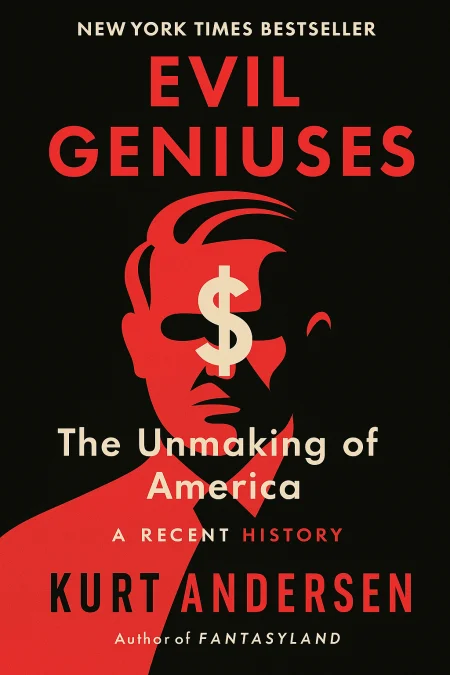
Evil Geniuses
The Unmaking of America: A Recent History
Book Edition Details
Summary
The American Dream once symbolized a rising tide lifting all boats, crafting a nation where prosperity and fairness thrived hand in hand. But the dawn of the 1970s marked a sinister pivot—a calculated siege orchestrated by a ruthless alliance of corporate titans, financial overlords, and ideological extremists. Kurt Andersen, with surgical precision and unflinching candor, dissects this transformation in "Evil Geniuses." Through this compelling narrative, he exposes the deliberate dismantling of the middle class and the enthronement of unchecked greed. From shadowy boardrooms to the corridors of power, Andersen names the architects of America's unraveling, inviting readers to grapple with the stark reality of a nation veering off its course. Dive into this provocative chronicle to unearth the forces that redefined American society, casting a spotlight on the architects of inequality and their enduring impact on the economic landscape.
Introduction
In the summer of 1971, a confidential memo circulated among America's corporate elite that would fundamentally reshape the nation's economic destiny. Written by corporate lawyer Lewis Powell just months before his Supreme Court appointment, this document warned that American capitalism faced an existential crisis from consumer advocates, environmental regulators, and liberal intellectuals. Powell's solution was audacious: launch a coordinated counteroffensive to reclaim political and cultural power through systematic institution-building and ideological warfare. What followed represents one of the most successful political transformations in modern history. Over four decades, a network of wealthy donors, corporate leaders, and conservative intellectuals methodically dismantled the post-New Deal consensus that had created widespread prosperity. They replaced it with an economic system designed to concentrate wealth upward while leaving most Americans economically insecure and politically powerless. This wasn't the result of natural market forces or inevitable technological change, but rather a deliberate campaign to rewrite the rules of American capitalism. Understanding this history is essential for anyone seeking to comprehend how we arrived at today's extreme inequality and corporate dominance. The story reveals both the fragility of democratic institutions and the possibility of fundamental change, offering crucial lessons for those who believe that a more equitable economic system remains both necessary and achievable in the 21st century.
The Powell Memo and Business Counter-Attack (1970s)
The early 1970s marked a pivotal moment when American business leaders felt under siege despite healthy corporate profits. Environmental regulations were multiplying, consumer advocates like Ralph Nader were exposing corporate malfeasance, and public trust in big business had plummeted from 70 percent in 1968 to just 33 percent by 1970. The cultural upheavals of the 1960s had created a climate where questioning corporate authority seemed not just acceptable but patriotic. Lewis Powell's August 1971 memo to the U.S. Chamber of Commerce diagnosed the problem with surgical precision: American business was losing the war of ideas. Universities, media outlets, and government agencies were providing platforms for critics of the free enterprise system while business leaders remained passive and disorganized. Powell's solution was equally clear: business needed to organize, fund, and fight back with unprecedented coordination and sustained commitment over many years. The memo outlined a comprehensive four-front strategy spanning academia, media, politics, and the legal system. Business leaders needed to identify and fund scholars who believed in free enterprise, create new institutions to generate pro-business research and commentary, cultivate political power more aggressively, and develop legal strategies to advance corporate interests through the courts. Most importantly, Powell argued, this effort required the same intensity and long-term thinking that characterized their opponents. The response was swift and transformative. Within months, business leaders began creating the institutional infrastructure that would reshape American politics for decades. The American Enterprise Institute expanded rapidly, new think tanks like the Heritage Foundation emerged, and corporate political action committees multiplied from 89 in 1974 to over 1,200 by 1980. What began as a defensive reaction to 1960s liberalism evolved into an offensive campaign that would fundamentally alter the balance of power in American society.
Reagan's Revolution: Deregulation and Supply-Side Economics (1980s)
Ronald Reagan's 1980 election provided the perfect political vehicle for implementing the corporate counter-revolution that had been building throughout the previous decade. Reagan himself was no mere puppet of business interests, but rather a true believer in free-market ideology who had spent decades absorbing and articulating conservative economic principles. His sunny optimism and nostalgic appeal to American greatness provided ideal packaging for policies that might otherwise have seemed harsh or unfair to ordinary Americans. The centerpiece of Reagan's economic program was supply-side economics, a theory promising something for nothing: massive tax cuts for the wealthy and corporations that would supposedly generate so much economic growth that everyone would benefit. The theory's intellectual architect, economist Arthur Laffer, claimed that lower tax rates would actually increase tax revenues by unleashing entrepreneurial energy. This "Laffer Curve" became gospel among Reagan's advisors, despite widespread skepticism from mainstream economists who recognized it as dressed-up traditional Republican tax-cutting. The implementation proved devastating for the federal government's ability to fund public services and investments. The top marginal tax rate fell from 70 percent to 28 percent, while corporate tax rates were slashed even more dramatically. Meanwhile, Reagan's budget director David Stockman privately admitted that supply-side economics was merely a "Trojan horse" designed to reduce taxes on the wealthy. The promised economic growth materialized, but its benefits flowed overwhelmingly to those at the top of the income distribution. Deregulation proceeded with equal fervor across multiple industries. Airlines, telecommunications, banking, and other sectors saw decades of consumer and worker protections dismantled in the name of efficiency and competition. While some deregulation produced genuine benefits, much of it simply transferred wealth from ordinary Americans to corporate shareholders and executives. The crushing of the air traffic controllers' strike in 1981 sent a clear message that government would no longer protect workers' rights, setting the stage for the financialization that would dominate the following decades.
Wall Street's Conquest: Financialization and Shareholder Capitalism (1990s-2000s)
The 1990s and 2000s witnessed Wall Street's complete conquest of the American economy. What had begun as a service industry helping businesses raise capital and manage risk evolved into the dominant force shaping corporate behavior and economic policy. This transformation, known as financialization, fundamentally altered how American capitalism operated, prioritizing short-term financial returns over long-term productive investment and shared prosperity. The intellectual foundation for this shift was the "shareholder value" movement, which held that corporations existed solely to maximize returns to shareholders. This seemingly reasonable principle had radical implications when combined with new financial instruments and compensation structures. Corporate executives, now paid primarily in stock options, had powerful incentives to boost share prices by any means necessary, including massive layoffs, aggressive cost-cutting, and financial engineering that added little real value to the broader economy. Wall Street developed increasingly sophisticated and risky financial products that promised high returns while obscuring their true dangers. Derivatives markets exploded in size and complexity, creating a shadow banking system that operated with minimal oversight. The repeal of Depression-era banking regulations, most notably the Glass-Steagall Act, allowed commercial and investment banking to merge, creating financial behemoths that were both too big to fail and too complex to regulate effectively. The consequences of financialization extended far beyond Wall Street itself. Manufacturing companies found it more profitable to engage in financial speculation than to invest in new factories or research and development. Private equity firms used massive amounts of borrowed money to acquire companies, strip their assets, and leave workers and communities to deal with the aftermath. The American economy increasingly resembled a casino where the house always won, and the house was located in Manhattan, fundamentally transforming the relationship between capital and labor that had governed American prosperity since the New Deal.
The New Gilded Age: Corporate Power Consolidation (2010s-Present)
By the early 21st century, the transformation of American capitalism appeared complete and seemingly irreversible. The institutions, legal frameworks, and cultural norms that had once ensured broadly shared prosperity had been systematically dismantled and replaced with structures that channeled wealth upward with unprecedented efficiency. What had begun as a defensive reaction to 1960s liberalism had evolved into a comprehensive reengineering of American society that concentrated both economic and political power in fewer hands than at any time since the original Gilded Age. The statistics tell a stark story of this transformation's completion. From 1980 to 2020, the share of national income going to the top 1 percent doubled, while the bottom 50 percent saw their share cut nearly in half. CEO compensation rose from 20 times the average worker's pay to over 300 times, while social mobility declined dramatically, making it harder for Americans to rise above the economic circumstances of their birth. The American Dream, once a realistic aspiration for most families, became increasingly hollow for all but the most fortunate. This new economic order was sustained by a powerful ideological apparatus that portrayed extreme inequality as natural and inevitable. Conservative think tanks, funded by billionaire donors like the Koch brothers, produced a steady stream of research justifying low taxes on the wealthy and minimal regulation of business. Media outlets owned by corporate conglomerates amplified these messages, while universities dependent on wealthy donors found it difficult to support research that challenged the new orthodoxy. The Supreme Court, packed with conservative justices trained in law and economics programs, consistently ruled in favor of corporate interests. Perhaps most remarkably, this transformation occurred during a period of unprecedented technological progress and economic growth. The productivity gains from computers, the internet, and other innovations could have been shared broadly, lifting living standards for all Americans as had happened in previous eras of technological advancement. Instead, these gains were captured primarily by those who owned capital rather than those who provided labor, demonstrating that the concentration of wealth was a political choice rather than an inevitable consequence of technological change.
Summary
The story of America's transformation from shared prosperity to extreme inequality reveals how determined elites can reshape an entire society's economic arrangements within just a few decades through sustained, coordinated action. What began with Lewis Powell's memo in 1971 evolved into a comprehensive campaign that changed not just policies but the fundamental assumptions underlying American capitalism, demonstrating both the power of ideas and the importance of long-term institutional building in achieving lasting political change. The historical parallel with the original Gilded Age of the late 19th century is instructive but not deterministic. Just as that era of extreme inequality eventually gave way to Progressive Era reforms and New Deal policies, the current concentration of wealth and power need not be permanent. However, meaningful change will require the same kind of strategic thinking and institutional building that characterized the conservative counter-revolution, recognizing that simply winning elections or passing individual policies will not be sufficient to restore broadly shared prosperity. The path forward demands rebuilding the countervailing institutions that once balanced corporate power: strong labor unions, aggressive antitrust enforcement, progressive taxation, and robust public investment in education, infrastructure, and research. It also requires a cultural shift away from the celebration of extreme wealth toward a renewed commitment to the common good. Most importantly, it requires recognizing that economic arrangements are political choices, not natural laws, and that different choices remain possible for those willing to organize and fight for them with the same determination that corporate elites have shown over the past four decades.
Related Books
Download PDF & EPUB
To save this Black List summary for later, download the free PDF and EPUB. You can print it out, or read offline at your convenience.
By Kurt Andersen
