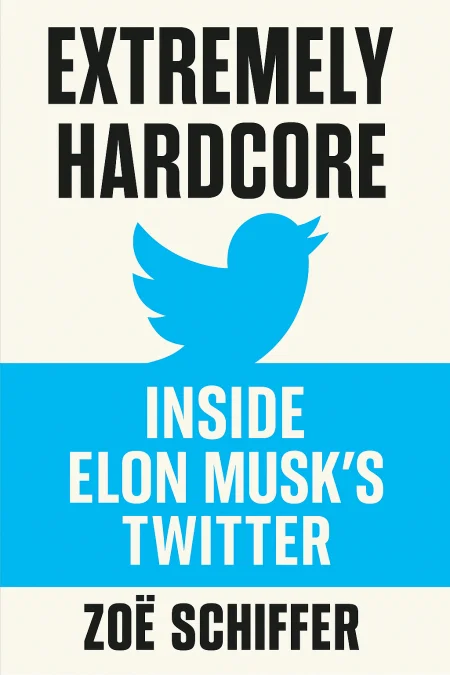
Extremely Hardcore
Inside Elon Musk's Twitter
Book Edition Details
Summary
Chaos ensues as Elon Musk's audacious acquisition of Twitter unfolds, revealing a tempest of ambition, rebellion, and shattered dreams. In "Extremely Hardcore," witness the tumultuous transformation of a digital empire under the iron-fisted visionary who revolutionized Tesla and SpaceX. This gripping narrative, woven from insider accounts and explosive revelations, chronicles the meteoric rise and calamitous descent of Twitter 2.0. Employees' voices echo through the pages, sharing stories of betrayal, resistance, and the clash of ideals as Musk's controversial leadership style turns their world upside down. At the heart of this saga lies a compelling exploration of power dynamics, the fight for free speech, and the human cost of innovation. A visceral, eye-opening account that delves into the soul of Silicon Valley's most sensational drama, it captures the essence of a new age where tech titans hold the keys to our collective future.
Introduction
In October 2022, the world witnessed one of the most dramatic corporate transformations in Silicon Valley history when Elon Musk walked into Twitter headquarters carrying a kitchen sink, symbolically announcing his intention to overhaul everything about the platform. What followed was a real-time experiment in how a single individual's vision could reshape global communication infrastructure overnight, revealing fundamental questions about power, free speech, and democratic discourse in the digital age. This extraordinary period exposes the fragile nature of platforms we've come to view as permanent fixtures of modern life. It demonstrates how quickly essential digital infrastructure can be destabilized when subjected to ideological experimentation without institutional safeguards. The transformation reveals the human cost of treating employees as expendable resources and the broader implications of concentrating communicative power in the hands of a single individual, regardless of their wealth or stated intentions. For business leaders grappling with corporate governance, policymakers concerned about digital regulation, and citizens who depend on social media for news and community, this saga provides essential insights into the intersection of technology and democracy. It serves as both a cautionary tale about unchecked authority and a revealing examination of what happens when Silicon Valley's "move fast and break things" mentality collides with the complex realities of global communication platforms.
The $44 Billion Gamble: Acquisition and Ideological Vision (2022)
The seeds of Twitter's transformation were planted long before Musk's theatrical entrance. By early 2022, he had grown increasingly frustrated with what he perceived as the platform's systematic bias against conservative voices, particularly following Twitter's decision to permanently suspend Donald Trump after the January 6 Capitol riots. His criticism wasn't merely philosophical but deeply personal, stemming from his belief that a "woke mind virus" was threatening civilization itself and needed to be stopped through the restoration of "free speech absolutism." Musk's path to ownership was characteristically impulsive and legally fraught. After quietly accumulating a significant stake in the company, he made an offer of $54.20 per share, valuing Twitter at $44 billion. When the reality of the purchase set in, he attempted to back out, citing concerns about bot accounts that he had previously dismissed. The Delaware Chancery Court's insistence that he honor his contractual obligations ultimately forced his hand, but by then, his public attacks on Twitter's leadership had already poisoned the well for any collaborative transition. The acquisition represented far more than a business transaction; it was an ideological statement about the future of digital communication. Musk's willingness to overpay by an estimated $20 billion demonstrated his conviction that controlling this particular platform was worth almost any price. His vision promised to transform Twitter from what he saw as a censorious liberal echo chamber into a true digital town square where all legal speech could flourish without corporate interference. This phase established a crucial pattern that would define Musk's entire tenure: the subordination of institutional knowledge and collaborative decision-making to his personal vision and impulses. The acquisition wasn't just a change of ownership but the beginning of a fundamental reimagining of how social media platforms could and should operate, setting the stage for the chaos that would follow.
Organizational Shock Therapy: Mass Layoffs and Platform Chaos (Late 2022)
Within days of closing the deal, Musk initiated what can only be described as organizational shock therapy. His first major decision was to lay off approximately 3,700 employees, roughly half of Twitter's workforce, in a single night. The process was so hastily executed that critical institutional knowledge walked out the door, including engineers who knew essential passwords and systems administrators responsible for keeping the platform stable during peak traffic periods. The layoffs weren't surgical strikes targeting inefficiency but rather broad cuts that decimated entire departments. The trust and safety team, responsible for content moderation, lost significant staff just as Musk was promising to loosen content restrictions. The infrastructure team was cut in half, leaving skeleton crews to maintain systems serving hundreds of millions of users. Most tellingly, Musk eliminated nearly everyone who understood Twitter's complex microservices architecture, creating immediate operational vulnerabilities that would plague the platform for months. Musk's management philosophy during this period can be summarized by his demand for "extremely hardcore" commitment from remaining employees. His November ultimatum requiring workers to commit to long hours and high intensity or accept severance resulted in nearly 1,000 additional departures. The company that once employed 7,500 people was suddenly operating with fewer than 2,700, while simultaneously attempting to launch new features and maintain global operations across multiple time zones. The immediate aftermath was chaotic and revealing. Critical systems began failing, verification badges became meaningless overnight, and impersonators flooded the platform with fake accounts posing as major brands. The human cost was immense, but it also revealed something crucial about modern tech platforms: they're far more fragile than they appear. Twitter's continued operation during this period was less a testament to Musk's efficiency than to the dedication of remaining employees who worked around the clock to prevent total collapse.
The Main Character Era: Algorithm Manipulation and Personal Vendettas (2023)
By early 2023, Musk's transformation of Twitter had devolved into a personal obsession with his own engagement metrics and public image. The revelation that he had ordered engineers to artificially boost his tweets after his Super Bowl post performed worse than President Biden's marked a new low in platform manipulation. This incident crystallized how Musk's ownership had turned Twitter into a vehicle for his personal brand rather than a neutral public communication utility. The technical implementation of Musk's ego-driven demands revealed the extent to which Twitter's infrastructure had been subordinated to his whims. Engineers created "VIP user" lists and modified core algorithms to ensure Musk's content appeared prominently in users' feeds, regardless of their preferences or interests. The irony was stark: the man who had criticized Twitter's previous leadership for alleged bias was now explicitly rigging the system in his favor, while simultaneously claiming to champion algorithmic transparency. This period also witnessed the systematic dismantling of expertise and institutional safeguards. Musk's public feuds with journalists, former employees, and critics played out in real-time, often resulting in suspensions or reduced visibility for those who challenged him. The "Twitter Files" releases, while framed as transparency initiatives, often misrepresented internal communications and put individual employees at risk of harassment. Safety experts who warned about harmful content were marginalized, and institutional knowledge built over years was discarded in favor of Musk's intuition. The platform's relationship with truth became increasingly strained as Musk promoted conspiracy theories and used his algorithmic control to amplify preferred narratives. The line between platform governance and personal revenge blurred beyond recognition, creating an environment where fear replaced professional judgment and where the global town square had become primarily a vehicle for one man's need for attention and ideological validation.
Death of the Bird: From Twitter to X Corporation (2023)
The final transformation came in July 2023, when Musk literally tore down the iconic Twitter bird logo and replaced it with an X, symbolically killing one of the internet's most recognizable brands. This wasn't merely cosmetic rebranding; it represented the complete abandonment of Twitter's original mission in favor of Musk's long-held dream of creating an "everything app" modeled after China's WeChat, where users could message, shop, bank, and consume media all within a single platform. The rebrand coincided with increasingly erratic platform decisions that seemed designed to extract revenue while alienating the very communities that had made Twitter valuable. Rate limits prevented users from reading tweets, the elimination of free API access killed countless research projects and public service bots, and the implementation of paid verification transformed the blue checkmark from a symbol of authenticity into a marker of financial support for Musk's vision. Under the X banner, the platform's content policies shifted dramatically in ways that contradicted Musk's stated principles. His promise of free speech absolutism proved highly selective, applying mainly to previously banned right-wing voices while maintaining or even expanding restrictions on others. The platform began complying with authoritarian government requests at higher rates than before, contradicting claims about supporting free expression globally and revealing the hollow nature of his free speech rhetoric. The human cost of this transformation extended far beyond Twitter's walls. Former employees faced delayed severance payments and legal battles, while users watched their digital communities fragment and disperse to alternative platforms. The service that had once facilitated everything from the Arab Spring to real-time disaster response became unreliable, its credibility undermined by its owner's personal agenda and erratic decision-making. The death of the bird represented not just the end of a brand, but the destruction of a digital commons that had served as essential infrastructure for global communication and democratic discourse.
Summary
The transformation from Twitter to X reveals a fundamental tension in our digital age: the conflict between private ownership and public utility when essential communication infrastructure is controlled by individual billionaires. What began as Elon Musk's vision of free speech absolutism became a cautionary tale about the concentration of communicative power in the hands of a single individual, demonstrating how quickly democratic discourse can be destabilized when subjected to personal whims rather than institutional safeguards. The saga exposes the fragile nature of platforms we've come to view as permanent fixtures of modern life. Musk's approach of treating a global communication platform as a personal project resulted in the degradation of systems that millions relied upon for news, community, and democratic participation. The human cost, measured in destroyed careers, fragmented communities, and diminished public trust, far exceeded any theoretical benefits of his reforms. The story reveals that true free speech requires not just the absence of censorship, but the presence of reliable, trustworthy institutions that serve the public interest rather than personal agendas. For the future, this transformation offers crucial lessons about digital governance and accountability that extend far beyond social media. Democratic societies must develop robust regulatory frameworks that prevent critical communication infrastructure from being subject to the arbitrary decisions of individual owners, regardless of their wealth or stated intentions. We need institutional safeguards that protect both free expression and public safety, while ensuring that platforms serving hundreds of millions cannot be casually dismantled by their proprietors. Most importantly, we must recognize that in an interconnected world, the governance of digital spaces is too important to be left to the unchecked authority of tech billionaires, no matter how visionary they may appear in other domains.
Related Books
Download PDF & EPUB
To save this Black List summary for later, download the free PDF and EPUB. You can print it out, or read offline at your convenience.
By Zoë Schiffer
