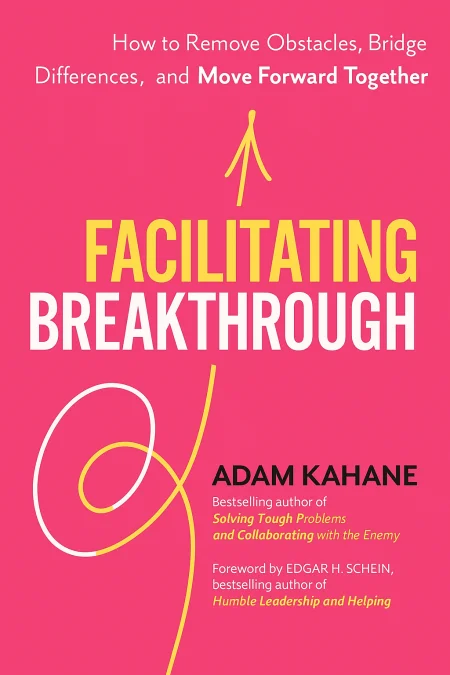
Facilitating Breakthrough
How to Remove Obstacles, Bridge Differences, and Move Forward Together
Book Edition Details
Summary
When faced with the tangled web of complex challenges, traditional methods of collaboration often fall short, leaving participants adrift and yearning for genuine progress. Enter "Facilitating Breakthrough," a revolutionary guide that reshapes how we approach facilitation itself. This book unveils the art of transformative facilitation, a dynamic dance between directive leadership and supportive guidance. It’s about clearing the path for authentic connection and contribution, allowing groups to transcend barriers and achieve collective breakthroughs. Ideal for facilitators, managers, coaches, and anyone striving to foster meaningful collaboration, this work offers a bold vision of empowerment through nuanced facilitation, promising to transform how we solve the unsolvable.
Introduction
Picture yourself in a sunlit courtyard of a small Colombian hotel, where the impossible is quietly unfolding. A former guerrilla commander extends his hand to a wealthy businesswoman, their greeting surprisingly warm and familiar. When asked how they know each other, she explains simply: "We met when I brought him the money to ransom a man who had been kidnapped by his soldiers." The guerrilla adds with quiet conviction: "The reason we're at this meeting is so that no one will have to do such things again." This extraordinary moment captures the essence of what happens when people discover they can work together to transform even the most entrenched conflicts. Across the world, in boardrooms and community centers, government offices and nonprofit organizations, groups are discovering that there's a third way beyond either forcing others to comply or simply walking away from difficult situations. They're learning that by removing the obstacles to genuine collaboration, breakthrough becomes not just possible, but inevitable. The stories and insights that follow reveal how this transformation happens. Through real accounts from Colombia to Canada, from corporate strategy sessions to peace negotiations, we'll explore how skilled facilitation can help any group move from stuckness to flow, from conflict to creative partnership. These aren't just techniques or methodologies, but a fundamentally different approach to working together—one that honors both individual contribution and collective wisdom, creating space for something truly remarkable to emerge.
Breaking Through in Colombia: From Guerrillas to Governance
The workshop had been months in the planning, yet nothing could have prepared the facilitation team for what unfolded on that first morning. Thirty-three leaders from across Colombia's fractured landscape sat in a circle, their differences as stark as their shared commitment to change. Politicians who had spent careers as adversaries, business leaders and former guerrilla commanders, Indigenous activists and army generals—all brought together by the audacious hope that dialogue might succeed where decades of violence had failed. Francisco de Roux, the Jesuit priest who would later lead Colombia's Truth Commission, had traveled from the capital specifically to observe this unprecedented gathering. As the first day progressed, he watched the facilitators guide the participants through carefully crafted conversations, each designed to lower barriers and open possibilities. People who had never been in the same room began sharing their deepest concerns about their country's future. Stories emerged that humanized enemies, revealing the fears and dreams that lay beneath ideological differences. By evening, something extraordinary had happened. The tension that had filled the room that morning had transformed into something else entirely. As participants prepared to leave for dinner, de Roux approached the lead facilitator with barely contained excitement. "Now I see what you are doing!" he exclaimed. "You are removing the obstacles to the expression of the mystery!" His words captured something profound about the nature of transformation itself—that breakthrough often comes not from forcing new realities into being, but from clearing away what prevents them from naturally emerging. This Colombian experience illuminates a fundamental truth about human collaboration: when we create the right conditions, people's innate wisdom and capacity for connection can overcome even the deepest divisions. The facilitator's role becomes not one of manipulation or control, but of careful attention to what blocks genuine engagement and the patient work of removing those barriers, one conversation at a time.
Beyond Vertical and Horizontal: The Dance of Facilitation
The tension became apparent immediately in that first workshop in Mexico. The facilitation team had mapped out what they believed was a perfect agenda—a sophisticated blend of large group conversations and intimate learning journeys designed to help thirty-three national leaders find ways to address their country's crisis of illegality, insecurity, and inequity. But by the second day, confusion and frustration rippled through the group as participants struggled with unfamiliar processes and mounting pressure. When the facilitation team huddled over dinner to redesign the next day's agenda, one of the Mexican organizers erupted in frustration: "You don't know what you're doing! You are just improvising!" Her words exposed the fundamental dilemma that lies at the heart of all collaborative work. Should facilitators stick rigidly to their expert-designed plan, maintaining the authority that comes with having "the right answer"? Or should they respond fluidly to what's actually happening, trusting the group's wisdom even when it leads into uncertainty? What emerged from that heated discussion was a deeper understanding of facilitation as a dynamic dance between structure and responsiveness. Sometimes groups need clear direction and expert guidance to move forward. Other times, they need space to find their own way, with facilitators stepping back to support rather than lead. The art lies not in choosing one approach over the other, but in sensing moment by moment which is needed and having the courage to shift fluidly between them. Over the five years that followed, the Mexican group continued to grapple with this same tension on project after project. They learned that breakthrough comes not from finding the perfect balance, but from developing the capacity to cycle gracefully between different modes of working together. Like skilled dancers, they discovered they could maintain their connection and forward momentum even as they shifted from leading to following and back again, always staying attuned to the music of the moment.
Love, Power, and Justice: The Hidden Forces of Transformation
The earthquake struck Mexico City on a Tuesday afternoon, its devastating power cracking not only buildings but also the usual ways of working together. Within minutes of the tremors stopping, messages began flowing through the WhatsApp channels of two different groups that had been working on issues of security and inequality. Both teams sprang into action, but their responses revealed something profound about the nature of collaborative relationships. The newer team, formed just two months earlier, focused their energy on blame and criticism. Their messages dissected which politicians had responded inadequately, which departments had failed in their coordination, whose corruption had led to building collapses. Their outrage was justified, their analysis sharp, but their capacity for collective action remained limited by their focus on what others should have done differently. The older team, despite having worked together for two years without resolving their fundamental ideological differences, immediately began coordinating concrete help. Someone was organizing supply deliveries to affected areas and needed a contact person. Another had medical connections and was arranging emergency care. A third was mobilizing neighborhood networks to check on vulnerable residents. Their deep political disagreements hadn't disappeared, but something else had grown alongside them—a web of relationships strong enough to support effective action even in crisis. This contrast reveals the deeper currents that flow beneath all successful collaboration. Beyond the techniques and methodologies lies a more fundamental transformation that occurs when people learn to work with three essential forces. Love—the drive toward connection and unity that enables us to see beyond our immediate self-interest. Power—the drive toward self-realization that ensures everyone's voice and contribution matters. And justice—the structure that ensures love and power flow equitably, creating space for all to contribute and benefit. When groups learn to engage all three forces simultaneously, they develop the resilience to act together even when the ground beneath them literally shakes.
Summary
These stories from around the world reveal a profound truth about human potential: that even in our most divided and challenging times, breakthrough remains possible. When skilled facilitators help groups remove the obstacles to genuine collaboration—the barriers that prevent people from contributing their gifts, connecting across differences, and working together equitably—something remarkable consistently emerges. Groups discover they can address challenges they could never tackle alone, creating solutions that honor both individual wisdom and collective insight. The path forward requires cultivating a new kind of leadership—one that serves not by having all the answers, but by creating conditions where breakthrough can naturally occur. It asks us to develop the courage to stay present with conflict and complexity rather than rushing to premature solutions. Most importantly, it invites us to trust in the fundamental human capacity for transformation when love, power, and justice are allowed to flow freely together. In a world facing unprecedented challenges that no single person or organization can solve alone, these insights offer both hope and practical guidance. They remind us that we already possess the most essential tool for creating positive change: our ability to work together in ways that bring out the best in everyone involved. The mystery isn't whether transformation is possible, but whether we'll have the wisdom and courage to remove whatever obstacles stand in its way.
Related Books
Download PDF & EPUB
To save this Black List summary for later, download the free PDF and EPUB. You can print it out, or read offline at your convenience.
By Adam Kahane
