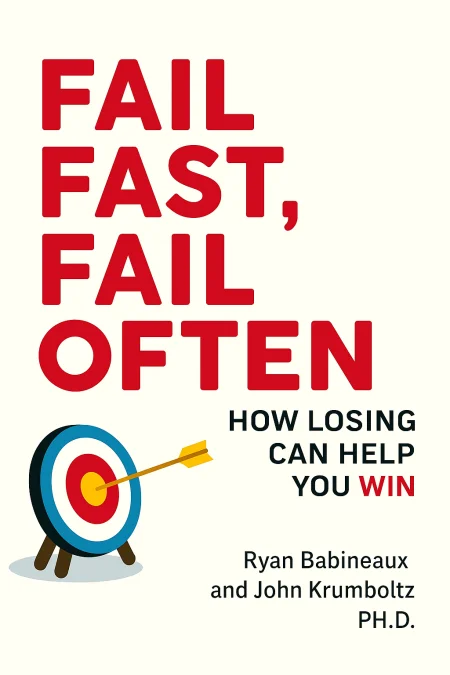
Fail Fast, Fail Often
How Losing Can Help You Win
byRyan Babineaux, John Krumboltz
Book Edition Details
Summary
In the whirlwind of modern ambition, the art of stumbling is celebrated in Ryan Babineaux and John Krumboltz's invigorating manifesto, "Fail Fast, Fail Often." These visionary psychologists and career guides from Stanford University argue that the greatest error is not daring to err at all. Their groundbreaking insights reveal that true joy and achievement arise not from meticulous planning but from the bravery to leap into the unknown. This book is your invitation to dance with uncertainty, embrace every mishap as a stepping stone, and harness the power of missteps to unlock unexpected doors. Shed the shackles of fear, meet the world with fervor, and discover a life rich with unplanned victories and serendipitous connections.
Introduction
Picture Sarah, a talented marketing executive who spent three years meticulously planning her dream business venture. She researched every angle, analyzed countless market reports, and crafted the perfect five-year strategy. Yet when the moment came to take action, she found herself paralyzed by doubt. Meanwhile, her colleague Jake launched his startup with nothing more than a rough prototype and boundless enthusiasm. While Sarah remained stuck in planning mode, Jake was already learning from real customers, adapting his approach, and building momentum through trial and error. This stark contrast illuminates a fundamental truth about success that challenges everything we've been taught about achievement. We live in a culture obsessed with getting things right the first time, avoiding mistakes at all costs, and waiting until we feel completely prepared before taking action. But what if this approach is actually sabotaging our dreams? What if the very failures we desperately try to avoid are the key ingredients for creating an extraordinary life? The reality is that our most meaningful accomplishments rarely emerge from flawless execution or perfect planning. Instead, they arise from our willingness to embrace uncertainty, learn from setbacks, and take action despite our fears. The pages ahead will transform how you think about failure, turning it from something to be avoided into a powerful tool for discovery and growth. You'll discover how quick experimentation beats lengthy preparation, how small steps create extraordinary outcomes, and how building the right community can accelerate your journey toward fulfillment.
The Happiness Tipping Point: Finding Joy Through Action
Madison walked into her counselor's office carrying the weight of three years spent in legal analysis, her voice monotone as she described her mounting job stress. Her new manager had announced his intention to eliminate "deadwood" from the department, creating an atmosphere of fear that left her questioning everything about her career path. Though she had planned to attend law school, the prospect felt more like a burden than a dream. Her evenings were consumed by exhaustion and dread, particularly when she thought about studying for the LSAT exam that loomed ahead. The breakthrough came when her counselor suggested something unexpected: take a three-month sabbatical from worrying about the LSAT and focus entirely on doing things that brought her genuine joy. Madison's face transformed as she recalled her passion for acting, describing her college drama experiences with animation and humor that revealed the vibrant person hidden beneath her professional facade. Within a week, she had organized an informal drama group at work, sending out an email that drew four colleagues to her home for their first meeting. That single evening of "big-smile, unadulterated fun" became the catalyst for Madison's complete transformation. The joy she rediscovered through acting gave her the clarity to see how unfulfilling her legal work had become and the energy to explore new possibilities. She ultimately found her calling as a manager of student engagement at a software company, where she could express her natural enthusiasm while making a meaningful impact on students' lives. Madison's story reveals a profound truth about human psychology: positive emotions don't just make us feel good, they fundamentally change how we think and perceive opportunities. Research shows that when we experience joy, appreciation, and enthusiasm, we become more creative, more open to possibilities, and more likely to spot the very opportunities that can transform our lives. The happiness we experience today literally creates the insights and connections that appear tomorrow.
Failing Forward: Learning Through Quick Experimentation
In a ceramics classroom, an instructor divided students into two groups for an unusual experiment. The first group would be graded solely on the quantity of pottery they produced fifty pounds earned an A, forty pounds a B. The second group faced a different challenge: their entire grade would rest on creating one perfect pot. They could spend the entire semester crafting this single piece, but it had to be flawless to earn top marks. When grading time arrived, the results defied conventional wisdom. The quantity group, who had been churning out pot after pot without worrying about perfection, had created the most beautiful and technically sophisticated work. Through constant experimentation and rapid iteration, they had learned from each mistake, developed their skills, and discovered techniques that the quality-focused group never encountered. Meanwhile, the students obsessing over perfection had produced carefully planned but ultimately inferior work. This experiment captures the essence of how real mastery develops in the world beyond the classroom. Howard Schultz's creation of Starbucks began with an Italian coffee shop concept that bore little resemblance to today's familiar stores. The original locations featured bow-tied baristas, Italian-only menus, opera music, no seating, and a strict no-nonfat-milk policy. Every element that defines modern Starbucks emerged through thousands of small experiments, adjustments, and yes, failures along the way. The most successful people in any field share a counterintuitive secret: they deliberately seek out opportunities to perform badly. Rather than waiting until they feel ready or trying to avoid mistakes, they actively pursue situations that will stretch their abilities and expose their limitations. They understand that the discomfort of failure is temporary, but the insights gained from rapid experimentation compound over time, creating the foundation for extraordinary achievement.
Small Wins and Bold Moves: Building Success Incrementally
Allan stood shocked in a department store, staring at his reflection in a display case and barely recognizing the overweight man wearing his distinctive blue conference t-shirt. That moment of brutal honesty sparked an ambitious plan: within one year, he would lose thirty pounds and complete his first marathon. He bought a three-year gym membership, invested in high-tech running gear, and created an intensive workout schedule that would transform his body and his life. Two weeks later, Allan's grand plan lay in ruins. His exhausted body ached from head to toe, the scale showed he had gained weight, and the overwhelming scope of his goal felt impossible to maintain alongside his demanding work schedule. He took a break that stretched from weeks to months, eventually canceling his expensive gym membership without ever returning. His big, audacious goal had paralyzed him into complete inaction. Contrast Allan's experience with that of Tom Fatjo, who accidentally built a billion-dollar waste management empire by starting with a single garbage truck. When an obnoxious neighbor challenged him to become their "garbageman," Fatjo took the dare seriously but began small. His calculations were wrong, his first truck was too small, and he found himself literally sinking into garbage up to his armpits when equipment failed. But each problem taught him something new about the industry. What began as a side investment to serve one housing community grew incrementally into BFI, a company with $256 million in annual revenue and operations in 131 cities. Fatjo's success came not from planning a massive enterprise but from taking one small, manageable step and then building on what he learned. Each small win opened new possibilities, attracted new resources, and revealed opportunities that no amount of advance planning could have predicted. The power of small wins lies not in their individual impact but in their ability to create momentum and reveal unexpected pathways. When we break complex challenges into manageable pieces, we maintain motivation through regular progress, reduce the risk of any single decision, and stay flexible enough to adapt as new information emerges.
Community and Innovation: Creating Your Support Network
Sheila had spent a year trapped in analysis paralysis, desperately wanting to leave her high-stress corporate architecture job but unable to find a viable specialty for her own practice. Every niche she explored seemed saturated with established competitors. Historical renovations, school design, residential work—all the obvious paths appeared blocked by firms with decades of experience and established client relationships. The breakthrough came not from more research or better planning, but from a spontaneous lunch with an old college friend. This friend happened to be a commercial broker struggling to close a deal because the buyer was ready to walk away from a building purchase. The space had an awkward layout that seemed to eliminate four hundred square feet of usable area, making it unsuitable for the medical clinic the buyer wanted to create. When Sheila offered to look at the space for free, she wasn't seeking her career destiny—she was simply helping a friend. But during that walk-through, she discovered both a solution to the buyer's problem and her own professional calling. Her suggestions not only saved the deal but earned her the contract to design the clinic. That single project led to referrals for more medical facilities, eventually allowing Sheila to leave corporate life and build a thriving practice designing healthcare spaces. Sheila's story illustrates a profound truth about innovation and opportunity: our best ideas rarely emerge from isolation and analysis. Instead, they arise through unexpected conversations, chance encounters, and diverse perspectives that we could never have planned for. The person sitting next to you at a conference, the neighbor you chat with while walking your dog, or the friend you haven't seen in months may be carrying exactly the insight or connection that transforms your life. Research confirms what Sheila experienced firsthand: innovation functions as an import-export business where ideas mundane in one context become revolutionary breakthroughs in another. The most successful people deliberately cultivate diverse relationships not to "network" for personal gain, but to expose themselves to different ways of thinking and unexpected possibilities that expand their own creative potential.
Summary
The stories woven throughout these pages reveal a startling paradox: in our quest to avoid failure, we often guarantee it. While we wait for perfect conditions, complete preparation, and guaranteed outcomes, life's most extraordinary opportunities slip past unnoticed. Madison discovered her calling not through careful career planning but by following her joy back to the drama group that reignited her spirit. The ceramics students achieved mastery not by pursuing perfection but by embracing the messy process of constant experimentation. True success emerges from a willingness to act despite uncertainty, to learn through doing rather than extensive planning, and to view every setback as valuable data rather than personal defeat. The path forward requires a fundamental shift in perspective: from seeing failure as something to avoid to recognizing it as the fastest route to discovery and growth. When we fail fast and fail often, we compress years of learning into months, turn dead ends into new directions, and transform fear into fuel for achievement. The invitation before you is both simple and revolutionary: start before you feel ready, embrace the discomfort of not knowing, and trust that action creates clarity far more effectively than analysis. Your dreams are not waiting for you to become perfect—they are waiting for you to begin. Every small step taken in uncertainty, every lesson learned from failure, and every connection made with fellow travelers on the journey brings you closer to a life of meaning, impact, and authentic fulfillment. The time for preparation has passed; the moment for action has arrived.
Related Books
Download PDF & EPUB
To save this Black List summary for later, download the free PDF and EPUB. You can print it out, or read offline at your convenience.
By Ryan Babineaux
