
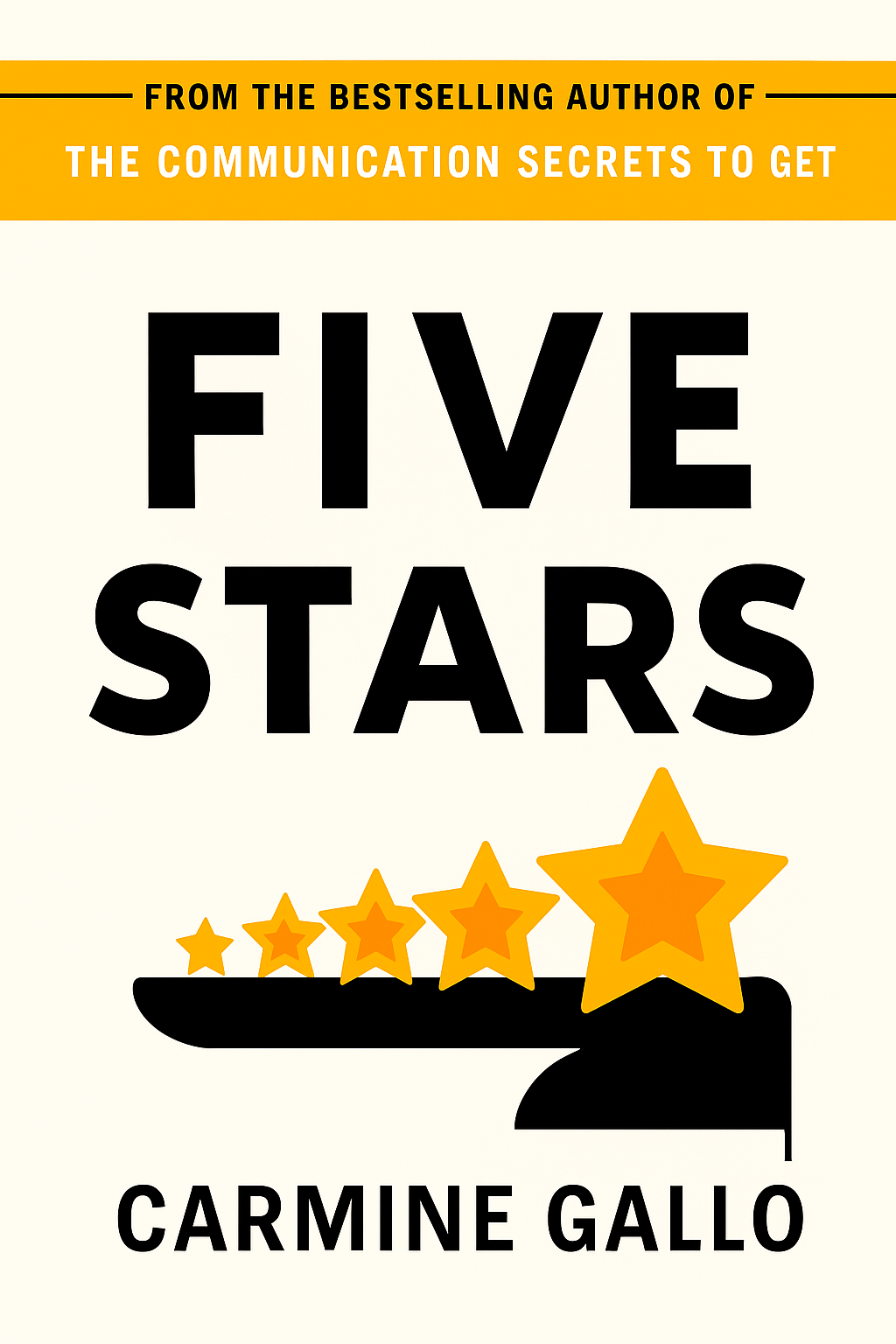
Five Stars
The Communication Secrets to Get from Good to Great
Book Edition Details
Summary
In a world where ideas are the new currency, the ability to persuade is more crucial than ever. Enter "Five Stars" by Carmine Gallo, a riveting exploration of how mastering the art of communication can set you apart in the age of automation. Gallo, celebrated for his insights in "Talk Like TED," unveils the secrets of Aristotle's timeless persuasion formula, blending it with modern examples from icons like Steve Jobs and Warren Buffett. Through engaging interviews with leaders from Google to Airbnb, he illustrates how compelling communication can elevate your ideas from overlooked to irresistible. This book is your roadmap to transforming the ordinary into extraordinary, equipping you with the tools to captivate any audience and amplify your voice in an ever-evolving world. Discover how to become not just a speaker, but a storyteller who commands attention and inspires action.
Introduction
We stand at an unprecedented inflection point where artificial intelligence and automation threaten to reshape every profession, yet one skill emerges as humanity's ultimate differentiator. While machines excel at processing data and executing algorithms, they cannot forge emotional connections, inspire action through storytelling, or persuade through empathy. The capacity to communicate persuasively has evolved from a desirable soft skill to the fundamental competency that determines who thrives in the age of AI. This transformation demands a rigorous examination of what makes human communication irreplaceable. The evidence spans neuroscience laboratories revealing how stories literally sync brains, boardrooms where presentation skills determine billion-dollar deals, and hiring processes where communication ability trumps technical expertise. Ancient rhetorical principles, validated by modern brain imaging, provide the foundation for understanding why certain individuals command attention while others fade into irrelevance. The analysis that follows dissects the mechanics of persuasive communication through multiple lenses: the biological imperatives that make humans crave narrative, the economic forces that increasingly reward those who can articulate ideas, the neurochemical responses triggered by skilled storytellers, and the practical techniques that separate exceptional communicators from the merely competent. This exploration reveals not just what works, but why it works, offering a systematic approach to developing the one skill that remains uniquely human.
Why Great Communicators Are Irreplaceable in the AI Age
The fundamental premise driving modern communication theory rests on a stark economic reality: as artificial intelligence assumes routine cognitive tasks, human value concentrates in activities requiring emotional intelligence and creative thinking. Research across multiple industries demonstrates that while machines process information with superhuman speed and accuracy, they cannot replicate the empathetic connections that drive human decision-making. Evidence from venture capital firms reveals this shift in dramatic terms. Investors processing thousands of pitches annually report that technical competence has become a baseline requirement, while the ability to craft compelling narratives determines funding success. The most successful entrepreneurs excel not because they possess superior technical skills, but because they can articulate visions that inspire others to join their mission. This pattern repeats across sectors where human judgment matters most. Neuroscientific research provides the biological foundation for understanding why persuasive communication remains irreplaceable. Brain imaging studies show that when humans process emotional stories, neural activity synchronizes between speaker and listener in ways that pure information transfer cannot achieve. This biological programming, evolved over millennia for social survival, creates opportunities for those who understand how to trigger these ancient pathways. The economic implications are profound. Labor economists tracking skill premiums over decades document that jobs requiring social interaction and persuasion command increasing wage premiums, even as technical roles face downward pressure from automation. The most secure career paths combine technical competence with superior communication abilities, creating value that machines cannot replicate and competitors cannot easily match.
Who's Earned Five Stars Through Masterful Communication
The most compelling evidence for communication's transformative power emerges from systematic analysis of exceptional performers across diverse fields. These individuals share common characteristics that transcend industry boundaries: they translate complex ideas into accessible narratives, forge emotional connections with audiences, and inspire action through carefully crafted messages. In scientific communication, researchers who achieve broad impact master the art of making specialized knowledge universally compelling. They employ analogies that connect abstract concepts to familiar experiences, structure presentations around narrative arcs that maintain audience engagement, and prioritize clarity over technical precision when addressing general audiences. These communication choices amplify their research impact far beyond traditional academic metrics. Entrepreneurial success increasingly correlates with storytelling ability rather than technical innovation alone. Venture capitalists report that entrepreneurs who frame their ventures as heroic journeys, complete with obstacles overcome and missions accomplished, secure funding at dramatically higher rates than those who focus solely on technical specifications. The most successful founders understand that investors are buying into narratives about the future, not just products or services. Corporate leaders who rise to the highest levels consistently demonstrate superior communication skills, regardless of their technical backgrounds. They excel at distilling complex strategic concepts into memorable messages, using personal anecdotes to illustrate broader principles, and adapting their communication style to different audiences. These abilities become increasingly valuable as organizations flatten hierarchies and require leaders to influence rather than command.
How to Get from Good to Great: Ancient Rhetoric Meets Modern Science
Aristotle's framework for persuasive communication, developed over two millennia ago, gains new relevance when validated by contemporary neuroscience. The three pillars of effective persuasion—logical reasoning, speaker credibility, and emotional connection—correspond precisely to how modern brains process and evaluate information. This convergence suggests that persuasive communication operates through universal human mechanisms that transcend cultural and temporal boundaries. Logical structure provides the foundation for all effective communication by creating cognitive frameworks that audiences can follow and remember. Modern research on working memory confirms that humans can process only limited amounts of new information simultaneously, making clear organizational patterns essential for comprehension. The most effective communicators structure their messages around simple, memorable frameworks that guide audience attention and facilitate retention. Speaker credibility emerges from demonstrable expertise, authentic vulnerability, and genuine concern for audience welfare. Brain imaging studies reveal that audiences continuously evaluate speakers for trustworthiness markers, using unconscious social algorithms developed for prehistoric group survival. Communicators who signal competence through preparation, relatability through personal disclosure, and goodwill through audience focus trigger positive credibility assessments that enhance message reception. The systematic application of these principles requires deliberate practice and continuous refinement. Excellence in communication develops through repeated exposure to high-stakes situations where feedback is immediate and consequences are significant. The most accomplished communicators treat their craft as an ongoing discipline, constantly testing new approaches and refining their techniques based on audience response.
The Neuroscience of Persuasion: Pathos as the Human Edge
Emotional engagement operates as the primary differentiator between human and artificial communication because emotions represent evolutionary adaptations that machines cannot authentically replicate. Neuroscientific research reveals that emotionally charged information receives preferential processing in human brains, with strong feelings triggering the release of chemicals that enhance memory formation and decision-making. Storytelling activates these emotional systems more powerfully than any other communication method. When skilled narrators share personal experiences or compelling case studies, listener brains begin to mirror the neural activity patterns of the storyteller, creating a form of mental synchronization that pure information transfer cannot achieve. This neurological coupling explains why stories persuade more effectively than statistics, even when the logical content is equivalent. The specific structure of emotional narratives matters enormously for their persuasive impact. Stories that follow classical dramatic patterns—establishing characters, introducing conflicts, and resolving tensions—trigger predictable neurochemical responses that increase audience engagement and compliance with subsequent requests. The most effective communicators deliberately craft their narratives to include these elements, understanding that emotional journey is as important as informational content. These insights suggest that developing emotional intelligence and narrative skills provides sustainable competitive advantage in an increasingly automated world. While machines may eventually replicate logical reasoning and information processing, the authentic emotional connections that drive human decision-making remain fundamentally biological phenomena that require genuine human experience to generate effectively.
Summary
The convergence of technological advancement and human psychology reveals that exceptional communication skills have become the essential differentiator in professional success, with emotional connection serving as humanity's irreplaceable advantage over artificial intelligence. The evidence demonstrates that while machines excel at processing information, only humans can forge the empathetic bonds that drive meaningful decisions and inspire collaborative action toward shared goals.
Related Books
Download PDF & EPUB
To save this Black List summary for later, download the free PDF and EPUB. You can print it out, or read offline at your convenience.
By Carmine Gallo
