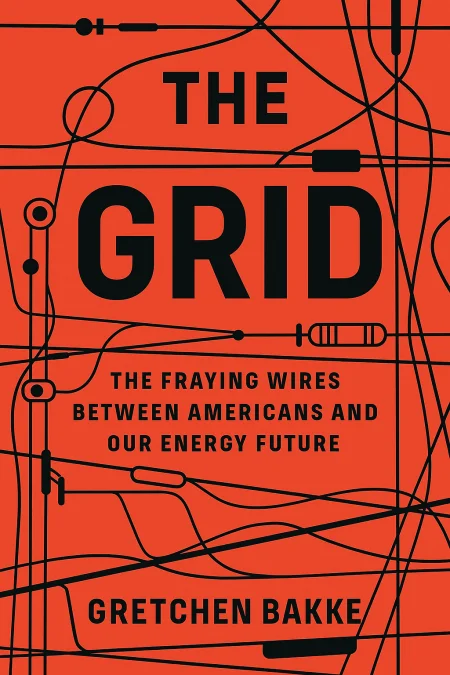
The Grid
The Fraying Wires Between Americans and Our Energy Future
Book Edition Details
Summary
America's electrical grid is a sprawling, intricate beast—a marvel of twentieth-century engineering now stumbling into obsolescence. It stands as both a symbol of past triumphs and a barricade to an electrifying future fueled by the sun, wind, and beyond. Gretchen Bakke, a cultural anthropologist, takes us on a vivid journey through this colossal infrastructure's history and its clumsy tango with modern innovation. She reveals a landscape where visionaries collide with bureaucrats, and idealists clash with pragmatists, all striving to reshape the "largest machine in the world." As we confront crumbling wires and flickering lights, Bakke's narrative crackles with urgency and hope, urging us to rethink the very backbone of American life. Can this aging titan transform into the cornerstone of a cleaner, brighter tomorrow? The stakes are high, the drama is real, and the grid's saga is unfolding at the speed of light.
Introduction
In the summer of 1882, Thomas Edison stood before a massive steam engine in lower Manhattan, preparing to throw a switch that would illuminate just eighty-five customers with four hundred incandescent bulbs. This modest moment at Pearl Street Station marked the beginning of what would become the world's largest and most complex machine—America's electric grid. Yet few could have imagined that this simple network of copper wires and carbon filament bulbs would evolve into an infrastructure so essential that its failure could paralyze entire regions within minutes. The story of America's electrical system reveals three profound historical questions that continue to shape our world today. First, how do societies balance the efficiency of centralized systems against the resilience of distributed networks? Second, what happens when revolutionary technologies collide with entrenched political and economic interests? And third, how do nations manage the transition from one energy paradigm to another without sacrificing reliability or equity? These questions have driven more than a century of conflict between visionary entrepreneurs and cautious regulators, between monopolistic utilities and competitive markets, between fossil fuel incumbents and renewable energy insurgents. This historical journey illuminates patterns that extend far beyond electricity into every aspect of modern infrastructure and technological change. Whether you're a policy maker grappling with climate change, a business leader navigating technological disruption, or simply a citizen curious about the hidden systems that power modern civilization, understanding how America's grid evolved from Edison's simple circuit to today's smart grid revolution offers essential insights into how complex systems adapt, fail, and transform under pressure.
The Rise of Electric Monopolies (1880s-1970s)
The late nineteenth century witnessed one of history's most dramatic infrastructure battles, as competing electrical systems fought for dominance in America's rapidly electrifying cities. Thomas Edison's direct current technology faced off against George Westinghouse's alternating current in what became known as the "War of Currents." Edison's Pearl Street Station could only transmit power a few city blocks before voltage dropped too low to be useful, requiring a power plant for every neighborhood. Westinghouse's AC system, enhanced by Nikola Tesla's innovations, could transmit electricity across vast distances using transformers, fundamentally changing the economics of power generation. The real architect of America's electrical monopoly was Samuel Insull, Edison's former secretary who transformed Chicago's struggling electric company into a continental empire. Insull recognized that electricity's unique characteristics—it cannot be stored, must be produced instantly when demanded, and requires massive infrastructure investments—made traditional competition wasteful and potentially dangerous. His revolutionary insight was that electrical utilities were "natural monopolies" that could serve customers more efficiently and cheaply than competing systems ever could. Insull's strategy was brilliant in its simplicity. He embraced government regulation in exchange for exclusive service territories, creating a grand bargain between private enterprise and public oversight. Utilities could raise capital for massive power plants and transmission lines, knowing they had captive customers and guaranteed returns on investment. This model spread rapidly across America, creating integrated monopolies that controlled everything from coal mines to household meters, driving down costs through economies of scale while ensuring universal access to electric power. For nearly a century, this system delivered remarkable results. By the 1950s, electricity had become so reliable and affordable that Americans consumed more power per capita than any other nation in history. Utility stocks were considered the safest investments on Wall Street, while the industry's motto "bigger is better" drove continuous technological innovation. Yet the very success of this monopoly model contained the seeds of its eventual transformation, as utilities grew so large and insulated from market forces that they began making costly mistakes that would ultimately shatter public confidence in their judgment.
Deregulation Revolution and Market Competition (1970s-2000s)
The energy crises of the 1970s marked a dramatic turning point that shattered Americans' faith in their electrical system. The Arab oil embargo of 1973 exposed the nation's dangerous dependence on imported energy, while President Jimmy Carter's call for conservation—symbolized by his cardigan sweater during a televised fireside chat—signaled the end of an era of cheap, abundant power. Simultaneously, the economic model that had driven utility success for decades began breaking down as construction costs soared, environmental regulations tightened, and demand growth slowed for the first time in the industry's history. The breakthrough came with an obscure provision buried deep in the Public Utility Regulatory Policies Act of 1978. Section 210 of PURPA, passed by a single vote in the House of Representatives, required utilities to purchase electricity from small independent producers at fair market rates. Though few noticed at the time, this seemingly technical regulation broke the utilities' total monopoly over electricity generation for the first time since the 1920s, opening the door to competition from wind farms, solar plants, and efficient industrial cogeneration systems. California became the epicenter of this transformation, offering generous long-term contracts to renewable energy developers and creating the world's first large-scale wind industry. Entrepreneurs rushed to build wind farms in mountain passes like Altamont and Tehachapi, while industrial companies rediscovered the economics of cogeneration—using waste heat from manufacturing processes to generate electricity. The results were mixed: many early wind turbines were poorly designed and frequently broke down, but the principle was established that competition could drive innovation in ways that regulated monopolies never could. The real revolution came with the Energy Policy Act of 1992, which mandated wholesale competition in electricity markets nationwide. This legislation separated electricity generation from transmission and distribution, transforming power from a local service into a tradeable commodity that could be bought in one state and sold in another. Suddenly, utilities were forced to transport competitors' electricity over their own wires, while power plants could sell to the highest bidder anywhere on the interconnected grid. This fundamental restructuring unleashed market forces that would reshape the entire industry, though not always in ways that reformers had anticipated.
Grid Crisis and the Smart Infrastructure Challenge (2000s-2010s)
The new millennium began with a spectacular demonstration of deregulation's potential pitfalls. California's botched electricity restructuring created a playground for energy traders like Enron, who manipulated markets to extract billions from consumers while threatening the state with rolling blackouts. The collapse of Enron in 2001 revealed the dark side of treating electricity like any other commodity, while exposing how financial engineering had replaced actual infrastructure investment in many companies' business strategies. The vulnerability of America's aging electrical infrastructure became undeniably clear on August 14, 2003, when a tree branch touching a power line in suburban Ohio triggered a cascade of failures that blacked out fifty million people across eight states and parts of Canada. The outage began with something as mundane as deferred tree trimming—FirstEnergy had extended their vegetation management schedule to save money—but revealed how small problems could rapidly become catastrophic in complex, interconnected systems. Grid operators watched helplessly as massive waves of electricity surged unpredictably across the Eastern interconnection, while a software bug prevented them from seeing the crisis unfold in real time. The response came in the form of the "smart grid"—a vision of an electricity system enhanced with digital communications, automated controls, and real-time data analytics. Utilities began installing smart meters in millions of homes, promising consumers greater control over their energy use while giving themselves better tools to manage an increasingly complex system. The Obama administration invested billions in smart grid demonstration projects, from Xcel Energy's SmartGridCity in Boulder to comprehensive grid modernization efforts across the country. Yet the smart grid revolution proved more difficult than anticipated. Many projects became expensive failures that delivered few tangible benefits to consumers while raising concerns about privacy, electromagnetic radiation, and surveillance. The fundamental challenge was that the grid's problems were not merely technological but deeply rooted in regulatory structures, business models, and institutional relationships that resisted change. Simply adding digital technology to an antiquated system could not address these underlying issues, while the promise of a fully automated, self-healing grid remained largely theoretical despite billions in investment.
Distributed Energy Future and System Transformation (2010s-Present)
The 2010s witnessed an acceleration of trends that had been building for decades, as falling costs for solar panels and batteries made distributed generation economically attractive for millions of Americans. Solar panel prices plummeted by more than eighty percent during the decade, while lithium-ion battery costs dropped even faster, making rooftop solar competitive with grid electricity in most markets. Electric vehicles began their transition from curiosity to mainstream product, promising to turn millions of cars into mobile storage devices that could both consume and supply electricity to the grid. This distributed energy revolution created both opportunities and existential threats for traditional utilities. In Hawaii, where expensive oil-fired power plants made solar particularly attractive, rooftop installations grew so rapidly that they sometimes produced more electricity than the islands could use during sunny afternoons. Similar patterns emerged across the Sun Belt, forcing grid operators to grapple with the "duck curve"—a daily cycle where renewable generation peaks at midday while demand peaks in the evening, creating unprecedented challenges for system balancing. The COVID-19 pandemic and extreme weather events like Winter Storm Uri in Texas further exposed the fragility of centralized power systems. Millions of Americans experienced extended blackouts while watching their neighbors with solar panels and batteries maintain power throughout the crisis. These experiences accelerated interest in energy independence and resilience, driving explosive growth in everything from home battery systems to community microgrids that could operate independently during emergencies. Meanwhile, the rise of distributed energy resources challenged fundamental assumptions about how electrical systems should operate. Military bases, hospitals, universities, and even neighborhoods began building microgrids that combined local generation, energy storage, and smart controls to create resilient power systems. These installations demonstrated that the future might lie not in fixing the existing grid, but in fundamentally reimagining how we generate, store, and distribute energy through networks of interconnected but independent systems that could provide both local resilience and system-wide benefits.
Summary
The transformation of America's electric grid reveals a fundamental tension between the efficiency of centralized systems and the resilience of distributed networks. For over a century, the logic of economies of scale drove the construction of ever-larger power plants and more extensive transmission networks, creating efficiencies that made electricity affordable and abundant for virtually all Americans. Yet this same centralization created vulnerabilities that climate change, cyber threats, and aging infrastructure are now exposing with increasing frequency and devastating consequences. The lessons of grid history suggest that successful infrastructure transitions require careful alignment between technology, economics, and institutions. The monopoly era delivered universal electrification and remarkable reliability, but at the cost of innovation and consumer choice. Deregulation unleashed competition and drove down costs in generation, but also created new vulnerabilities and market manipulation opportunities. The smart grid promised to optimize existing systems through digital technology, yet often felt more like surveillance than empowerment to ordinary consumers who saw little benefit from expensive upgrades. Today's distributed energy revolution offers the possibility of a more resilient and sustainable future, but requires overcoming institutional inertia and regulatory structures designed for a different technological era. The path forward demands policies that harness market forces while ensuring universal access to reliable power, technologies that enhance both efficiency and equity, and new business models that can sustain investment in shared infrastructure while accommodating distributed generation. Most importantly, we must remember that the grid is not just a machine but a social institution that reflects our values and shapes our communities, making the choices we face today about energy infrastructure fundamentally about the kind of society we want to become.
Related Books
Download PDF & EPUB
To save this Black List summary for later, download the free PDF and EPUB. You can print it out, or read offline at your convenience.
By Gretchen Bakke
