
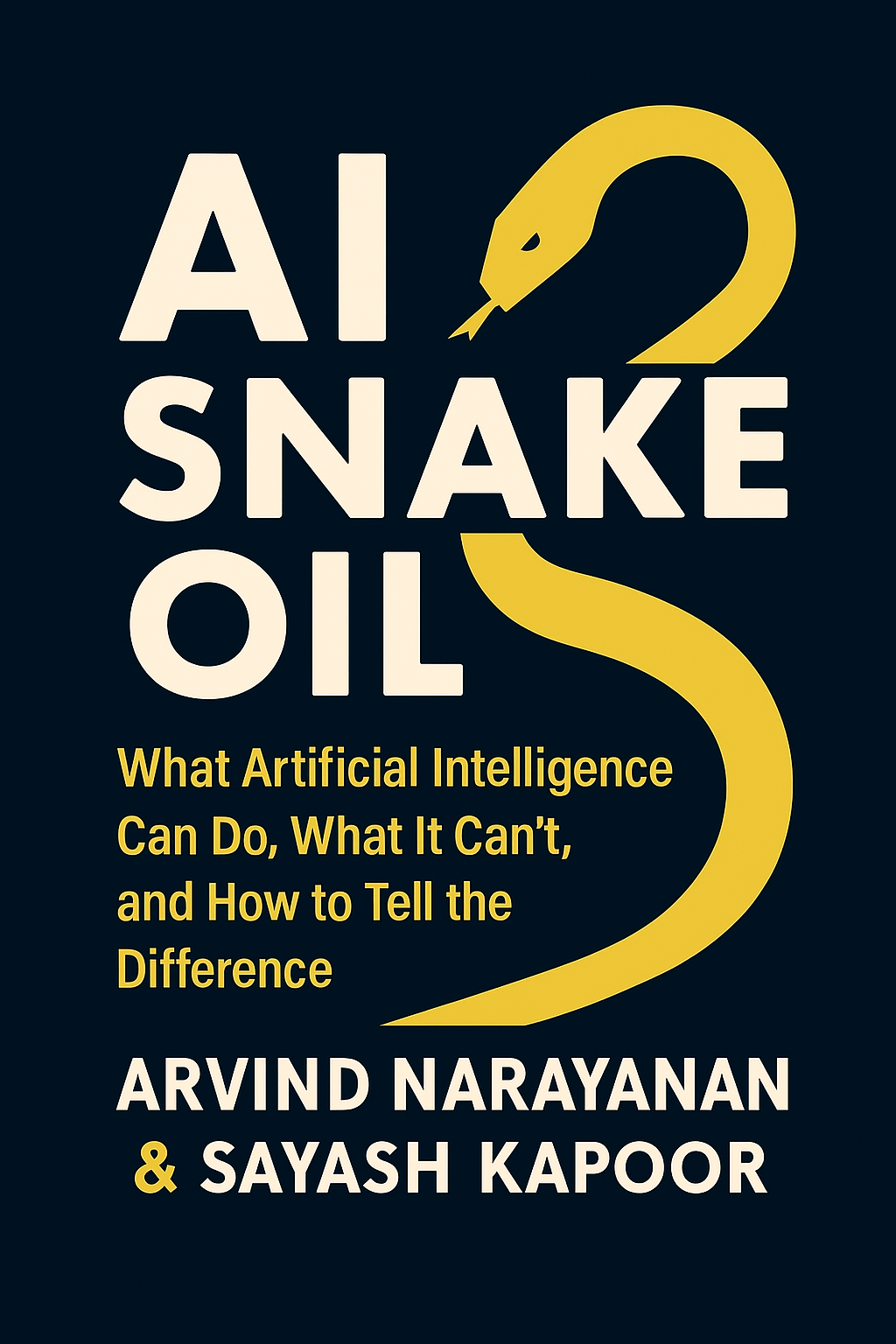
AI Snake Oil
What Artificial Intelligence Can Do, What It Can’t, and How to Tell the Difference
byArvind Narayanan, Sayash Kapoor
Book Edition Details
Summary
In a landscape where artificial intelligence promises much but often delivers little, "AI Snake Oil" by Arvind Narayanan and Sayash Kapoor offers a bold, clarifying lens. Strip away the tech industry's bravado, and you'll find a world rife with overhyped algorithms and misunderstood technologies. This insightful narrative dissects AI’s triumphs and tribulations, debunking myths that surround its capabilities. From the classrooms to the courts, the authors illuminate how AI's misuse impacts critical sectors like education and justice, painting a vivid picture of the potential pitfalls and ethical quandaries. Essential for anyone navigating our tech-driven world, this book serves as a crucial guide to discerning real innovation from digital delusion, challenging us to question who holds the power—and the accountability—in this evolving narrative.
Introduction
Artificial intelligence has become the defining technological narrative of our era, yet beneath the breathless headlines and corporate promises lies a troubling disconnect between marketed capabilities and actual performance. The fundamental challenge facing society today is not whether AI will transform human civilization, but rather how to distinguish between legitimate technological advances and sophisticated forms of digital snake oil that exploit public misunderstanding for commercial gain. The analysis presented here cuts through the prevailing mythology surrounding AI by employing a methodical examination of real-world deployments across multiple sectors. Rather than treating AI as a monolithic force, this investigation disaggregates different types of AI systems and evaluates each category based on empirical evidence rather than theoretical potential. The approach reveals systematic patterns of failure in predictive applications while acknowledging genuine capabilities in generative technologies, ultimately providing a framework for understanding why certain AI applications consistently underperform while others deliver measurable value. This examination proves particularly crucial because it addresses the institutional and cognitive factors that perpetuate AI myths despite mounting evidence of failure. The investigation demonstrates how economic incentives, regulatory gaps, and human psychological biases combine to create markets for ineffective AI products, while simultaneously obscuring the genuine risks and limitations of more capable systems. The ultimate goal is not to dismiss AI technology entirely, but to develop more sophisticated analytical tools for evaluating AI claims and building appropriate governance frameworks for these powerful but often misunderstood technologies.
The Core Distinction: Why Predictive AI Fails While Generative AI Works
The most important insight for understanding contemporary AI lies in recognizing the fundamental difference between predictive and generative applications. Predictive AI systems attempt to forecast future human behavior and outcomes based on historical data patterns, while generative AI creates new content by recombining learned patterns from training data. This distinction explains why certain AI applications consistently fail to deliver on their promises while others demonstrate genuine utility. Predictive AI systems fail because they rest on a flawed assumption that human behavior follows sufficiently stable patterns to enable accurate forecasting. Criminal recidivism prediction tools, healthcare outcome forecasters, and hiring assessment algorithms all struggle with the inherent unpredictability of human agency and the dynamic nature of social systems. These systems typically achieve accuracy rates barely better than simple heuristics or random chance, yet their technological sophistication creates an illusion of precision that masks their fundamental limitations. The failure of predictive AI becomes particularly problematic when these systems operate in high-stakes environments where their decisions directly impact individual lives. Criminal justice risk assessment tools influence decisions about freedom and incarceration despite accuracy rates around 65 percent, while healthcare prediction systems can trigger inappropriate interventions based on unreliable forecasts. The gap between promised precision and actual performance creates systematic harm while providing institutional cover for biased decision-making. Generative AI operates within fundamentally different constraints that explain its relative success. These systems excel at pattern recognition and recombination within well-defined domains where success can be measured by utility rather than predictive accuracy. Language models demonstrate genuine capability in assisting with writing tasks, code generation, and creative applications because they operate as sophisticated tools for content creation rather than oracles predicting future events. Understanding this distinction provides essential guidance for evaluating AI applications and setting appropriate expectations for different types of systems.
Evidence of Systematic Failures Across AI Applications
Systematic examination of AI deployments reveals consistent patterns of failure that extend far beyond isolated incidents or implementation problems. Healthcare AI systems demonstrate particularly troubling performance gaps, with sepsis prediction models achieving accuracy rates of only 63 percent despite promises of life-saving precision. Medicare systems deploy AI tools with documented error rates exceeding 90 percent to deny coverage to elderly patients, knowing that most denials will not be appealed due to the complexity and cost of the appeals process. Criminal justice applications provide perhaps the most documented evidence of AI failure, with risk assessment tools showing no meaningful improvement over simple demographic factors while introducing systematic racial bias. The COMPAS system, widely deployed across American courts, demonstrates accuracy barely better than untrained human volunteers making predictions based on minimal information. Yet these systems continue to influence bail, sentencing, and parole decisions because they provide institutional cover for maintaining existing patterns of discrimination while appearing scientific and objective. Educational AI systems reveal similar patterns of failure across student retention prediction, mental health monitoring, and academic performance assessment. These systems rarely improve actual outcomes but allow institutions to claim systematic approaches to complex problems while avoiding more expensive interventions. The University of Mount St. Mary's use of predictive analytics to identify struggling freshmen exemplifies how AI can become a tool for institutional cost-cutting rather than genuine student support. Employment screening algorithms demonstrate how AI failures can become embedded in hiring processes that affect millions of job seekers. These systems often rely on spurious correlations, penalize candidates for factors beyond their control, and perpetuate existing workplace inequalities while claiming objectivity. The opacity of these systems makes it nearly impossible for candidates to understand or challenge adverse decisions, creating accountability gaps that would be unacceptable in traditional hiring processes.
Institutional Incentives That Perpetuate AI Snake Oil
The persistence of ineffective AI systems reflects institutional incentives that prioritize risk reduction, cost cutting, and liability management over actual performance improvement. Organizations adopt AI solutions not because they work effectively, but because they serve other institutional needs such as appearing innovative, shifting responsibility away from human decision-makers, or providing legal cover for controversial decisions. This dynamic creates sustainable markets for AI snake oil that persist despite documented failures. Healthcare institutions deploy AI systems that promise efficiency gains while often degrading care quality because these tools help manage liability exposure and reduce labor costs. The systems allow administrators to claim systematic approaches to complex medical decisions while insulating individual practitioners from responsibility for adverse outcomes. Medicare Advantage plans particularly benefit from AI denial systems that reduce payouts while providing plausible deniability about discriminatory practices against elderly patients. Academic institutions embrace AI tools for student monitoring and assessment not because they improve educational outcomes, but because they demonstrate systematic approaches to retention and mental health challenges without requiring expensive investments in counseling staff or reduced class sizes. These systems allow administrators to claim data-driven decision-making while avoiding more costly interventions that might actually address underlying problems. Corporate adoption of AI hiring tools reflects similar institutional logic, where companies can process large volumes of applications while avoiding direct responsibility for discriminatory outcomes. These systems enable employers to maintain plausible deniability about bias while systematically excluding qualified candidates based on irrelevant factors. The legal complexity of challenging algorithmic decisions provides additional protection against discrimination lawsuits, making these tools attractive despite their poor performance.
Building Democratic Oversight for Responsible AI Governance
Effective AI governance requires moving beyond technical solutions and corporate self-regulation toward democratic oversight mechanisms that prioritize public welfare over private profit. The European Union's AI Act represents progress by categorizing applications based on risk levels and imposing transparency requirements, but effective implementation requires adequate funding for enforcement agencies and technical expertise that currently does not exist at sufficient scale. Regulatory frameworks must address the broader social impacts of AI deployment rather than focusing narrowly on technical performance metrics. Mandatory impact assessments should evaluate distributional effects, bias amplification, and impacts on vulnerable populations, similar to environmental impact assessments for major development projects. Public participation in these processes ensures that affected communities have meaningful input into decisions about AI deployment in consequential domains. Transparency requirements should extend beyond algorithmic auditing to include disclosure of training data sources, performance metrics across different demographic groups, and the human labor involved in AI development and maintenance. Companies deploying AI systems in high-stakes decisions should provide meaningful explanations for individual outcomes rather than generic descriptions of algorithmic processes. These requirements must be enforceable through significant penalties that make compliance more cost-effective than violation. Democratic oversight also requires addressing the concentration of AI development within a small number of technology companies that lack accountability to the communities affected by their products. Worker protections must address both displacement effects and the exploitation of human labor in AI development, while antitrust enforcement should prevent the emergence of AI monopolies that could undermine democratic governance of these powerful technologies.
Summary
The fundamental insight emerging from this systematic analysis is that the current AI landscape is characterized by a dangerous misalignment between technological capabilities and public understanding, creating conditions where ineffective systems can cause systematic harm while genuinely capable systems operate without appropriate oversight. The distinction between predictive and generative AI applications provides a crucial analytical framework for navigating these complexities, revealing that the most hyped applications often deliver the least value while genuinely useful tools operate quietly in specialized domains. This framework, combined with understanding of the institutional incentives that perpetuate AI myths, offers essential tools for building more responsible approaches to AI development and deployment that prioritize democratic accountability over technological determinism.
Related Books
Download PDF & EPUB
To save this Black List summary for later, download the free PDF and EPUB. You can print it out, or read offline at your convenience.
By Arvind Narayanan
