
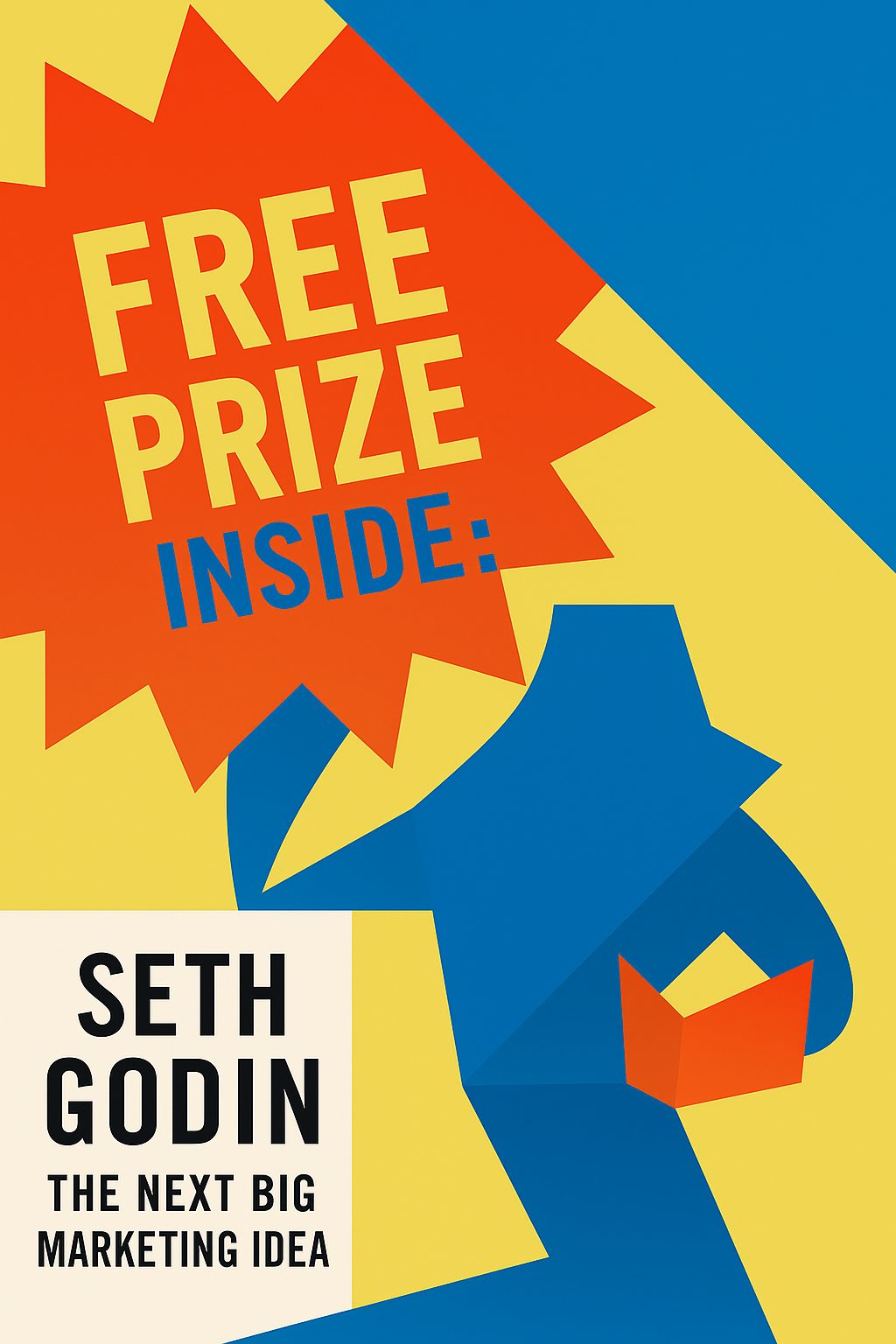
Free Prize Inside
The Next Big Marketing Idea
Book Edition Details
Summary
In an era where conventional advertising has lost its charm, Seth Godin’s "Free Prize Inside" emerges as a beacon for the intrepid marketer. Imagine creating products so irresistibly unique, they spark curiosity and sell themselves, without a colossal marketing budget. Godin, with his knack for spotting the extraordinary in the mundane, takes you beyond the allure of the Purple Cow, guiding you to craft innovations that redefine markets. Think of the seismic impact of a Tupperware party or the allure of frequent flier miles—transformative ideas that didn't just meet expectations but shattered them. With wit and insight, Godin equips you with the tools to champion your own groundbreaking concepts, even within the most risk-averse environments. A handbook for visionaries and disruptors, this book is your roadmap to discovering that elusive 'free prize' which transforms ordinary offerings into unforgettable experiences.
Introduction
The traditional marketing playbook is crumbling before our eyes. Companies spend millions on advertising campaigns that consumers ignore, while R&D departments burn through budgets chasing the next technological breakthrough that may never materialize. Yet amidst this chaos, a remarkable pattern emerges among the fastest-growing organizations of our time. They're not winning through bigger ad budgets or cutting-edge patents. Instead, they're discovering something far more powerful and surprisingly accessible: the art of creating remarkable innovations that cost little to implement but generate extraordinary returns. These innovations transform ordinary products into conversation starters, turning customers into enthusiastic advocates who spread the word organically. The secret lies not in what these companies spend, but in how they think differently about value creation. Every organization, regardless of size or industry, possesses the untapped potential to create these breakthrough moments. The question isn't whether you have the resources to compete, but whether you're ready to embrace a fundamentally different approach to growth.
From Advertising to Innovation: Why You Need a Free Prize
The industrial marketing machine that powered business growth for decades has finally met its match: consumer indifference. When Jeff Bezos announced that Amazon would abandon traditional advertising entirely and instead invest those dollars into free shipping, industry experts predicted disaster. Twelve months later, sales had surged 37 percent, international growth exploded by 81 percent, and Amazon reported its first quarterly profit outside the holiday season. This wasn't luck—it was strategic brilliance. Bezos understood that the cost curve of traditional marketing had fundamentally shifted. The Godin Curve reveals this uncomfortable truth: as investments in technology and media advertising increase, the returns diminish dramatically. Companies pouring millions into Super Bowl commercials or complex R&D projects often find themselves trapped in an expensive cycle that delivers marginal improvements at exponential costs. The solution lies in what appears to be a paradox: the most profitable innovations often cost the least to implement. Consider the nurse who realized that post-surgery patients suffered unnecessarily from sore throats and painful urination—problems easily solved with a throat lozenge and cranberry juice. This simple insight could transform patient satisfaction and generate referrals worth thousands of dollars, yet it requires no technology budget or advertising campaign. Smart organizations are discovering that the sweet spot of innovation exists in the gap between high-tech solutions and high-cost marketing. Here, creativity and insight matter more than budgets. A packaging redesign, a service modification, or a simple process improvement can create remarkable value when executed thoughtfully. The key is understanding that remarkable doesn't mean expensive—it means worth remarking about.
Becoming the Champion: How to Sell Your Breakthrough Ideas
Having a brilliant idea means nothing if you can't make it happen. The graveyard of corporate innovation is filled with concepts that died not because they were flawed, but because no one successfully championed them through the organization. James Dyson didn't set out to become a vacuum cleaner manufacturer—he spent years trying to license his revolutionary bagless design to established companies. Every major manufacturer rejected his innovation, not because it wasn't superior, but because he couldn't navigate their internal decision-making processes. The secret to successful innovation lies in understanding the fulcrum of innovation—three critical questions that every organization asks before embracing change: Is it going to be successful? Is it worth doing? Is this person able to champion the project? Your job as a champion isn't just to have good ideas; it's to build credibility across all three dimensions simultaneously. Joe Perrone at FedEx exemplified this approach when he proposed cutting slots in delivery trucks to accept packages directly from customers. Rather than presenting his idea to senior management immediately, he methodically built support across departments. He consulted corporate identity about brand impact, worked with legal on security concerns, and collaborated with engineering on weatherproofing. By the time he reached decision-makers, he had transformed his individual inspiration into organizational consensus. The most effective champions understand that selling internally requires the same skill as selling externally: emotional engagement combined with logical support. They paint vivid portraits of the future while acknowledging current limitations. They create prototypes that make abstract concepts tangible. Most importantly, they take responsibility for outcomes rather than hiding behind committees or consensus. Start small to build your reputation as someone who can execute. Champion lunch decisions, volunteer for task forces, and consistently deliver on commitments. Each successful project builds the credibility foundation that will support larger innovations later.
Edgecraft Mastery: Creating Remarkable Products Worth Talking About
Brainstorming sessions rarely produce breakthrough innovations because they focus on generating ideas rather than identifying opportunities. Edgecraft offers a more systematic approach: find an edge that matters to consumers, then go all the way to that edge without compromise. Half-measures are invisible; only extreme positions create remarkable experiences worth discussing. Rita's candy shop on Highway 11 demonstrates edgecraft in action. While competitors offered standard convenience store fare, Rita went to the edge of variety and nostalgia. She stocks individually wrapped penny candy, discontinued childhood favorites, and even British spotted dick pudding. Her remarkable selection transforms a routine purchase into a treasure hunt, generating $30 to $100 transactions from customers who originally planned to buy a quick snack. The edges are everywhere once you learn to see them. Master Lock increased sales 50 percent through four simple design changes: clearer labeling for specific uses, front-facing keyholes, color-coded keys and bumpers, and improved packaging. None of these improvements enhanced security, but all dramatically improved functionality and user experience. QBNet revolutionized Japanese barbershops by going to the edge of speed. They eliminated everything except cutting hair—no shampoo, no massage, no lengthy waits. Customers buy tokens from machines, sensors in chairs indicate wait times through color-coded exterior signs, and barbers use centralized vacuum systems. The result: ten-minute haircuts that cost one-sixth the traditional price, creating a chain of two hundred profitable locations. Successful edgecraft requires courage to abandon the middle ground where most companies cluster. Whether you choose to maximize variety like Rita, simplify functionality like Master Lock, or optimize speed like QBNet, the principle remains constant: partial changes are expensive and ineffective, while complete transformations create new market categories. The process is straightforward but demands commitment. Identify edges that resonate with your target audience, study how other industries have successfully reached similar extremes, then adapt those approaches to your specific context. Remember, you're not seeking incremental improvement—you're pursuing remarkable differentiation that compels conversation and drives organic growth.
Summary
The future belongs to organizations that understand a fundamental shift: marketing is no longer something you do to your product after you make it—it is the product itself. "Every product and every service can be made remarkable, and anyone in your organization can make it happen." This isn't about having unlimited resources or revolutionary technology; it's about having the courage to pursue innovations that matter to real people solving real problems. The path forward is clear and immediately actionable. Stop waiting for permission or perfect conditions. Choose one aspect of your product or service that could become genuinely remarkable, apply edgecraft principles to reach an extreme position, and champion that change through your organization with unwavering commitment. The companies thriving today aren't the ones with the biggest budgets—they're the ones brave enough to be remarkable.
Related Books
Download PDF & EPUB
To save this Black List summary for later, download the free PDF and EPUB. You can print it out, or read offline at your convenience.
By Seth Godin
