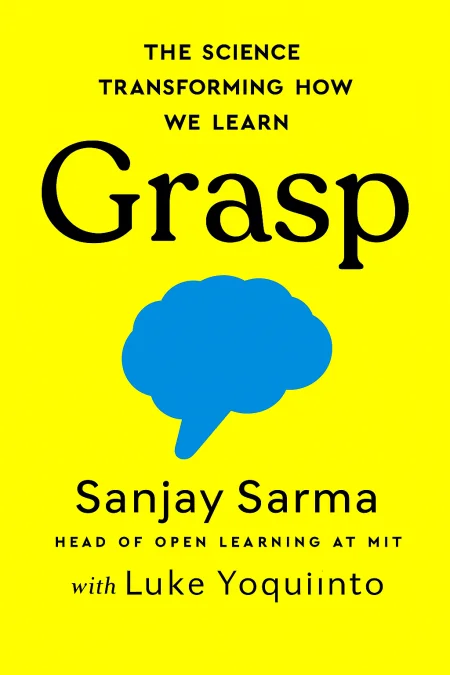
Grasp
The Science Transforming How We Learn
Book Edition Details
Summary
Minds are complex, and unlocking their educational potential is a quest that challenges even the most seasoned of scholars. Enter Sanjay Sarma, the visionary head of Open Learning at MIT, who dares to redefine what it means to learn. "Grasp" is not just a book; it's a revolution in understanding the science behind education. Sarma dismantles outdated myths—such as the obsolete concept of "learning styles"—and presents cutting-edge strategies that merge neuroscience with practical teaching methods. Whether you're an educator navigating the digital realm, a parent seeking the best for your child, or simply curious about the mechanics of learning, this book is a treasure trove of insights. From the surprising role of forgetting to breakthroughs in neuroimaging for reading, "Grasp" lights the path to a more inclusive and dynamic future in education. Prepare to be enlightened and equipped with tools to transform not just classrooms, but society at large.
Introduction
Picture this: you're sitting in a classroom where one student effortlessly grasps complex algebra while another struggles with basic arithmetic, despite both having similar intelligence and motivation. What creates this learning divide? The answer lies not in mysterious talents or character flaws, but in the fascinating biological machinery of learning itself. For over a century, our educational systems have operated on outdated assumptions about how minds work, while revolutionary discoveries in neuroscience and cognitive psychology have been quietly rewriting the rules of effective learning. Scientists have discovered that memory formation follows specific biological rhythms, that curiosity literally rewires our brains for better retention, and that many traditional study methods actually work against our natural learning processes. This exploration reveals how understanding the brain's learning mechanisms can transform education from a system that sorts students into winners and losers into one that unlocks every learner's potential. You'll discover why forgetting can actually strengthen memory, how spacing out study sessions works better than cramming, and why the most effective learning often feels more difficult in the moment but produces dramatically superior long-term results.
Memory Formation: From Neural Circuits to Lasting Knowledge
Deep within your brain, every moment of learning triggers a remarkable biological transformation. When you encounter new information, networks of neurons fire in synchronized patterns, creating temporary electrical storms that, if properly reinforced, eventually carve permanent pathways through your neural landscape. This process, called long-term potentiation, is like wearing a trail through a forest by walking the same route repeatedly until it becomes a well-established path. The magic happens at the synapses, the tiny gaps between brain cells, where repeated activation causes physical changes that strengthen connections and even grow new ones. What makes this process truly extraordinary is its dependence on timing. Scientists studying creatures as simple as sea slugs discovered that memories form most effectively when learning episodes are spaced apart rather than massed together. This spacing effect appears to be fundamental to how biological memory works, operating from the simplest organisms to humans. When we cram information in marathon study sessions, we're essentially fighting against millions of years of evolutionary optimization for how brains actually learn. The implications are profound yet largely ignored by traditional education. Our brains have evolved sophisticated mechanisms for converting temporary experiences into lasting knowledge, but these mechanisms require time to operate. Between learning sessions, cellular machinery rebuilds and strengthens neural connections, a process that can't be rushed. This explains why students who distribute their study over multiple sessions dramatically outperform those who spend the same total time cramming, even though cramming often feels more productive in the moment. Understanding memory formation as a biological process rather than a simple recording mechanism reveals why so many traditional educational practices fail. When schools organize learning into intensive units followed by final exams, or when students pull all-nighters before tests, they're working against the brain's natural rhythms. The most effective learning strategies aren't just helpful study tips, they're applications of fundamental principles about how neural networks actually form and strengthen over time.
Cognitive Architecture: Working Memory and Learning Systems
The human mind processes information through a remarkably constrained bottleneck called working memory, which can juggle only about four pieces of information simultaneously. Think of working memory as a mental workspace where conscious thinking happens, but one with severely limited capacity. When this workspace becomes overloaded with too many demands at once, learning essentially shuts down, explaining why students often struggle not because they lack ability, but because instructional methods overwhelm their cognitive architecture. This discovery revolutionized our understanding of why certain teaching approaches succeed while others fail. When novice learners encounter complex problems, most of their mental resources get consumed by managing the problem-solving process itself, leaving little capacity for actually learning the underlying concepts. It's like trying to learn to drive while simultaneously navigating an unfamiliar city, reading a map, and having a phone conversation. Each task might be manageable alone, but together they exceed our cognitive limits. The brain's learning systems have evolved elegant solutions to these limitations. Expert knowledge gets organized into meaningful chunks that compress vast amounts of information into single, easily manipulated units. A chess master doesn't see individual pieces but recognizes patterns and strategic configurations that would overwhelm a beginner. This chunking process explains why building foundational knowledge is so crucial, it literally expands our capacity to handle complexity by reorganizing how information gets stored and accessed. Effective instruction must respect these cognitive constraints while gradually building the knowledge structures that transcend them. This means providing worked examples for beginners rather than expecting them to discover solutions independently, scaffolding complex tasks into manageable components, and ensuring that students have automated basic skills before tackling advanced applications. The goal isn't to dumb down learning, but to sequence it in ways that work with, rather than against, the architecture of human cognition.
Educational Revolution: Brain Science Meets Classroom Practice
The convergence of neuroscience, cognitive psychology, and educational technology is creating unprecedented opportunities to align teaching practices with how learning actually works. Modern brain imaging reveals that different types of knowledge activate distinct neural networks, suggesting that effective instruction must engage multiple learning systems simultaneously. When students connect abstract concepts to concrete experiences, link new information to existing knowledge, and practice retrieving memories rather than simply reviewing them, they're activating the brain's most powerful learning mechanisms. Perhaps most importantly, this research reveals that many students labeled as slow or learning disabled may simply learn differently, not deficiently. The brain's reading network, for example, develops along predictable pathways in most children, but some individuals wire these circuits differently, leading to dyslexia despite normal or superior intelligence in other areas. Understanding these differences as variations rather than deficits opens possibilities for personalized approaches that work with each student's unique neural architecture. Technology is beginning to make such personalization possible at scale. Adaptive learning systems can track student responses in real-time, identifying knowledge gaps and adjusting instruction accordingly. These platforms represent a dramatic departure from the industrial model of education, where all students march through identical curricula at the same pace. Instead, they create individualized learning pathways that respect both the universal principles of how brains learn and the unique needs of each learner. The most promising educational innovations combine technological capabilities with human wisdom. While algorithms can personalize content delivery and identify struggling students, master teachers remain irreplaceable for inspiring curiosity, providing emotional support, and helping students see connections across different domains of knowledge. The future of education lies not in choosing between human teachers and artificial intelligence, but in creating hybrid systems that amplify the best of both.
Summary
The central revelation emerging from learning science is that effective education must work with the brain's natural learning mechanisms rather than against them. This means embracing strategies like spaced practice, active retrieval, and interleaved learning that may feel more challenging in the moment but produce dramatically better long-term retention and understanding. It means recognizing that cognitive limitations aren't obstacles to overcome but constraints to respect as we design learning experiences. Most importantly, it means moving beyond educational systems designed primarily to sort and rank students toward approaches focused on developing every person's unique potential. As we face global challenges requiring unprecedented innovation and collaboration, we must ask ourselves: how might we redesign education to unlock the learning capacity that neuroscience tells us exists within every human brain? What would our world look like if we could help every student discover and develop their distinctive talents and interests?
Related Books
Download PDF & EPUB
To save this Black List summary for later, download the free PDF and EPUB. You can print it out, or read offline at your convenience.
By Sanjay Sarma
