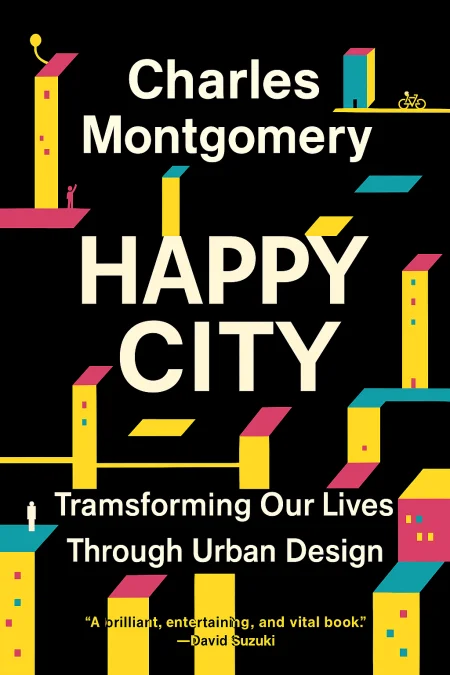
Happy City
Transforming Our Lives Through Urban Design
Book Edition Details
Summary
Amidst the hustle and bustle of our concrete jungles, Charles Montgomery’s "Happy City" unravels the secret blueprint to urban bliss. Picture this: sidewalks that spark connections, buses that elevate status, and public spaces that transform into vibrant social hubs. Montgomery, a lauded journalist, journeys through dynamic metropolises, uncovering how innovative urban designs can foster joy and well-being. From Bogotá’s charismatic transit to Parisian roadways turned sandy retreats, this narrative fuses cutting-edge happiness science with captivating city tales. It challenges us to rethink and reimagine our urban landscapes, suggesting that by redesigning our cities, we might just redesign our lives—and in doing so, save our world.
Introduction
Maria stepped off the crowded bus in downtown Bogotá, her heart racing as she navigated through what had once been one of the world's most dangerous cities. Yet something extraordinary surrounded her—children laughing as they rode bicycles along protected lanes, elderly couples sitting peacefully in tree-lined parks, and neighbors chatting at outdoor cafés where gunfire once echoed. This transformation didn't happen through economic miracles or political revolution, but through something far more subtle and powerful: the deliberate redesign of how a city works for its people. Across the globe, a quiet revolution is reshaping our understanding of what makes cities truly successful. From Copenhagen's cycling highways to Vancouver's family-friendly towers, from Portland's neighborhood intersections to New York's reclaimed streets, communities are discovering that the secret to urban happiness lies not in grand monuments or expensive technology, but in the careful attention to how our daily environments shape our relationships, health, and sense of belonging. The width of a sidewalk determines whether children can walk safely to school. The placement of a bench decides whether strangers become neighbors. The design of a bus stop influences whether public transit feels dignified or degrading. This exploration reveals how the places we inhabit don't merely reflect our values—they actively create them. Through compelling stories of transformation from around the world, we'll discover how thoughtful urban design can turn isolated communities into thriving neighborhoods, how public spaces become catalysts for trust and cooperation, and how the simple act of prioritizing people over cars can unlock reservoirs of human joy and connection that transform entire societies. The happy city isn't a utopian dream—it's a choice we can make, one street corner at a time.
Bogotá's Revolution: How One Mayor Redesigned Urban Dignity
When Enrique Peñalosa became mayor of Bogotá in 1998, he inherited a city where 80 percent of residents couldn't afford cars, yet virtually all public investment served the wealthy minority who could drive. Children from poor neighborhoods risked their lives crossing eight-lane highways just to reach the few parks in the city. The message was clear: if you couldn't afford a car, you were a second-class citizen in your own city. Peñalosa's response was audaciously simple—flip the priorities entirely. He began by giving buses the best lanes on major roads, creating a rapid transit system with stations as elegant as airports. The TransMilenio didn't just move people faster; it transformed their sense of dignity and belonging. When Peñalosa pointed to workers in overalls cycling along his new bike paths, he explained that the real value wasn't transportation efficiency but self-respect. The infrastructure told every citizen that someone on a thirty-dollar bicycle deserved the same consideration as someone in a thirty-thousand-dollar car. He built spectacular libraries in the poorest neighborhoods, planted 100,000 trees, and created hundreds of parks where families could gather safely. The most dramatic symbol of this transformation was the annual "Day Without Cars," when private vehicles were banned from the city entirely. On that first car-free day, something magical happened—hospital admissions dropped by a third, air quality improved dramatically, and children played in streets that had been death traps just hours before. Citizens reported feeling more optimistic about their city than they had in years. The experiment revealed a profound truth: when cities prioritize human dignity over automotive efficiency, when they create spaces for people to see and interact with one another, something fundamental shifts in the social fabric. Peñalosa's revolution proved that urban transformation isn't about choosing between prosperity and livability—it's about recognizing that true prosperity comes from creating places where everyone can thrive. By designing infrastructure that served the majority rather than the privileged few, Bogotá didn't just improve transportation; it rebuilt the social contract between citizens and their city, demonstrating that the pursuit of urban happiness is ultimately about creating conditions for an entire community to flourish together.
The Science of Place: Why Design Shapes Our Well-being
Frances Kuo walked through the Ida B. Wells housing project in Chicago, struck by a stark contrast that seemed to tell two different stories about urban life. Some courtyards were barren expanses of concrete, avoided by residents who sensed their inhospitable nature. Others, though poorly maintained, featured patches of grass and scattered trees that created islands of green in the urban landscape. The difference in human behavior between these spaces was immediate and dramatic—the green courtyards buzzed with life while the concrete ones stood empty. When Kuo and her colleagues studied the residents more closely, they discovered that this difference in landscape had profound effects on human behavior and well-being. People living near green spaces reported feeling less psychologically fatigued and more capable of handling daily stresses. They were less likely to lash out in anger and more likely to know their neighbors' names. Most remarkably, police records showed that buildings overlooking green courtyards experienced roughly half the violent crime of those facing barren concrete. The presence of nature wasn't just making people feel better—it was making them behave better. Meanwhile, researchers studying hospital patients discovered that those with views of trees from their windows healed faster, needed less pain medication, and left the hospital sooner than those staring at brick walls. Children with access to natural views from their classrooms performed better on tests and showed improved attention spans. Even brief walks in parks boosted creativity and reduced mental fatigue in ways that urban walks could not. The mechanism was profound: natural environments restored our capacity for directed attention, the mental resource we exhaust through modern life's constant demands. These discoveries challenge the conventional wisdom that dense urban living necessarily means sacrificing our connection to nature and well-being. Instead, they reveal that thoughtfully integrated green spaces, even small and imperfect ones, can transform urban neighborhoods into more humane and livable places. The key isn't the quantity of nature, but its accessibility and integration into daily life, proving that we don't have to choose between urban convenience and human flourishing.
Global Lessons: From Copenhagen Streets to Vancouver Towers
Jan Gehl stood in Copenhagen's main shopping street in 1962, watching a radical experiment unfold as the city banned cars from the Strøget. Critics predicted disaster—surely Danes were too car-obsessed and weather-beaten to embrace outdoor public life. Instead, something magical happened. Cafés spilled onto sidewalks, street musicians appeared, and families lingered in squares that had been traffic corridors just months before. The city had discovered that when you give people beautiful places to be together, they will choose community over isolation. Gehl spent the next fifty years documenting this phenomenon worldwide, discovering that people everywhere hunger for public life but need places designed to support it. In Times Square, he counted pedestrians squeezing onto tiny traffic islands, desperate for somewhere to pause in the urban rush. When New York finally closed Broadway to cars and installed simple tables and chairs, the space exploded with life—office workers eating lunch, tourists resting, children playing while parents watched. The transformation was swift and universal: quality public space creates quality public life. Meanwhile, in Vancouver, planners were solving a different puzzle: how to house a growing population without sacrificing livability. Their answer was "Vancouverism"—slender towers surrounded by low-rise buildings, parks, and pedestrian-friendly streets. Families lived in the sky but came down to sidewalks where children could play safely and neighbors could meet naturally. The density that other cities feared became Vancouver's greatest asset, supporting everything from corner cafés to rapid transit while maintaining one of the world's lowest per-capita carbon footprints. These experiments revealed that the design details that seem merely aesthetic—the width of sidewalks, the placement of benches, the rhythm of storefronts—actually determine whether strangers become neighbors, whether children can play independently, and whether cities nurture human connection or enforce isolation. Great places aren't accidents; they're the result of understanding how small design choices accumulate to transform the possibilities of daily life, proving that the happy city emerges from careful attention to human needs rather than grand gestures alone.
Citizen Power: Neighbors Reclaiming Their Communities
Mark Lakeman returned to his Portland neighborhood feeling profoundly disconnected despite living on tree-lined streets surrounded by neighbors. His architectural training told him something was wrong with the design of his community, but he couldn't identify what until he traveled to a remote village in Mexico's rainforest. There he discovered what was missing: places where people naturally gathered, talked, and built relationships through daily encounters. Back in Portland, Lakeman saw his intersection with new eyes—here was the heart of his neighborhood, buried under asphalt and surrendered entirely to cars. With a handful of neighbors, Lakeman built a small teahouse on the corner and invited people for tea. Curiosity drew dozens, then hundreds. Children drew maps connecting neighbors' skills and needs, discovering a complete village economy that had been invisible because it lacked a center. One evening, the crowd spilled into the intersection itself, cars stopped, and people began to dance in the warm air. When the city ordered the teahouse demolished, the neighbors made a bold decision: they painted the intersection with concentric circles, transforming it into a piazza. The intervention was simple, but its effects were profound. They built a tiny library, a message board, and a produce-sharing stand. Fences between yards came down. An elderly woman left town for a week and returned to find her neighbors had painted her house. Crime dropped, social connections multiplied, and people began to see their neighborhood as a place worth caring for. The transformation spread as communities worldwide began reclaiming intersections, turning parking spaces into tiny parks, and organizing neighborhood car-free days. Each action proved the same truth: we don't have to wait for permission to make our communities more livable. When citizens take ownership of public space with creativity and persistence, they don't just change places—they rediscover their power to shape the world around them, demonstrating that the happy city emerges not just from professional planning but from neighbors who care enough to act on their vision of what community life could become.
Summary
The stories woven throughout this exploration reveal a truth both simple and revolutionary: the places we build become the lives we live. From Bogotá's transformation through dignified public transit to Copenhagen's discovery that pedestrian streets create community, from Vancouver's proof that density can enhance rather than diminish quality of life to Portland's demonstration that neighbors can reclaim their streets, we see the same pattern repeated—when we design cities for human flourishing rather than just economic efficiency, everything changes. The science confirms what our hearts have always known: we are social creatures who thrive on connection, movement, and beauty. Yet for decades, we've built places that isolate us in cars, separate us behind walls, and mistake consumption for community. The cost has been enormous—rising rates of depression, obesity, and loneliness; environmental destruction; and the erosion of civic bonds that hold societies together. But the solution isn't to abandon cities; it's to build them better, recognizing that urban design is ultimately about creating conditions for human happiness and social connection. The happy city isn't a utopian fantasy but a choice available to every community willing to prioritize human well-being over outdated assumptions about progress. Whether you're a mayor with power to transform transit systems, a planner designing new neighborhoods, or a citizen painting circles in an intersection, you have the ability to create places that nurture rather than diminish human potential. The future of our cities—and our happiness—lies not in grand gestures alone, but in countless decisions to choose connection over isolation, community over convenience, and hope over resignation. The transformation begins with recognizing that we deserve places worthy of our highest aspirations, and we have the power to create them.
Related Books
Download PDF & EPUB
To save this Black List summary for later, download the free PDF and EPUB. You can print it out, or read offline at your convenience.
By Charles Montgomery
