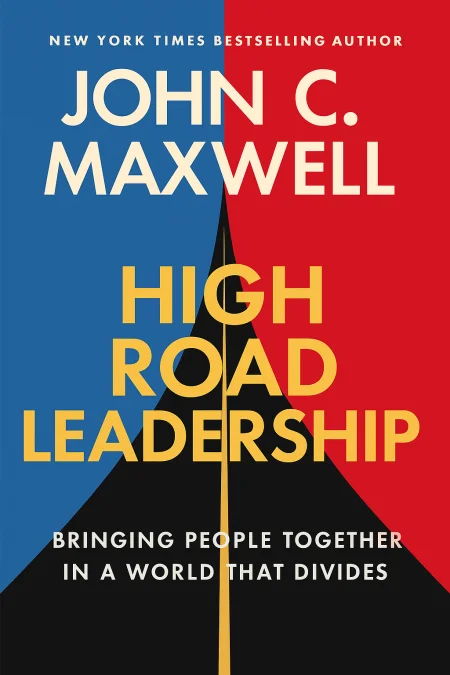
High Road Leadership
Bringing People Together in a World That Divides
Book Edition Details
Summary
In a world teetering on the edge of division, John C. Maxwell presents a beacon of hope with "High-Road Leadership." This transformative guide invites leaders to transcend conflict by choosing integrity and empathy over self-interest and division. Maxwell, a revered authority in leadership, illuminates the path to impactful leadership through principled choices and human-centered values. He critiques the pitfalls of low and middle-road approaches, advocating for a high-road strategy where accountability, respect, and altruism reign supreme. Whether you're guiding a team or influencing a community, Maxwell's insights empower you to elevate others, forging a legacy of positive change. Dive into this compelling narrative and discover how to become a leader who not only succeeds but uplifts all those around you.
Introduction
Contemporary leadership faces an unprecedented crisis of division and mistrust, where disagreement has transformed into contempt and political discourse has devolved from respectful competition to bitter warfare. Maxwell identifies a fundamental shift in how leaders approach their responsibilities, moving from serving others to serving themselves, creating a culture where winning at any cost has replaced principled decision-making. The central thesis challenges leaders to abandon the comfortable middle ground of transactional relationships and reject the destructive path of self-serving manipulation. The work presents a compelling framework distinguishing three distinct approaches to leadership: the low road of exploitation, the middle road of conditional exchange, and the high road of unconditional service. Through systematic examination of twelve essential practices, Maxwell demonstrates how high-road leadership transcends mere effectiveness to become transformational, requiring leaders to value people above profits, authenticity above appearance, and collective success above personal advancement. This analytical framework provides readers with concrete tools for identifying their current leadership approach while charting a course toward more principled and sustainable influence. The methodology combines philosophical reasoning with practical application, offering both diagnostic clarity and prescriptive guidance for leaders seeking to unite rather than divide.
The Three Roads of Leadership: Why High Road Leaders Stand Apart
The foundational argument establishes three distinct paradigms of leadership behavior, each characterized by fundamentally different motivational structures and relational approaches. Low-road leaders operate from scarcity mindset, viewing leadership as a zero-sum game where personal advancement necessitates others' diminishment. Their decision-making process prioritizes immediate self-interest, creating organizational cultures marked by fear, competition, and minimal trust. This approach generates short-term gains through manipulation and control but ultimately undermines sustainable influence as people recognize the transactional nature of such relationships. Middle-road leaders embrace fairness as their governing principle, seeking equilibrium in exchanges and maintaining careful scorekeeping to ensure reciprocity. While seemingly more ethical than low-road approaches, this paradigm remains fundamentally limited by its transactional nature. These leaders willingly engage in compromise and negotiation but only when guaranteed equivalent returns on their investments. The inherent weakness lies in their conditional approach to relationship-building, where trust depends on maintaining perfect balance rather than genuine care for others' welfare. High-road leadership transcends transactional thinking entirely, operating from abundance mentality where giving precedes receiving without expectation of reciprocity. These leaders demonstrate consistent behavior patterns that prioritize others' success even when personal costs are involved. The distinguishing characteristic involves their willingness to absorb losses, forgive offenses, and invest in people regardless of immediate returns. This approach creates exponential influence because people naturally gravitate toward leaders who demonstrate genuine care and authentic commitment to collective success rather than personal advancement. The practical implications reveal themselves in organizational culture, employee engagement, and long-term sustainability. High-road leaders create environments where innovation flourishes, loyalty deepens, and performance improves because team members feel valued rather than exploited. The evidence suggests that while high-road leadership may involve short-term costs, the long-term benefits far exceed those generated by alternative approaches.
Twelve Essential Practices of High Road Leadership
The comprehensive framework identifies twelve interconnected behaviors that collectively define high-road leadership, forming a systematic approach to principled influence. These practices operate synergistically rather than independently, creating reinforcing patterns that strengthen overall leadership effectiveness. The first cluster focuses on foundational attitudes: valuing all people regardless of their status or contribution, acknowledging personal limitations and failures without defensiveness, and consistently choosing ethical behavior even when alternatives promise easier outcomes. The second group addresses relational dynamics through generous giving that exceeds taking, emotional regulation that maintains stability under pressure, and priority systems that place others' welfare above personal agendas. These practices require leaders to develop internal strength and external focus simultaneously, balancing personal needs with collective responsibilities. The evidence demonstrates that leaders who master these intermediate practices create trust-based relationships that enhance their influence exponentially. The final cluster encompasses advanced leadership behaviors including authentic communication that reveals vulnerability, complete accountability for outcomes regardless of external factors, strategic thinking that encompasses broader implications beyond immediate concerns, and generous forgiveness that releases both self and others from past failures. The culminating practice involves genuinely desiring others' success and taking concrete action to facilitate their achievement. Implementation requires sequential development rather than simultaneous adoption, as each practice builds foundation for subsequent behaviors. The interconnected nature means that weakness in foundational areas undermines advanced practices, while strength in basic behaviors accelerates development of sophisticated leadership capabilities. Research indicates that leaders who consistently demonstrate these twelve practices create organizational cultures marked by higher performance, greater innovation, improved retention, and increased adaptability to changing circumstances.
The Cost and Challenges of Choosing the High Road
High-road leadership demands significant personal sacrifice, contradicting popular assumptions about leadership privileges and benefits. The analysis reveals that principled leadership often requires accepting short-term losses, enduring criticism from those who prefer expedient solutions, and maintaining standards even when others abandon theirs. These costs manifest in various forms: financial sacrifice when choosing ethical options over profitable alternatives, social isolation when taking unpopular but correct positions, and emotional burden when accepting responsibility for others' failures. The challenges intensify in competitive environments where low-road and middle-road leaders gain temporary advantages through manipulation, corner-cutting, or political maneuvering. High-road leaders must develop resilience to withstand pressure from stakeholders who demand immediate results regardless of methods employed. The temptation to compromise principles increases during crisis situations when expedient solutions appear more attractive than principled approaches that require patience and persistence. Organizational resistance presents another significant obstacle, as existing systems often reward behaviors that contradict high-road principles. Leaders attempting transformation face skepticism from team members accustomed to transactional relationships, resistance from stakeholders invested in status quo arrangements, and systemic barriers that favor short-term thinking over long-term development. The change process requires consistent demonstration of new behaviors over extended periods before trust develops and cultural transformation occurs. The evidence suggests that leaders who successfully navigate these challenges experience profound personal satisfaction alongside professional success. While costs are real and immediate, benefits compound over time, creating sustainable influence that transcends individual tenure. High-road leaders report greater fulfillment, stronger relationships, and more meaningful impact than those who choose alternative approaches. The key lies in accepting initial costs as investments in long-term effectiveness rather than viewing them as unfair burdens to be minimized or avoided.
Why High Road Leadership Is Essential for Our Divided World
Contemporary society faces unprecedented polarization, with institutional trust declining across all sectors and public discourse deteriorating into hostile confrontation rather than constructive dialogue. Traditional leadership approaches contribute to this fragmentation by encouraging zero-sum thinking, promoting tribal loyalty over universal principles, and rewarding divisive rhetoric that mobilizes supporters while alienating opponents. The resulting environment makes collaborative problem-solving increasingly difficult as leaders focus on defeating opponents rather than addressing shared challenges. High-road leadership offers a proven alternative that bridges divisions through consistent demonstration of universal values and genuine concern for all stakeholders. These leaders create common ground by focusing on shared interests rather than highlighting differences, building trust through transparent communication and reliable behavior, and modeling the collaborative approaches necessary for addressing complex societal problems. Historical evidence demonstrates that transformational social progress occurs when leaders transcend partisan boundaries to unite diverse groups around common purposes. The global nature of contemporary challenges requires leadership approaches that can function across cultural, ideological, and national boundaries. Climate change, economic inequality, technological disruption, and pandemic response demand coordinated action that transcends traditional divisions. High-road leaders possess the credibility and relationship-building capability necessary for such coordination because their commitment to principle supersedes loyalty to particular groups or ideologies. The multiplication effect of high-road leadership creates hope for systemic change as these leaders develop other high-road leaders, creating expanding networks of principled influence. Organizations led by high-road leaders become training grounds for future leaders who carry these principles into new contexts, gradually transforming institutional culture across society. While individual high-road leaders make important contributions, the cumulative impact of growing numbers of such leaders offers genuine possibility for reversing current trends toward fragmentation and restoring collaborative approaches to shared challenges.
Summary
The fundamental insight emerging from this comprehensive analysis reveals that effective leadership in divisive times requires deliberate choice to prioritize others' welfare above personal advancement, creating influence through service rather than dominance. Maxwell's systematic examination of high-road principles demonstrates that sustainable leadership effectiveness flows from character-based behaviors that build trust, foster collaboration, and generate mutual benefit rather than zero-sum competition. The twelve practices provide concrete framework for developing such leadership, while honest acknowledgment of associated costs and challenges prepares aspiring leaders for the realities of principled influence in competitive environments. The evidence strongly supports the conclusion that high-road leadership, despite requiring significant personal sacrifice, produces superior long-term results for leaders, organizations, and society while offering the most promising approach for bridging divisions that threaten democratic institutions and social cohesion.
Related Books
Download PDF & EPUB
To save this Black List summary for later, download the free PDF and EPUB. You can print it out, or read offline at your convenience.
By John C. Maxwell
