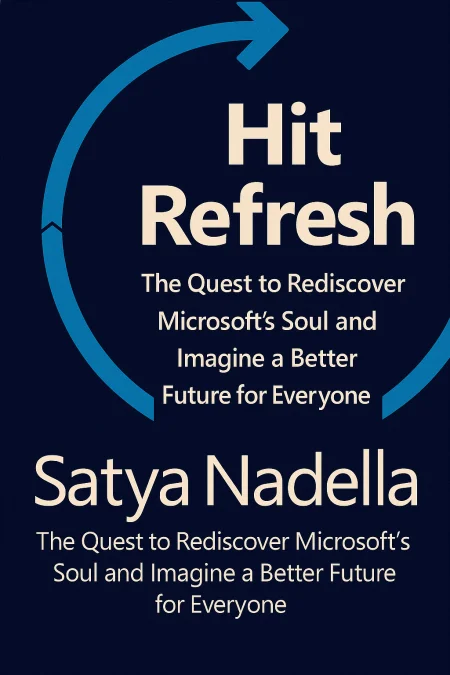
Hit Refresh
The Quest to Rediscover Microsoft’s Soul and Imagine a Better Future for Everyone
bySatya Nadella, Greg Shaw, Jill Tracie Nichols
Book Edition Details
Summary
From the bustling streets of Hyderabad to the cutting-edge boardrooms of Microsoft, Satya Nadella's transformative journey is a masterclass in innovation and resilience. In "Hit Refresh," Nadella shares his vision of a world poised on the brink of change, where technology's relentless advance demands a renewal of spirit and strategy. Balancing the duality of technologist and humanist, Nadella explores how empathy and ingenuity can power a new era of corporate and personal reinvention. This narrative dives deep into the mind of a leader committed to empowering individuals and organizations alike, offering rare insights into the life of one of the tech industry's most influential figures. Here, in the intertwining tales of global leadership and personal growth, Nadella invites readers to reimagine what's possible in a future shaped by intelligent machines and human creativity.
Introduction
On a cold February morning in 2014, Satya Nadella stood before thousands of Microsoft employees as the company's newly appointed CEO, carrying the weight of a tech giant that had lost its way. The son of an Indian civil servant and a Sanskrit scholar, Nadella had immigrated to America with little more than dreams and determination, eventually rising through Microsoft's ranks over more than two decades. His appointment marked a pivotal moment not just for him personally, but for one of the world's most influential technology companies, which was struggling to remain relevant in a rapidly changing digital landscape. What makes Nadella's story particularly compelling is how he transformed both himself and Microsoft through a philosophy centered on empathy, growth mindset, and inclusive leadership. Unlike the aggressive, competitive culture that had defined Microsoft's earlier decades, Nadella advocated for a more collaborative approach that emphasized learning over knowing, partnerships over dominance, and human connection over pure technological prowess. His journey from a cricket-loving student in Hyderabad to the leader of a global technology empire offers profound insights into modern leadership, the power of cultural transformation, and the responsibility of technology companies in shaping society's future. Through his experiences, readers will discover timeless lessons about resilience, the courage to reinvent oneself, and the importance of leading with both head and heart in an age of artificial intelligence and digital disruption.
From Hyderabad to Redmond: Early Life and Microsoft Journey
Satya Nadella's formative years in India profoundly shaped the leader he would become. Growing up as the son of an Indian Administrative Service officer and a Sanskrit scholar, he was exposed to both intellectual rigor and spiritual wisdom from an early age. His father's Marxist leanings instilled a love of history and intellectual curiosity, while his mother's teachings emphasized happiness, balance, and living in the moment without regret. This unique blend of influences would later manifest in his approach to leadership, combining analytical thinking with deep empathy for others. Cricket played a central role in young Nadella's development, teaching him lessons about teamwork, perseverance, and leadership that would prove invaluable in his corporate career. Playing as an off-spin bowler for his school team, he learned the importance of putting team success above personal statistics and witnessed firsthand how effective leadership could build confidence in struggling teammates. These early experiences on the cricket field became metaphors for business collaboration and the delicate art of knowing when to step in and when to step back as a leader. The transition from India to America marked a crucial turning point in Nadella's life. Arriving in Milwaukee on his twenty-first birthday with limited coding experience, he immersed himself in computer science studies while working to overcome both technical and cultural challenges. His journey from Sun Microsystems to Microsoft in 1992 demonstrated his ability to recognize and seize opportunities, joining the company during the early days of Windows NT development. This move would prove prescient, positioning him at the forefront of Microsoft's evolution from a PC-focused company to a cloud and enterprise software leader. Nadella's early years at Microsoft were marked by his willingness to tackle complex technical challenges and his natural ability to bridge different worlds. His work as a Windows NT evangelist required him to convince skeptical enterprise customers that their mission-critical applications could run effectively on PC architecture, developing skills in persuasion, technical translation, and customer empathy that would serve him throughout his career. Even then, colleagues recognized his unique combination of technical expertise and human understanding, qualities that would eventually distinguish him as a transformational leader in the technology industry.
Leading Through Crisis: Cultural Transformation and Strategic Partnerships
When Nadella assumed the CEO role in 2014, Microsoft faced an existential crisis. The company that had once dominated personal computing was struggling to remain relevant in a mobile-first, cloud-first world. PC sales were declining, Windows Phone had failed to gain significant market share, and the company's culture had become increasingly siloed and competitive. Employees felt frustrated and directionless, while competitors like Google, Apple, and Amazon seemed to be defining the future of technology. Nadella recognized that technical innovation alone would not be sufficient; Microsoft needed a fundamental cultural transformation. The cornerstone of Nadella's transformation strategy was shifting Microsoft from a "know-it-all" to a "learn-it-all" culture. Drawing inspiration from psychologist Carol Dweck's research on growth mindset, he emphasized three core principles: obsessing about customers rather than competitors, embracing diversity and inclusion as essential for innovation, and operating as "One Microsoft" instead of competing internal fiefdoms. This cultural shift required dismantling long-established hierarchies and encouraging collaboration across traditional organizational boundaries. The transformation was neither quick nor easy, requiring consistent reinforcement through actions, decisions, and symbolic gestures that demonstrated the new values in practice. One of Nadella's most counterintuitive strategic decisions involved embracing partnerships with traditional competitors. Rather than viewing the technology landscape as a zero-sum game, he pursued collaborative relationships with Apple, Google, and other rivals, recognizing that Microsoft's success in a connected world depended on making its software and services available across all platforms. This approach culminated in surprising moments, such as Nadella demonstrating Microsoft Office running on an iPhone at a competitor's conference, signaling a dramatic departure from the company's historically combative stance toward rivals. The results of this cultural and strategic transformation became evident in Microsoft's renewed growth and innovation. Employee engagement scores improved dramatically, the company's cloud business Azure became a legitimate competitor to Amazon Web Services, and Microsoft's stock price reflected renewed investor confidence. Perhaps more importantly, the company regained its sense of purpose and mission, with employees feeling empowered to take risks, learn from failures, and collaborate across traditional boundaries. Nadella's leadership during this period demonstrated that successful transformation requires not just strategic vision, but the emotional intelligence to guide people through fundamental change while maintaining their dignity and motivation.
Building the Future: Cloud Computing, AI, and Quantum Technologies
Nadella's vision for Microsoft's future centered on three transformative technology platforms: cloud computing, artificial intelligence, and quantum computing. His experience building Bing search engine had given him deep insights into the scalability and complexity required for cloud-based services, preparing him to guide Microsoft's aggressive expansion into Azure cloud platform. Under his leadership, Microsoft made massive investments in global data center infrastructure while developing the technical capabilities needed to compete with Amazon's established cloud dominance. This wasn't merely about matching competitors; it represented a fundamental reimagining of how businesses would consume computing resources in the future. The integration of artificial intelligence across Microsoft's product portfolio reflected Nadella's belief that AI should augment rather than replace human capabilities. From Cortana's conversational abilities to machine learning services embedded in Office applications, Microsoft pursued a vision of AI that enhanced human creativity and productivity rather than threatening job security. Nadella emphasized the importance of building AI systems with ethical considerations at their core, advocating for transparency, accountability, and inclusivity in algorithmic decision-making. This approach positioned Microsoft as a responsible leader in AI development while creating practical applications that delivered immediate value to users. Perhaps most ambitiously, Nadella championed Microsoft's investment in quantum computing research through initiatives like Station Q at UC Santa Barbara. Recognizing that quantum computing could revolutionize everything from drug discovery to climate modeling, he supported long-term research investments that might not yield commercial results for decades. This willingness to invest in horizon-three technologies while managing day-to-day business operations demonstrated his ability to balance short-term performance pressures with long-term strategic vision. The convergence of these three technology platforms promised to create entirely new categories of human-computer interaction. Nadella envisioned a future where mixed reality interfaces powered by AI and enabled by quantum computing would transform everything from education to healthcare to entertainment. This integrated technology vision required Microsoft to develop capabilities across hardware, software, and services while maintaining the cultural agility to adapt as these technologies evolved. His leadership in navigating these complex technical and business challenges established Microsoft as a credible player in defining the next generation of computing experiences.
Global Leadership: Trust, Ethics, and Inclusive Economic Growth
Nadella's tenure as CEO coincided with increasingly complex questions about the role of technology companies in global society. High-profile incidents like the Sony Pictures hack and the FBI's demand that Apple unlock a terrorist's iPhone forced Microsoft to take principled stands on issues of free speech, privacy, and national security. Rather than avoiding these controversies, Nadella positioned Microsoft as a advocate for digital rights and international cooperation, arguing for a "Digital Geneva Convention" to govern cyberspace conflicts and protect civilian digital infrastructure from state-sponsored attacks. The challenge of building trust in an era of digital surveillance and data breaches became central to Microsoft's strategy under Nadella's leadership. He developed what he called a "trust equation" combining empathy, shared values, safety, and reliability delivered consistently over time. This approach required significant investments in data security, transparent reporting about government data requests, and clear policies about how customer information would be protected and used. These weren't merely defensive measures; trust became a competitive differentiator that enabled Microsoft to win enterprise customers who demanded the highest levels of data protection. Nadella's global perspective, shaped by his own immigrant experience and Microsoft's worldwide operations, led him to advocate for technology policies that promoted inclusive economic growth. He recognized that technological advancement without corresponding social progress could exacerbate inequality and undermine the political stability that enabled innovation to flourish. His advocacy for expanded computer science education, digital skills training, and policies supporting technology adoption in developing countries reflected his belief that technology companies had responsibilities beyond profit maximization. The acquisition of LinkedIn for twenty-six billion dollars exemplified Nadella's vision of using technology to create economic opportunity rather than merely maximizing efficiency. By combining Microsoft's productivity tools with LinkedIn's professional networking platform, he aimed to help individuals navigate career transitions and access opportunities regardless of their geographic location or educational background. This represented a broader philosophy that technology should democratize access to opportunity rather than concentrating advantages among those who already possessed them, positioning Microsoft as a force for social mobility and economic inclusion in an age of increasing automation and digital disruption.
Summary
Satya Nadella's remarkable journey from cricket-loving student in Hyderabad to CEO of one of the world's most influential technology companies demonstrates that authentic leadership in the digital age requires both technical vision and profound human empathy. His transformation of Microsoft from a struggling, insular organization into a collaborative, growth-oriented company that embraces both competition and partnership offers a powerful model for leading change in complex, rapidly evolving industries. Perhaps most significantly, Nadella's insistence that technology should empower every person and organization on the planet to achieve more reflects a mature understanding of corporate responsibility that extends far beyond quarterly earnings. The lessons from Nadella's experience resonate far beyond the technology sector, offering insights for anyone seeking to lead meaningful change in their organization or community. His emphasis on growth mindset over fixed thinking, collaboration over competition, and long-term value creation over short-term wins provides a framework for navigating uncertainty while maintaining core values. For leaders facing their own transformation challenges, Nadella's story suggests that the most profound changes often begin with honest self-reflection and a willingness to embrace vulnerability as a source of strength rather than weakness.
Related Books
Download PDF & EPUB
To save this Black List summary for later, download the free PDF and EPUB. You can print it out, or read offline at your convenience.
By Satya Nadella
