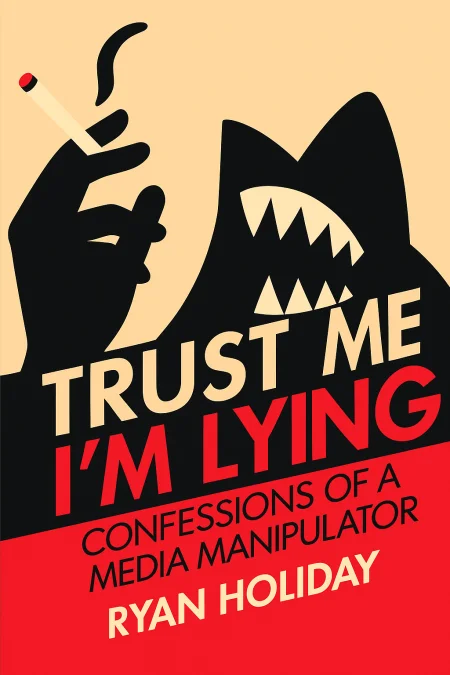
Trust Me, I’m Lying
Confessions of a Media Manipulator
Book Edition Details
Summary
Beneath the polished veneer of the digital age lies a tangled web of deceit, and one man stands at its chaotic core—a self-proclaimed puppet master of the blogosphere. In "Trust Me, I'm Lying," the anonymous orchestrator reveals the dark art of media manipulation, where whispered rumors can topple empires and viral fame is but a flick of the wrist away. With an insider's unflinching eye, the author exposes the mercenary nature of modern news, a world where bloggers dance to the tune of profit and deadlines, and truth becomes a casualty. This provocative exposé lifts the veil on the shadowy forces steering our information landscape, daring you to question every headline, every post, and every tweet. In a realm where accountability has vanished, understanding the machinations is your only armor.
Introduction
The digital age promised democratization of information, yet beneath the surface of our interconnected media landscape lies a sophisticated system of manipulation that shapes public discourse in ways most readers never imagine. This exploration reveals how modern blogging culture has created unprecedented vulnerabilities in our information ecosystem, where economic incentives consistently triumph over accuracy and truth. The author approaches this examination not as an outside critic but as a practitioner who has exploited these weaknesses for profit, offering a unique insider's perspective on the mechanics of media manipulation. The analysis demonstrates how the fundamental economics of online publishing—driven by pageviews, clicks, and advertising revenue—creates perverse incentives that corrupt the very foundations of journalism. Through detailed case studies and personal confessions, we witness how easily false narratives can be planted, amplified, and transformed into accepted reality through a process that rewards sensationalism over substance. This investigation challenges readers to reconsider their relationship with digital media, question the sources of their information, and understand the hidden forces that influence public opinion in the twenty-first century.
The Mechanics of Media Manipulation
The architecture of modern media manipulation operates through a systematic process that exploits the structural weaknesses of digital journalism. At its core, this system functions as a chain reaction where small, fabricated stories are strategically planted in lower-tier blogs and then methodically traded up through increasingly prestigious media outlets until they achieve mainstream acceptance. This process, known as "trading up the chain," transforms manufactured controversies into genuine public discourse with remarkable efficiency. The mechanics rely heavily on the desperation of bloggers who face crushing economic pressures to produce content constantly. With payment structures tied directly to pageviews and traffic metrics, writers become willing accomplices in spreading unverified information simply because sensational content performs better than careful journalism. The speed demands of digital publishing create an environment where verification becomes a luxury few can afford, and where being first matters infinitely more than being right. This system's power lies in its ability to create self-reinforcing cycles of misinformation. Once a story gains traction at lower levels, it becomes increasingly difficult for journalists at higher tiers to ignore, even when the foundational claims remain unsubstantiated. The appearance of widespread coverage itself becomes evidence of newsworthiness, creating an illusion of legitimacy that masks the artificial origins of many trending topics. The most insidious aspect of this manipulation is how it exploits the public's trust in traditional markers of credibility, using the language and formatting conventions of legitimate journalism to lend authority to manufactured content.
The Economic Incentives Behind Blog Corruption
The corrupting influence of blog economics stems from a fundamental misalignment between public interest and financial incentives that govern digital publishing. Unlike traditional journalism, where subscription models created some buffer between immediate audience reaction and editorial decisions, blogs operate in a pure attention economy where every story must compete individually for clicks and engagement. This creates relentless pressure to sensationalize, exaggerate, and prioritize emotional impact over factual accuracy. Payment structures in the blogging world directly reward manipulation and sensationalism. Writers compensated per pageview have clear financial incentives to publish provocative content regardless of its truth value. The most successful bloggers learn to craft headlines that promise scandal, controversy, or exclusive information, even when the accompanying articles fail to deliver on these promises. This system transforms journalists from information gatherers into attention merchants, fundamentally altering their relationship with both sources and readers. The business model itself depends on creating artificial scarcity and urgency around information that may be neither scarce nor urgent. Blogs manufacture exclusive access to mundane press releases, transform routine business announcements into breaking news, and create false impressions of insider knowledge to justify their existence in an oversaturated information landscape. The pressure to maintain this illusion of special access makes bloggers particularly vulnerable to manipulation by skilled publicists and marketers. These economic realities create a race to the bottom where ethical considerations become competitive disadvantages, and where the most successful operations are often those most willing to abandon traditional journalistic standards in pursuit of traffic and revenue.
The Dangerous Consequences of Fake News
The proliferation of manufactured information through corrupted media channels produces consequences that extend far beyond simple misinformation, creating cascading effects that distort public understanding and influence real-world decisions. When false narratives achieve widespread acceptance through the trading-up process, they become the basis for subsequent reporting, creating self-perpetuating cycles of error that prove nearly impossible to correct. The speed of digital information sharing ensures that corrections, when they come, reach only a fraction of those who encountered the original false claims. Perhaps most troubling is how this system weaponizes human psychology against itself. Research demonstrates that people form initial judgments rapidly and then unconsciously filter subsequent information to confirm these first impressions. When blogs exploit this tendency by leading with sensational but false claims, they effectively hijack readers' cognitive processes, making audiences more likely to believe misinformation even when presented with contradictory evidence. The attempt to correct false information often backfires, reinforcing the original misconceptions rather than dispelling them. The democratization of publishing has eliminated many traditional gatekeepers without replacing them with effective alternatives, creating an environment where malicious actors can easily introduce false information into public discourse. Corporate interests, political operatives, and attention-seeking individuals have learned to game the system, understanding that a well-placed lie can travel faster and farther than careful truth-telling. This transformation has turned the media landscape into a battleground where truth and falsehood compete on unequal terms. The cumulative effect of these dynamics is the creation of an "unreality" where the distinction between authentic and manufactured information becomes increasingly difficult to maintain, undermining the foundation of informed democratic discourse.
Toward Understanding Our Information Crisis
The path toward comprehending our current information crisis requires recognizing that the problems plaguing digital media are not merely technical glitches or temporary growing pains, but fundamental contradictions built into the economic and technological structures of online publishing. The crisis emerges from the collision between the democratic promise of universal access to information and the reality of systems designed to prioritize engagement over accuracy, speed over verification, and profit over public service. Understanding this crisis demands acknowledgment that solutions cannot be found within the existing framework of incentives that created the problems. The metrics that drive success in digital media—clicks, shares, time spent on page—actively reward the production of low-quality, emotionally manipulative content while penalizing careful, nuanced reporting that serves genuine public interest. Any meaningful response must address these underlying economic realities rather than simply calling for better behavior within a corrupted system. The crisis also reflects a broader cultural shift toward what might be called "ambient misinformation," where the sheer volume of questionable content creates an environment of epistemological uncertainty. When readers cannot reliably distinguish between authentic reporting and manufactured controversy, they may retreat into cynical disengagement or, perhaps worse, embrace whatever information confirms their existing beliefs regardless of its veracity. Recognition of these dynamics suggests that rebuilding trustworthy information systems will require not just individual awareness but structural changes that realign incentives with public interest, creating sustainable models for quality journalism while developing new forms of media literacy adequate to our transformed information landscape.
Summary
The fundamental insight revealed through this examination is that our information ecosystem has been systematically corrupted by economic incentives that reward manipulation over truth-telling, creating a feedback loop where sensationalism becomes increasingly necessary for survival in the attention economy. The confession of a practitioner who exploited these weaknesses demonstrates not only how easily the system can be gamed, but how the resulting distortions of reality have real consequences for democratic discourse and public understanding. This analysis serves as both warning and call to action, suggesting that recognition of these manipulation techniques is the first step toward developing the critical awareness necessary to navigate an information landscape where truth and falsehood compete on fundamentally unequal terms.
Related Books
Download PDF & EPUB
To save this Black List summary for later, download the free PDF and EPUB. You can print it out, or read offline at your convenience.
By Ryan Holiday
