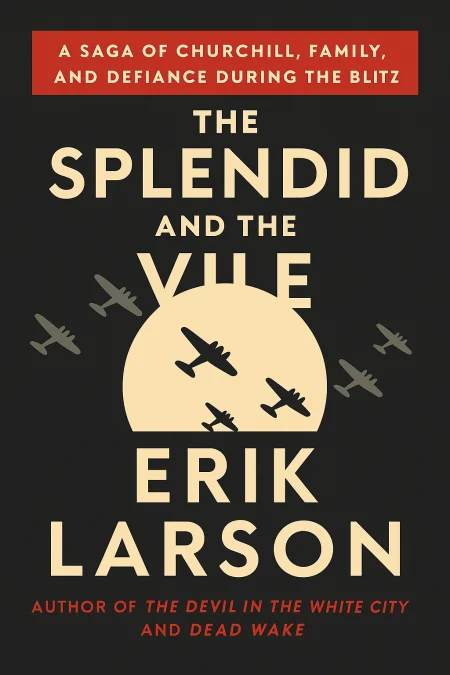
The Splendid and the Vile
A Saga of Churchill, Family, and Defiance During the Blitz
Book Edition Details
Summary
In the shadow of a relentless blitz, where the skies over London roared with the menace of Nazi bombers, a singular figure emerged to unite a nation on the brink. Erik Larson's "The Splendid and the Vile" delves into Winston Churchill's turbulent first year as prime minister, a year marked by unyielding courage and strategic brilliance. As Europe crumbled and hope seemed a distant memory, Churchill's indomitable spirit and rhetorical prowess turned fear into defiance. With cinematic clarity, Larson paints an intimate portrait not only of wartime politics but of the personal lives intertwined with history's grand narrative. Through newly unveiled documents and the whispers of clandestine meetings, readers gain an unprecedented glimpse into Churchill's inner circle and family dynamics. This masterwork transcends mere history, revealing the art of fearless leadership amid the chaos of war.
Introduction
In the spring of 1940, as Nazi Germany's war machine swept across Europe with terrifying efficiency, Britain stood alone against what seemed like an unstoppable force of tyranny. At this moment of supreme crisis, when the very survival of democracy hung in the balance, the British people turned to a man whose entire life had been preparation for this singular test of leadership. Winston Churchill, at sixty-five, finally ascended to the office he had coveted his entire career, becoming Prime Minister just as Hitler's forces prepared to deliver what many believed would be the final blow to Western civilization. Churchill's rise to power came not in triumph but in crisis, not in celebration but in desperation. His appointment coincided precisely with Hitler's devastating assault on Western Europe, marking the beginning of what would become known as Britain's finest hour. Yet this was also Churchill's most perilous gamble, for he inherited a nation woefully unprepared for the storm about to break upon its shores. Through the crucible of the London Blitz and the Battle of Britain, we witness how one man's indomitable will and extraordinary leadership transformed a demoralized nation into an instrument of resistance that would ultimately help save the free world. From Churchill's journey, we discover the anatomy of leadership under extreme pressure, the power of words to inspire courage against overwhelming odds, and the profound truth that sometimes civilization's fate rests upon a single individual who refuses to surrender.
The Reluctant Prime Minister: Rise to Power
Churchill's path to 10 Downing Street was neither straight nor assured. For years, he had been a voice crying in the wilderness, warning of the Nazi threat while his contemporaries pursued the false comfort of appeasement. His political career had been marked by spectacular failures and remarkable comebacks, earning him a reputation as brilliant but unreliable, a man whose judgment was often questioned even as his oratory was universally admired. When Neville Chamberlain's government finally collapsed under the weight of military disaster in Norway, Churchill emerged not as the obvious choice, but as the only man willing to shoulder the burden of leadership at Britain's darkest hour. The circumstances of his appointment were almost theatrical in their drama. As German panzers rolled through the Ardennes and the French army crumbled, King George VI summoned Churchill to Buckingham Palace on the evening of May 10. The King, who had harbored doubts about Churchill's temperament, asked with characteristic directness whether Churchill knew why he had been called. Churchill's response masked the profound emotion of a man who had waited his entire life for this moment. When the King asked him to form a government, Churchill accepted with gravity befitting the occasion, though privately he felt a surge of exhilaration that would sustain him through the trials ahead. Churchill understood immediately that he faced a task of almost impossible magnitude. France was collapsing with shocking speed, the British Expeditionary Force was trapped at Dunkirk, and invasion seemed not just possible but probable. Yet rather than being daunted by these circumstances, Churchill seemed energized by them. He brought to his new office a confidence in ultimate victory that bordered on the mystical, combined with realistic appreciation of immediate dangers. His first acts as Prime Minister revealed the man in full: appointing himself Minister of Defense to ensure complete control over military strategy, while simultaneously reaching out to former critics to build a government of national unity. The transformation of Whitehall under Churchill's leadership was immediate and electric. Where Chamberlain had been methodical and cautious, Churchill was dynamic and demanding. Civil servants who had grown comfortable with peacetime rhythms suddenly found themselves racing through corridors to meet impossible deadlines. Churchill's famous minutes, dictated at all hours and covering every conceivable aspect of the war effort, became the driving force of a government suddenly awakened to the reality of total war.
Standing Alone: Britain Under Siege
The summer of 1940 brought Britain face to face with extinction. With France fallen and the British Expeditionary Force evacuated from Dunkirk minus most of its equipment, Hitler turned his attention to the island nation that dared to defy him. The German plan was methodical and seemingly unstoppable: first, the Luftwaffe would destroy the Royal Air Force, then the Wehrmacht would launch Operation Sea Lion, the invasion of Britain. Against this threat, Churchill had to marshal not just military resources but the very soul of the British people. The Battle of Britain began in earnest on August 13, 1940, when Hermann Göring launched his promised campaign to annihilate the RAF. Day after day, hundreds of German bombers escorted by swarms of fighters crossed the English Channel, met by the few of Churchill's famous phrase, the young pilots of Fighter Command who rose to meet them in their Spitfires and Hurricanes. Churchill understood that this was more than a military campaign; it was a test of national will. He made himself visible throughout the crisis, visiting airfields, touring bombed areas, and maintaining a public presence that radiated confidence even as private intelligence reports painted an increasingly desperate picture. The air battle reached its crescendo on September 15, when the Luftwaffe launched what it intended to be the decisive blow against London. Churchill spent that day at the RAF operations room at Uxbridge, watching as every available fighter was committed to the battle. When he asked the controller what reserves remained, the chilling reply was "None." Yet somehow, the RAF held. The German formations were turned back with heavy losses, and Hitler, recognizing that air superiority remained elusive, postponed the invasion indefinitely. Churchill's immediate response was characteristic: "Never in the field of human conflict was so much owed by so many to so few." But survival in the air was only part of the challenge. As autumn arrived, Hitler shifted tactics from daylight raids on airfields to nighttime bombing of cities, beginning with the massive attack on London's East End on September 7. The Blitz had begun, and with it a new test of British resolve. Churchill's response revealed his deep understanding of the psychology of leadership under extreme stress. Rather than hiding in bunkers, he made himself conspicuously present in the bombed areas, weeping openly with the victims while simultaneously projecting an image of unshakeable determination.
Defiance Under Fire: The Blitz Spirit
Churchill's leadership during the Blitz revealed the full measure of his genius for inspiring others in the face of seemingly hopeless odds. Night after night, as German bombers pounded London and other British cities, Churchill demonstrated that effective leadership in crisis requires not just strategic vision but an almost theatrical understanding of how to embody the spirit of resistance. His decision to order London's anti-aircraft guns to fire with abandon, despite knowing they would rarely hit their targets, showed his intuitive grasp of the importance of morale. The sound of the guns gave Londoners the feeling that they were fighting back, transforming passive victims into active participants in their own defense. The prime minister's daily routine during this period became the stuff of legend. Working eighteen-hour days, dictating minutes and memoranda from his bed, his bath, or while pacing the Cabinet Room, Churchill drove his staff to exhaustion while somehow maintaining his own extraordinary energy. His ability to switch instantly from grand strategy to minute details, from planning the defense of Egypt to worrying about the tea ration, reflected a mind that could hold the entire war in focus while never losing sight of the human elements that would determine its outcome. His famous "ACTION THIS DAY" labels became symbols of a government finally awakened to the urgency of total war. Churchill's relationship with his inner circle during this period illuminated another aspect of his leadership philosophy. He surrounded himself with men like Lord Beaverbrook, whose abrasive personality and ruthless methods made him many enemies but whose results in aircraft production were undeniable. Churchill understood that in extremis, effectiveness mattered more than popularity, and he was willing to absorb the criticism that came with supporting controversial subordinates if they delivered what the nation needed. His protection of scientific adviser Frederick Lindemann, despite widespread hostility toward "the Prof," demonstrated the same principle: Churchill valued loyalty and competence above conventional wisdom. Perhaps most remarkably, Churchill maintained throughout this period his vision of ultimate victory, even when objective analysis suggested that survival was the best Britain could hope for. His secret correspondence with President Roosevelt, his planning for offensive operations even as Britain fought for its life, and his constant emphasis on taking the fight to the enemy all reflected a strategic imagination that refused to be bounded by immediate circumstances. This forward-looking perspective, combined with his ability to inspire others to share his vision, transformed what might have been a desperate defensive struggle into the foundation for eventual victory.
Forging Victory: Alliance and Transformation
The transformation of Britain from a nation fighting for survival to one capable of ultimate victory was perhaps Churchill's greatest achievement as a wartime leader. By the end of 1940, the immediate threat of invasion had passed, the RAF had proven its mettle, and the British people had demonstrated their capacity to endure punishment while maintaining their resolve. But Churchill understood that survival was not enough; Britain needed to become the base from which the liberation of Europe could be launched. This required not just military preparation but a fundamental shift in national psychology from defense to offense. Churchill's cultivation of the relationship with America proved crucial to this transformation. From his first days as Prime Minister, he had recognized that British victory was impossible without American participation, and he pursued this goal with a combination of strategic patience and tactical boldness. The destroyers-for-bases deal, while materially modest, represented a psychological breakthrough that began the process of American engagement. Churchill's ability to frame this transaction not as a commercial exchange but as a symbol of Anglo-American solidarity showed his deep understanding of how to manage the politics of alliance-building. The London Blitz, rather than breaking British morale as Hitler had intended, became instead a crucible that forged a new national identity. Under Churchill's leadership, the British people learned to see themselves not as victims but as the guardians of civilization itself. The prime minister's speeches during this period, with their combination of unflinching realism about present dangers and soaring confidence in ultimate victory, created a narrative framework that allowed ordinary citizens to understand their suffering as part of a larger historical drama. This transformation of meaning was perhaps Churchill's most important contribution to the war effort. By the winter of 1940-41, the foundation for victory had been laid. British aircraft production under Beaverbrook's driving leadership was exceeding all projections. The code-breakers at Bletchley Park were beginning to unlock German secrets. The Royal Navy, reinforced by American destroyers, was gradually gaining the upper hand in the Battle of the Atlantic. Most importantly, the British people had discovered reserves of courage and determination they had not known they possessed. Churchill's role in this transformation cannot be overstated; through the force of his personality, the power of his oratory, and the example of his own unshakeable resolve, he had shown a nation how to turn its darkest hour into the prelude to its finest achievement.
Summary
Winston Churchill's leadership during Britain's darkest hour stands as perhaps the supreme example in modern history of how a single individual's courage and vision can alter the course of human events. In those desperate months of 1940, when Nazi Germany seemed poised to complete its conquest of Europe, Churchill demonstrated that leadership in extremis requires not just strategic acumen but an almost mystical ability to inspire others to transcend their limitations and achieve what seems impossible. His greatest insight was understanding that in the face of existential threat, the leader's primary task is not merely to devise tactics but to provide meaning, to help people see their struggle as part of a larger story worthy of any sacrifice. The lessons of Churchill's wartime leadership remain profoundly relevant for anyone facing seemingly insurmountable challenges. His example teaches us that true leadership often means accepting responsibility when others flee from it, maintaining confidence when all objective evidence counsels despair, and never allowing immediate setbacks to obscure the larger vision of what must ultimately be achieved. For leaders in any field, students of history, and anyone seeking to understand how ordinary people can rise to extraordinary challenges, Churchill's story offers both inspiration and practical wisdom that the choice between surrender and resistance remains ours to make, and that sometimes the fate of everything we hold dear depends upon our willingness to fight on when fighting seems futile.
Related Books
Download PDF & EPUB
To save this Black List summary for later, download the free PDF and EPUB. You can print it out, or read offline at your convenience.

By Erik Larson
