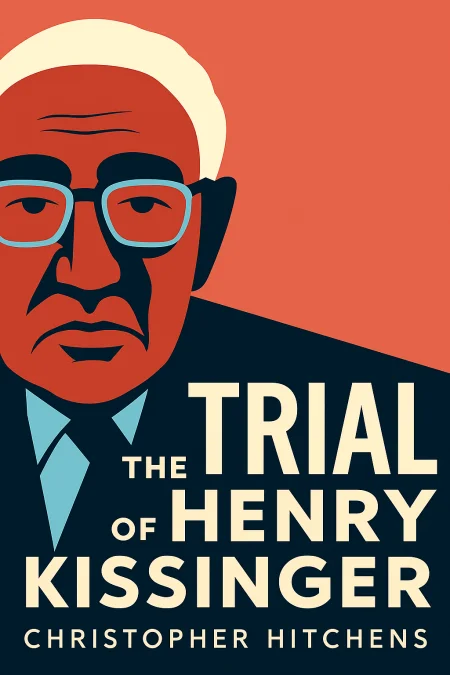
The Trial of Henry Kissinger
The dark side of American foreign policy
Book Edition Details
Summary
In a world where power often shields the wicked, Christopher Hitchens steps into the role of relentless prosecutor, unmasking the chilling legacy of Henry Kissinger. With a scalpel-like precision, Hitchens peels back the layers of diplomatic veneer to expose a tapestry of deceit and devastation spanning continents. From orchestrating civilian massacres in Indochina to fueling genocidal flames in East Timor, Kissinger's shadow looms large over some of history's darkest chapters. This book doesn't just recount events; it throws down a gauntlet, challenging the reader to confront the murky depths of American foreign policy. A gripping exposé, "The Trial of Henry Kissinger" is a clarion call for justice and accountability, daring to shed light on the truths that powerful interests would prefer to keep hidden.
Introduction
The systematic violation of international law by high-ranking government officials presents one of the most challenging questions in modern jurisprudence: how does a democratic society hold its most powerful figures accountable when they operate beyond traditional legal constraints? This examination confronts the uncomfortable reality that American foreign policy during the Nixon era involved deliberate acts that, under established international law, constitute war crimes and crimes against humanity. The analysis reveals a pattern of covert operations, illegal bombings, and assassination plots that fundamentally violated both domestic and international legal frameworks. The methodology employed here relies heavily on declassified government documents, congressional testimony, and contemporaneous diplomatic cables to construct an evidence-based case. Rather than relying on speculation or partisan interpretation, the argument builds upon official records that demonstrate clear knowledge and intent behind actions that resulted in massive civilian casualties across multiple continents. The significance lies not merely in cataloging past abuses, but in establishing that the principle of universal jurisdiction applies equally to American officials as it does to foreign dictators. This legal evolution represents a fundamental shift in how international law addresses state-sponsored violence, regardless of the perpetrator's nationality or political influence.
Kissinger's Pattern of International Crimes and Violations
The concept of systematic criminality in foreign policy requires understanding how individual decisions aggregate into recognizable patterns of lawlessness. Kissinger's approach to international relations consistently prioritized strategic outcomes over legal constraints, treating international law as an inconvenient obstacle rather than a binding framework. This mindset manifested in repeated violations of the Geneva Conventions, deliberate targeting of civilian populations, and the orchestration of covert operations designed to overthrow legitimate governments. The documentation reveals a decision-making process that explicitly acknowledged the illegal nature of proposed actions while proceeding nonetheless. Internal memoranda demonstrate awareness that bombing campaigns in Cambodia and Laos violated both the sovereignty of neutral nations and congressional oversight requirements. Similarly, covert operations in Chile involved direct participation in assassination plots against democratically elected officials and constitutional military leaders who refused to participate in coup attempts. The pattern extends beyond simple policy disagreements to include deliberate deception of Congress, systematic destruction of evidence, and the creation of parallel command structures designed to circumvent legal oversight. These actions represent a calculated assault on democratic accountability, transforming foreign policy into a personal fiefdom where constitutional constraints were treated as mere suggestions rather than binding law. The legal framework established at Nuremberg specifically addressed the argument that state officials cannot be held responsible for following orders or pursuing national interests. The principle of individual accountability for war crimes explicitly rejects the notion that government service provides immunity for actions that would be criminal if committed by private citizens.
Evidence of War Crimes in Indochina and Beyond
The documentary record of American military operations in Southeast Asia between 1969 and 1975 provides overwhelming evidence of systematic war crimes committed with full knowledge of their illegal nature. The secret bombing campaigns in Cambodia and Laos involved over 3,630 B-52 raids that deliberately targeted areas known to contain civilian populations. Internal military assessments acknowledged that these operations would result in significant civilian casualties, yet the campaigns continued for years without congressional authorization or public acknowledgment. Operation Speedy Express in the Mekong Delta demonstrates the systematic nature of civilian targeting. This six-month operation resulted in over 10,000 reported enemy deaths while capturing only 748 weapons, statistical evidence that the vast majority of casualties were unarmed civilians. Hospital records from the region during this period show a ratio of 343 patients injured by "friendly fire" compared to 25 injured by enemy action, further confirming the indiscriminate nature of American operations. The use of chemical defoliants across vast areas of rural Vietnam, Laos, and Cambodia constituted a form of environmental warfare that continues to affect civilian populations decades later. These operations deliberately targeted agricultural areas and water supplies, using ecological destruction as a weapon against entire populations. The long-term health effects on children and pregnant women represent ongoing crimes against humanity that persist long after the formal end of hostilities. Perhaps most damning is the evidence of deliberate concealment and false reporting to Congress. The dual reporting system for bombing operations created fictional accounts for congressional oversight while maintaining accurate records for operational planning. This systematic deception transformed what might have been policy disagreements into criminal conspiracy to obstruct justice and violate congressional war powers.
Complicity in Assassination and State Terror Operations
The transition from conventional military operations to targeted assassination represents a qualitatively different category of criminal behavior, one that implicates Kissinger in direct conspiracy to commit murder. The Chilean case provides the most detailed documentation of this progression, with CIA cables explicitly describing the supply of weapons and payment of funds to groups planning the kidnapping and murder of General René Schneider, the Chilean army commander who refused to participate in coup plotting. The paper trail reveals not passive acquiescence but active planning and coordination of assassination attempts. Kissinger personally authorized payments to coup plotters, approved weapons shipments through diplomatic channels, and maintained detailed oversight of operational planning. When the initial assassination attempt failed, additional payments and weapons were authorized, demonstrating persistent intent rather than accidental involvement. The expansion of these operations through Operation Condor created an international network of state terror that crossed national boundaries to target political refugees and dissidents throughout the Americas. Evidence now demonstrates that American intelligence agencies provided targeting information, communications support, and operational coordination for assassination teams operating across multiple countries. The car-bomb murder of Orlando Letelier in Washington DC represents the logical culmination of this program, bringing state-sponsored terrorism directly to the American capital. The legal distinction between war crimes committed during armed conflict and acts of terrorism committed during peacetime is crucial for understanding the breadth of criminal liability involved. While military operations might potentially be justified under the laws of armed conflict, targeted assassinations of political figures in stable democratic countries constitute clear violations of both domestic and international criminal law, with no possible justification under any recognized legal framework.
Legal Framework for Prosecuting Former Officials
Recent developments in international law have fundamentally altered the legal landscape surrounding prosecution of former government officials for war crimes and crimes against humanity. The principle of universal jurisdiction, established through the Pinochet precedent, eliminates the traditional defense of sovereign immunity for acts that constitute grave violations of international law. This evolution means that former officials can be prosecuted in any country that recognizes universal jurisdiction, regardless of where the crimes were committed or the nationality of the perpetrator. The Rome Statute establishing the International Criminal Court provides a comprehensive framework for prosecuting individuals rather than states for systematic violations of humanitarian law. While the United States has not ratified this treaty, the principles it establishes reflect emerging customary international law that applies to all nations. The statute's definition of crimes against humanity explicitly includes acts committed as part of a widespread or systematic attack against civilian populations, precisely the pattern documented in American operations across multiple theaters. Domestic American law provides additional avenues for prosecution through the Alien Tort Claims Act, which grants federal courts jurisdiction over violations of international law committed anywhere in the world. Recent successful cases under this statute demonstrate that American courts will exercise jurisdiction over war crimes and crimes against humanity when properly presented with evidence and legal arguments. The act specifically permits foreign victims to seek civil remedies against American officials who violated their rights under international law. The convergence of these legal developments creates a comprehensive framework for accountability that eliminates traditional defenses based on official position, following orders, or claims of national security necessity. The legal principle that no one is above the law has evolved from aspirational rhetoric to enforceable legal doctrine, fundamentally altering the calculus for officials who might consider violating international humanitarian law.
Summary
The comprehensive examination of declassified documents and testimonial evidence establishes beyond reasonable doubt that Henry Kissinger bears direct criminal responsibility for systematic violations of international law that resulted in the deaths of hundreds of thousands of civilians across multiple continents. The documentary record reveals not isolated incidents or policy errors, but a coherent pattern of criminal conduct that treated international law as subordinate to personal and political calculations. The evolution of universal jurisdiction and the elimination of sovereign immunity for crimes against humanity means that this evidence can now serve as the foundation for criminal prosecution in courts throughout the world. The failure to pursue such prosecution would represent a fundamental betrayal of the legal principles that democratic societies claim to uphold, demonstrating that justice remains contingent upon political power rather than adherence to law.
Related Books
Download PDF & EPUB
To save this Black List summary for later, download the free PDF and EPUB. You can print it out, or read offline at your convenience.
By Christopher Hitchens
