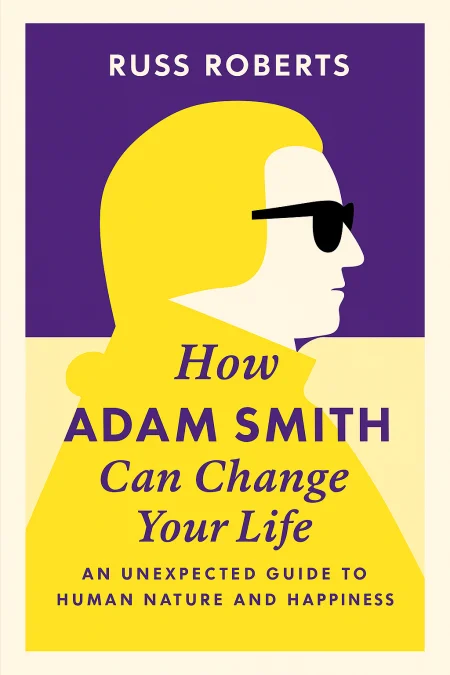
How Adam Smith Can Change Your Life
An Unexpected Guide to Human Nature and Happiness
Book Edition Details
Summary
In a forgotten tome by Adam Smith, the famed architect of economic theory, lies an unexpected guide to life’s most profound questions. Russ Roberts, in "How Adam Smith Can Change Your Life," unearths The Theory of Moral Sentiments to reveal the Scottish philosopher's insights into the essence of happiness, virtue, and the pursuit of meaningful connections. This book bridges centuries, pulling Smith’s reflections into the modern spotlight, challenging us to rethink the true measures of success beyond mere wealth. Can the thoughts of an 18th-century mind offer clarity in today’s chaotic world? Roberts argues yes, weaving Smith’s timeless wisdom with contemporary relevance, offering a lens through which we can enhance our personal lives and the fabric of society. This is not just a revival of a forgotten classic but an invitation to engage with ideas that could redefine what it means to lead a fulfilling life.
Introduction
In the bustling coffeehouses of eighteenth-century Edinburgh, where philosophers debated the nature of human society and morality, one quiet professor would fundamentally reshape how we understand ourselves and our relationships with others. Adam Smith, often remembered solely as the father of modern economics, possessed a far more nuanced vision of human nature than his reputation suggests. Long before he penned his famous work on markets and wealth, Smith spent years observing the intricate dance of human emotions, the delicate balance between self-interest and sympathy, and the invisible forces that bind civilized society together. Smith believed that understanding ourselves—our motivations, our moral instincts, and our capacity for both selfishness and virtue—was the key to living well and creating a better world. His insights reveal how we naturally seek not just to be loved by others, but to be worthy of that love through our actions and character. Through his keen observations, readers discover how to navigate the tension between caring for oneself and caring for others, how to develop genuine virtue rather than mere appearance of goodness, and how individual moral choices ripple outward to shape the fabric of civilization itself. His vision offers timeless guidance for anyone seeking to understand what it truly means to be human and how to live with both integrity and compassion.
Self-Knowledge and the Impartial Spectator
The journey toward wisdom begins with an uncomfortable truth: we are fundamentally self-centered creatures, yet we possess an remarkable capacity to step outside ourselves and see our actions through the eyes of others. Smith introduces us to a powerful mental exercise through what he calls the "impartial spectator"—an imaginary observer who watches our behavior with perfect objectivity, free from our personal biases and immediate desires. Consider how differently we behave when we believe someone is watching versus when we think we are alone. This natural human tendency reveals something profound about our moral nature. We instinctively understand that our actions should meet certain standards, not just of law or social convention, but of basic human decency. The impartial spectator becomes our internal compass, helping us distinguish between what we want to do and what we ought to do. Smith observed that we often struggle to see ourselves clearly because self-love clouds our judgment. We excuse our own failings while readily spotting similar flaws in others. Yet when we genuinely imagine how an objective observer would view our behavior—our treatment of family members, our professional conduct, our response to others' successes and failures—we gain access to powerful self-knowledge. This mental exercise doesn't require perfection, only honest self-examination. The practice of consulting our impartial spectator transforms everyday interactions. In conversation, it helps us recognize when we dominate discussions or fail to truly listen. In moments of anger or frustration, it provides perspective on whether our reactions are proportionate to the situation. Through this lens, we begin to understand that true self-knowledge requires both courage and humility—the courage to see ourselves as we really are, and the humility to acknowledge our need for improvement.
The Path to True Happiness and Loveliness
Smith's formula for happiness rests on a deceptively simple foundation: we naturally desire not only to be loved, but to be lovely—that is, worthy of love through our character and actions. This distinction between receiving affection and earning it through virtue cuts to the heart of human fulfillment. External validation feels hollow when we know it's undeserved, while genuine respect based on our actual qualities provides deep satisfaction. The pursuit of wealth, fame, and status often promises happiness but delivers disappointment because these achievements don't address our fundamental need to be genuinely admirable. Smith tells the story of a man who might trade his little finger to save millions of distant strangers, illustrating how our natural self-interest wars with our moral intuitions. Yet most civilized people would never actually make such a trade, revealing that something deeper than mere self-preservation guides our choices. True loveliness emerges from the harmony between our inner character and outer reputation. When others praise us for qualities we actually possess, when their love reflects who we truly are rather than a false image we've projected, we experience authentic contentment. This explains why unmerited praise can feel uncomfortable—it reminds us of the gap between perception and reality, highlighting what we could be but are not. Smith recognized that developing genuine virtue requires ongoing effort and self-reflection. We must resist the temptation to seek love through deception or manipulation, instead focusing on becoming the kind of person who naturally attracts respect and affection. This path proves more challenging than pursuing external markers of success, but it offers the only reliable route to lasting happiness. The goal is not perfection but continuous growth toward greater authenticity and moral beauty.
Virtue in Practice: Justice, Prudence, and Beneficence
Smith identified three essential virtues that form the foundation of moral character. Justice, the most fundamental, requires that we refrain from harming others—a negative virtue focused on what we must not do. Like grammatical rules, the principles of justice are precise and universal: don't steal, don't lie for personal gain, don't break promises, don't betray trust. These boundaries are non-negotiable because once we begin making exceptions for ourselves, we open the door to ever greater moral compromises. Prudence involves the wise care of ourselves—our health, finances, reputation, and relationships. The prudent person exercises self-control, thinking beyond immediate gratification to consider long-term consequences. Smith's prudent individual is sincere but reserved, choosing friends based on character rather than social status, avoiding both reckless risk-taking and paralyzing fear. This virtue requires balancing self-care with genuine humility, pursuing legitimate self-interest without falling into selfishness or narcissism. Beneficence, the positive virtue of actively doing good, proves the most complex and demanding. Unlike justice, which provides clear rules, beneficence offers only general principles requiring wisdom and judgment to apply. How much should we give to charity? When should we help struggling friends? What obligations do we have to strangers in need? Smith compared these challenges to the difference between grammatical correctness, which follows precise rules, and eloquent writing, which requires talent and practice that cannot be reduced to formulas. The interplay of these three virtues creates a complete moral framework. Justice establishes the minimum standard for civilized interaction, prudence ensures we can sustain our moral commitments over time, and beneficence allows us to contribute positively to others' wellbeing. Together, they enable us to be both self-respecting and other-regarding, creating the conditions for authentic relationships and meaningful contribution to society.
Building Civilization Through Individual Actions
Smith revealed how individual moral choices aggregate to create the invisible architecture of civilized society. Just as no single authority controls the evolution of language, yet clear patterns emerge from millions of individual communication choices, our daily ethical decisions collectively shape cultural norms and social trust. Each act of honesty, kindness, or integrity contributes to an environment where others are more likely to behave similarly. This process works through subtle feedback loops of approval and disapproval. When we honor trustworthy behavior and express disappointment with dishonesty, we reinforce social standards that benefit everyone. Our reactions to others' conduct—whether we laugh at cruel jokes, reward reliability, or excuse betrayals of trust—send signals that influence future behavior. Over time, these accumulated responses create powerful incentives for virtue and disincentives for vice. Smith understood that this decentralized system of moral enforcement works imperfectly but often more effectively than formal rules and punishments. Legal systems can address the worst offenses, but they cannot mandate kindness, generate trust, or create the countless small courtesies that make social life pleasant. These essential qualities emerge from the voluntary choices of individuals who recognize their stake in maintaining a decent society. The temptation exists to dismiss our individual impact as negligible—after all, one person's behavior seems unlikely to change the world. Yet Smith demonstrated that this thinking proves both false and dangerous. When we excuse our own lapses by claiming they don't matter, we contribute to the erosion of the very norms we depend upon. Conversely, when we maintain high standards for ourselves and appropriately honor virtue in others, we strengthen the cultural foundations that benefit everyone. The choice to be consistently trustworthy, even in small matters where detection seems unlikely, helps sustain the broader framework of social cooperation that enables civilization itself.
Summary
Adam Smith's enduring insight reveals that the path to both personal fulfillment and social progress runs through the cultivation of genuine virtue rather than the pursuit of external validation or material success. His vision of human nature acknowledges our natural self-centeredness while demonstrating our capacity to transcend narrow self-interest through moral imagination and the development of character. The impartial spectator he describes becomes not merely a tool for self-improvement, but a bridge between individual conscience and collective wisdom. For those seeking guidance in an age of moral complexity and social fragmentation, Smith offers practical wisdom grounded in deep understanding of human psychology. His framework suggests that meaningful change begins with honest self-examination and the patient work of becoming worthy of the love and respect we naturally crave. By focusing on justice, prudence, and beneficence in our daily choices, we contribute to the invisible but essential work of maintaining and improving civilized society. Smith's insights remain particularly valuable for anyone interested in ethics, leadership, or understanding the delicate balance between individual freedom and social responsibility.
Related Books
Download PDF & EPUB
To save this Black List summary for later, download the free PDF and EPUB. You can print it out, or read offline at your convenience.
By Russell "Russ" Roberts
