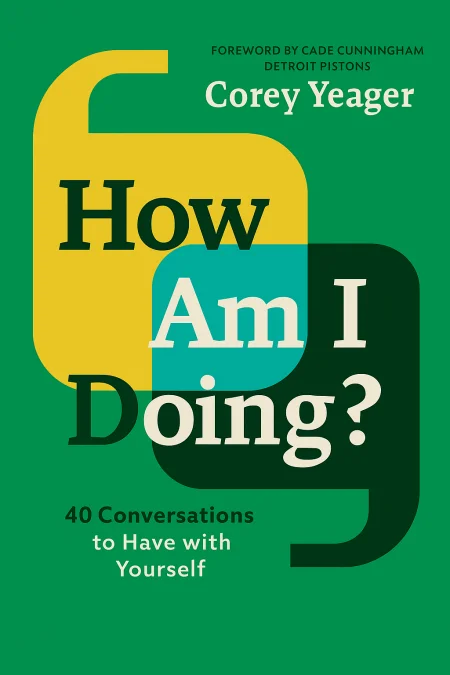
How Am I Doing?
40 Conversations to Have with Yourself
byCorey Yeager, Cade Cunningham
Book Edition Details
Summary
Confronting life's complexities becomes profoundly transformative when you engage in a heartfelt dialogue with yourself. In "How Am I Doing?", Dr. Corey Yeager, the insightful therapist behind the Detroit Pistons, guides you through an introspective journey with 40 probing questions that he employs with his clients. These inquiries are crafted to unravel the layers of your past, confront the shadows of trauma, and nurture a more resilient self. Each question is a gateway to self-awareness, paired with Dr. Yeager's reflective insights and practical self-care strategies. This book invites you to cultivate a kinder inner narrative, shed burdens of guilt, and embrace the full spectrum of your emotions. It's not just about asking questions; it's about building a deeper trust with yourself and charting a course toward mental clarity and confidence. Dive into this intimate exploration and discover the serenity of aligning with your truest self.
Introduction
In the world of professional sports, few stories capture the imagination quite like that of a former football player who traded his cleats for a therapist's chair. Dr. Corey Yeager's journey from the gridiron to the Detroit Pistons' bench represents more than just a career change—it embodies the transformative power of reinvention and the courage to pursue one's true calling. Growing up in rural Kansas as a Black man in a predominantly white community, Yeager learned early that survival meant being twice as good and infinitely more resilient than those around him. His physical prowess earned him a shot at professional football, but when that dream fell short, he discovered something far more profound: his genius lay not in breaking through defensive lines, but in breaking through the emotional barriers that keep people from their best selves. Today, as the psychotherapist for the Detroit Pistons, Yeager bridges two worlds that rarely intersect—the high-stakes arena of professional athletics and the intimate space of therapeutic healing. Through his remarkable transformation, readers will discover how failure can become the foundation for unexpected success, how vulnerability can be a source of strength, and how authentic connection transcends all boundaries of race, class, and circumstance.
From Kansas Fields to Academic Dreams
Corey Yeager's early life unfolded in Arkansas City, Kansas, where being one of the few Black families meant that community was both precious and precarious. His childhood was shaped by the wisdom of Granny Georgie, his grandmother who possessed what she called "the gift of discernment"—an ability to see beyond surface appearances to the heart of people and situations. Despite having only a fourth-grade education, Granny Georgie served as the unofficial counselor for their entire community, gathering people around her dining room table where dominoes served as the backdrop for life-changing conversations. She recognized something special in young Corey, telling him at age ten that he possessed the same gift and encouraging him to watch, listen, and learn from the patterns of human behavior around him. Football became Yeager's first language of excellence and his ticket to a larger world. His impressive size and natural athleticism earned him thirty-one Division I college offers, but the transition from rural Kansas to Long Beach State proved jarring. Without his father, who had passed away, to guide him through such a monumental decision, Yeager chose the California school primarily because his sister lived nearby. The culture shock was immediate and profound—from bagels and lox to teammates from every corner of the country, everything felt foreign. He struggled academically, barely attending classes while coaches changed his failing grades to maintain his eligibility. The dream of professional football carried him through college, but when the NFL draft came and went without his name being called, Yeager found himself in what he describes as "no-man's-land." For five years, he drifted from job to job, the identity that had defined him since childhood suddenly stripped away. This period of apparent failure, however, would prove to be the fertile ground from which his true calling would eventually emerge. Sometimes the end of one dream is simply the beginning of another, and Yeager's journey was far from over.
Breaking Barriers in Psychology and Sports
The transformation from factory worker to doctoral student began with the persistent encouragement of Yeager's wife, Carrie, who saw intellectual potential that he couldn't yet recognize in himself. Working ten-hour shifts at Ford Motor Company, he initially resisted her suggestions about returning to school, clinging to the belief that his identity was purely physical. However, his role as a union representative and work on diversity programs began to awaken a different kind of strength—one rooted in understanding systems, advocating for others, and facilitating meaningful change. When Ford offered employees educational funding during a plant closure, Yeager took the leap that would redefine his life. Graduate school at Metropolitan State University and later the University of Minnesota revealed that the intellectual capacity had always been there, waiting to be developed. Psychology, particularly community psychology, felt like coming home—the concepts of systems thinking and social dynamics matched how he had always understood the world. The same discernment that Granny Georgie had recognized decades earlier now had academic language and theoretical frameworks to support it. Yet the journey was far from smooth, particularly when it came to writing. His advisor, Dr. Doherty, became a crucial mentor, providing the tough love and relentless feedback necessary to transform Yeager's raw insights into scholarly discourse. Pursuing his PhD while navigating the predominantly white academic world required Yeager to maintain what W.E.B. DuBois called "double consciousness"—the challenge of succeeding within systems that weren't designed for people like him while remaining true to his authentic self. He refused to compromise his commitment to studying racial and ethnic relationships, even when committee members questioned the relevance of his research focus. This integrity cost him time and created additional obstacles, but it preserved the core values that would later make him so effective in his therapeutic work. When he became the first Black male to complete the PhD in his department in twenty-six years, it represented not just personal triumph but a breaking of barriers for those who would follow.
Building Bridges Through Therapeutic Practice
Yeager's entry into therapeutic work began in the Minneapolis public schools, where he helped create the Office of Black Male Student Achievement. Working with young men who struggled academically, he discovered that traditional approaches often missed the mark because they failed to account for the cultural and systemic challenges these students faced. His method was different—he met them where they were, speaking their language while helping them develop internal motivation rather than simply chasing external validation like grades. The key was shifting their focus from disappointing others to nurturing their own curiosity and sense of purpose. The transition to working with professional athletes represented the perfect fusion of Yeager's two worlds. His understanding of competitive pressure, combined with his therapeutic training, created a unique skill set that proved invaluable in high-stakes environments. At the Detroit Pistons Performance Center, he doesn't wear suits or maintain formal therapeutic boundaries. Instead, he shows up authentically, creating spaces where elite athletes can be vulnerable about their struggles without fear of judgment. His approach is conversational, meeting players courtside or in locker rooms, always available for the moments when they need support most. What sets Yeager apart in the sports psychology realm is his ability to address not just performance anxiety or competitive stress, but the whole person. Many of his players have experienced trauma, loss, and challenges that extend far beyond basketball. He helps them understand that vulnerability isn't weakness but strength, that examining their past doesn't diminish their present capabilities but enhances them. His work involves helping these young men integrate all aspects of their identity—the athlete, the son, the community member—into a coherent sense of self that can perform under pressure while remaining emotionally healthy. The therapeutic playground, as Yeager calls it, is where real transformation happens. It's a space of curiosity, humor, and honest exploration where both therapist and client can discover new insights together. His gift lies not in having all the answers, but in asking the right questions and creating safe spaces for difficult conversations. Whether working with teenagers struggling in school or professional athletes dealing with the pressures of fame, his approach remains consistent: meet people with genuine presence, help them find their own answers, and never underestimate the healing power of being truly seen and understood.
Living with Purpose and Authentic Connection
The integration of Yeager's personal and professional wisdom is perhaps best seen in how he approaches relationships and community building. Drawing from the collectivist values he learned in Kansas, where fictive kinship meant everyone was family regardless of blood relations, he and his wife have welcomed young men into their home to raise alongside their biological children. This isn't just generosity—it's a deliberate choice to model the kind of community support that helped shape him. His sons grow up understanding that family extends beyond DNA and that caring for others is both privilege and responsibility. Central to Yeager's philosophy is the revolutionary idea that you are the most important person in your own life. This isn't narcissism but necessary self-care—the recognition that you cannot pour from an empty cup. He practices what he calls "Corey days" when he steps away from all obligations to recharge, understanding that protecting his own well-being ultimately serves everyone in his life. This principle extends to his therapeutic work, where he helps clients recognize their own authority over their stories and decisions. Too often, people give their power away to others' expectations or opinions, losing touch with their own values and desires. The concept of living intentionally permeates every aspect of Yeager's approach to life and work. Rather than simply reacting to whatever circumstances arise, he advocates for taking those crucial twenty-three seconds—the time between a basketball foul and free throw—to center oneself and choose how to respond. This micro-practice of mindfulness can transform both athletic performance and daily interactions. It's about bringing consciousness to moments that typically pass on autopilot, creating space for wisdom rather than reaction. Perhaps most powerfully, Yeager embodies the idea that healing and growth are lifelong processes that require community. His own journey from questioning nine-year-old to accomplished therapist wasn't accomplished in isolation—it required mentors, challengers, supporters, and fellow travelers. He speaks openly about continuing his own therapy work, recognizing that the healer must also be committed to being healed. His life demonstrates that authenticity isn't about perfection but about showing up honestly, staying curious about yourself and others, and never losing sight of the truth that we all need each other to become our best selves.
Summary
Dr. Corey Yeager's extraordinary journey reveals that our greatest failures often contain the seeds of our most meaningful successes, and that true strength comes not from avoiding vulnerability but from embracing it as the pathway to authentic connection and healing. His transformation from small-town football player to pioneering sports psychologist demonstrates that reinvention is possible at any stage of life, but only when we have the courage to examine our deepest truths and the wisdom to recognize that our individual gifts are meant to serve something larger than ourselves. From his grandmother's dining room table to the Detroit Pistons' practice facility, Yeager has consistently created spaces where people feel safe to be seen, heard, and understood—perhaps the most fundamental human need. The lessons from Yeager's life extend far beyond the realms of sports or therapy. His insistence on being the author of your own story, his practice of intentional living, and his commitment to building genuine community offer a roadmap for anyone seeking to live with greater purpose and authenticity. His work reminds us that healing is not a destination but a daily practice, that wisdom often comes from the most unexpected sources, and that the courage to be vulnerable with ourselves and others might just be the key to unlocking our fullest potential.
Related Books
Download PDF & EPUB
To save this Black List summary for later, download the free PDF and EPUB. You can print it out, or read offline at your convenience.
By Corey Yeager
