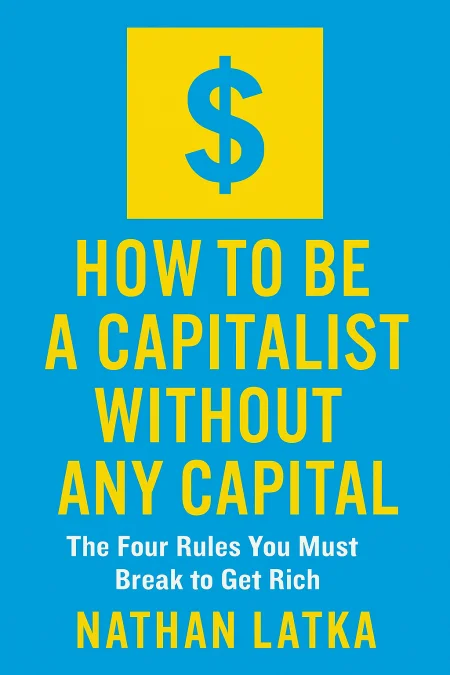
How to Be a Capitalist Without Any Capital
The Four Rules You Must Break to Get Rich
Book Edition Details
Summary
In the chaotic dance of modern capitalism, Nathan Latka emerges as the audacious choreographer who dares to rewrite the steps. From a college dropout with a mere $119 to his name, he orchestrates a symphony of success, crescendoing into millions without the crutch of Ivy League credentials or a groundbreaking idea. "How to Be a Capitalist Without Any Capital" invites you into a world where rules are meant to be broken, not followed. Latka pulls back the curtain on his personal playbook, laying bare his tax returns, business dealings, and the strategic moves that transformed him into a figure of the New Rich. With provocative insight, he dismantles conventional wisdom, urging you to juggle skills, replicate success with a twist, and reject the mass-market trap. This is not just a guide—it's a manifesto for the fearless, a blueprint for those who dare to seize their piece of the capitalist dream.
Introduction
Are you tired of watching others live seemingly effortless lives while you grind through endless hours at a desk job? You know those people whose Instagram posts from sailboats and overseas vacations make you wonder what secret they've unlocked. The truth is, they've discovered how to break four fundamental rules that society has conditioned us to follow religiously. These rules keep most people trapped in cycles of working harder for diminishing returns, while a select few have learned to work smarter and build genuine wealth. The path to financial freedom isn't about following conventional wisdom or waiting for retirement. It's about recognizing that the business world has sold us lies designed to keep us dependent on traditional employment structures. When you understand how to turn liabilities into assets, copy successful strategies, build systems instead of chasing goals, and sell tools to those chasing trends, you transform from someone who works for money into someone whose money works for them.
Four Rules to Break for Wealth
The wealthy have perpetuated four dangerous myths that keep average people struggling while they accumulate more resources. These aren't accidental misconceptions but deliberate misdirections designed to reduce competition for true wealth-building opportunities. Nathan Latka discovered this reality when he was a college student making his first $1,400 during a statistics exam. While his phone pinged with PayPal notifications from his Facebook fan page product sales, he was failing his midterm. This moment crystallized a profound truth: he could simultaneously fail at what society deemed important while succeeding at what actually mattered financially. The contrast was so stark that he realized traditional education was designed to create employees, not entrepreneurs. This experience led him to question every piece of conventional business wisdom he'd absorbed. Instead of focusing on one skill, diversifying became his strategy. Rather than innovating from scratch, he began systematically copying successful competitors. Goal-setting gave way to system-building, and instead of serving customers directly, he started selling tools to those who served customers. Each broken rule compounded his success, leading to multiple revenue streams that required minimal daily involvement. The four rules you must break are: stop focusing on one thing and embrace the three-focus approach, aggressively copy your competitors instead of trying to be original, quit setting goals and build systems that generate outcomes automatically, and sell pickaxes to gold miners rather than mining gold yourself. Breaking these rules simultaneously creates an unfair advantage that compounds over time. Most people resist this approach because it contradicts everything they've been taught about success, but this resistance is exactly what creates opportunity for those willing to think differently.
Turn Everything Into Assets
The sharing economy has fundamentally changed what constitutes an asset versus a liability, yet most people still operate under outdated definitions that keep them financially constrained. Every item you currently pay for monthly can potentially generate income instead of consuming it. Consider how Nathan transformed his Austin home from a $2,700 monthly expense into a $3,500 monthly income generator through strategic Airbnb hosting. By being absent twenty days per month for business travel, he converted his largest liability into his most reliable asset. The key wasn't owning expensive property but maximizing utilization of existing resources. He implemented pricing strategies like reducing nightly rates while increasing cleaning fees, which improved search rankings while maintaining profitability. The transformation extended beyond real estate. His minimalist wardrobe became a revenue source through Banana Republic's return policy and strategic bulk purchasing during sales. His car generated income through Turo during work hours. Even his business expenses became assets by strategically routing them through rewards credit cards and hiring travel experts to maximize point values. What appeared to be a $9,000 first-class ticket to Asia cost him only $120 after optimization. Start by inventory everything you currently pay for monthly and ask how each item could generate revenue during unused hours. Your apartment can host travelers when you're away, your car can serve ride-share customers during work hours, your unused parking space can accommodate neighbors, and your specialized knowledge can create digital products. The goal isn't to transform every possession immediately but to shift your mindset from consumption to utilization. Create systems that automatically monetize your underused assets while requiring minimal ongoing involvement from you.
Build and Buy for Maximum Returns
Most entrepreneurs exhaust themselves building businesses from scratch when buying existing operations provides superior returns with dramatically less risk and effort. The secret is identifying undervalued assets that already possess customer bases, distribution channels, and proven demand. Nathan's acquisition of The Top Inbox demonstrates this principle perfectly. He discovered the Gmail productivity tool through the Chrome Web Store, where it had accumulated over two thousand five-star reviews and thirty thousand users despite receiving no updates for eighteen months. This neglect signaled opportunity rather than decline. The founders were distracted by other projects and viewed the extension as a liability rather than an asset. Through strategic negotiation, they actually paid him $15,000 to assume control of the company and its associated debt. Within weeks of acquisition, Nathan implemented a simple $5 monthly paywall after fifty uses, instantly monetizing the engaged user base. The combination of The Top Inbox and a similar acquisition called SndLatr generated over $130,000 in the first eighteen months with minimal modifications. He then reinvested these profits into additional acquisitions, creating a portfolio of cash-flowing digital assets that required approximately fifteen minutes of monthly oversight each. Identify acquisition targets by browsing app stores, software marketplaces, and online directories for products with strong user reviews but stagnant development. Look for tools ranked highly in their categories but lacking recent updates, indicating potential owner fatigue. Reach out with simple inquiries about purchase interest, emphasizing your ability to improve the product for existing customers. Focus on businesses requiring minimal ongoing development and possessing natural distribution advantages. Structure deals with minimal upfront payments and performance-based terms that align your success with the seller's outcomes.
Summary
The path to genuine wealth requires abandoning the conventional wisdom that keeps most people financially trapped and embracing counterintuitive strategies that compound over time. As Nathan discovered, "Systems make the rich richer, and goals make the poor poorer" because systems generate outcomes continuously while goals create temporary achievements followed by motivational voids. The wealthy understand that focusing on multiple opportunities simultaneously, copying proven strategies, building automated systems, and selling infrastructure to trend-chasers creates sustainable competitive advantages that persist regardless of market conditions. Your transformation begins with a single decision to break the first rule that's currently limiting your potential, whether that's diversifying your focus, identifying a successful competitor to emulate, replacing your next goal with a system, or finding your first pickaxe to sell to eager gold miners. Choose one rule to break this week and commit to implementing the corresponding strategy within thirty days.
Related Books
Download PDF & EPUB
To save this Black List summary for later, download the free PDF and EPUB. You can print it out, or read offline at your convenience.
By Nathan Latka
