
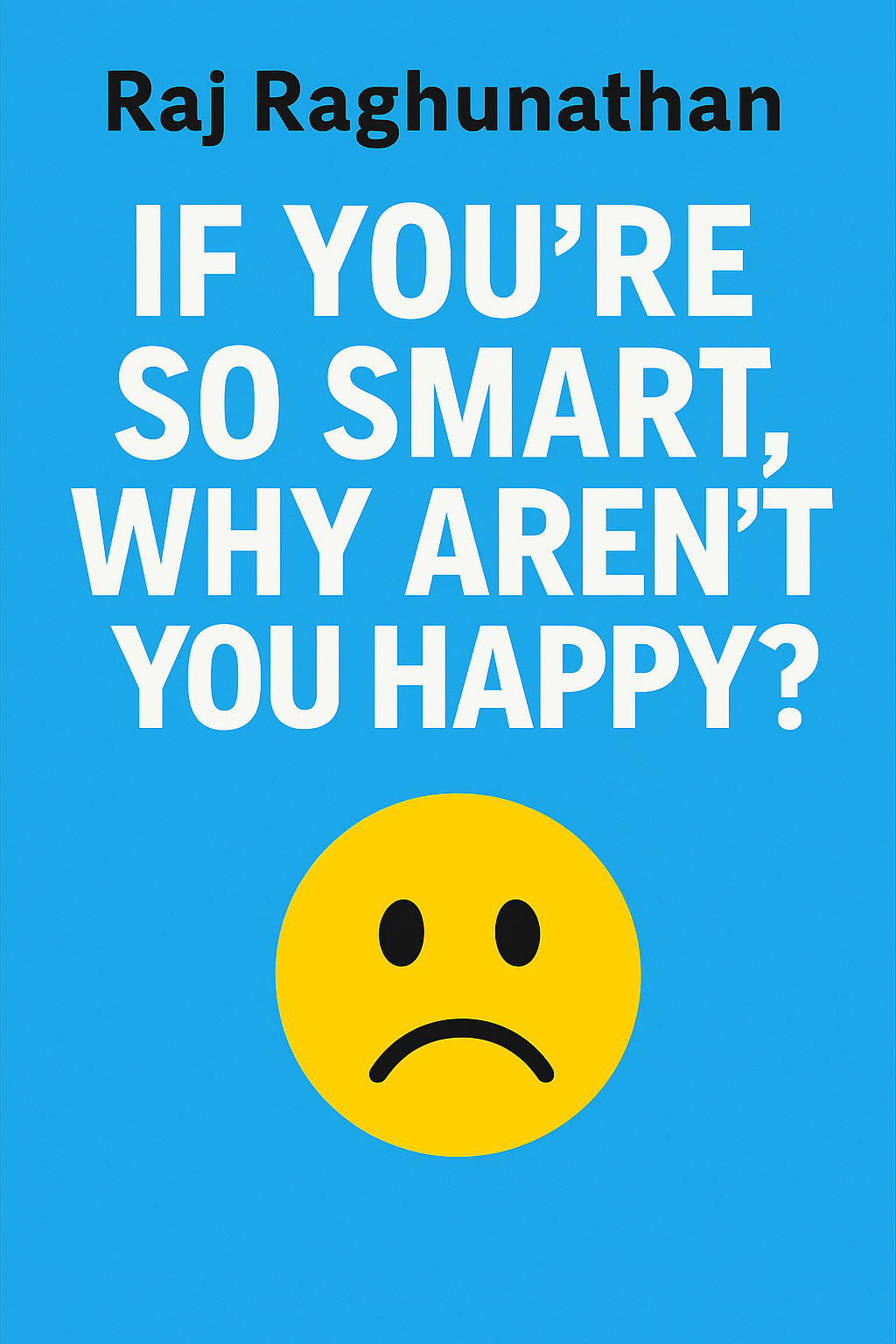
If You’re So Smart, Why Aren’t you Happy?
How to Turn Career Success into Life Success
Book Edition Details
Summary
In a world where career triumphs and personal satisfaction seem locked in a paradox, Raj Raghunathan's "If You’re So Smart, Why Aren’t You Happy?" flips the script on success. Here, intelligence isn't the golden ticket to bliss—it might just be a clever trap. After reconnecting with high-flying MBA peers, Raghunathan was startled to find that their professional glories often came at the cost of joy and fulfillment. This engaging exploration dissects the irony of how the very traits propelling us to the top can tether us to discontent. Through vivid research and real-life insights, Raghunathan unveils seven counterintuitive habits that can transform the smartest achievers into genuinely happy individuals. Whether you're conquering the boardroom or just starting your journey, this book invites you to rethink happiness, offering practical wisdom to break free from the cycle of success without satisfaction.
Introduction
Why do some of the most accomplished individuals often struggle with fulfillment despite their external success? This paradox reveals a fundamental misunderstanding about the nature of happiness and the psychological barriers that prevent us from achieving it. The research presented here introduces a comprehensive framework for understanding happiness through the lens of behavioral psychology and positive psychology research, identifying seven critical obstacles that systematically undermine our well-being and seven corresponding habits that can transform our relationship with satisfaction. This theoretical approach challenges conventional wisdom about success and happiness by demonstrating how many traits that drive achievement can simultaneously sabotage our emotional well-being. The framework addresses core questions about human motivation, the psychology of control, the nature of social connection, and the role of mindfulness in sustainable happiness. Through empirical research and practical application, this system offers a structured path toward understanding why traditional approaches to happiness often fail and how we can develop more effective strategies for lasting fulfillment.
The Seven Deadly Happiness Sins: Psychological Barriers to Well-Being
The concept of deadly happiness sins represents systematic psychological patterns that consistently undermine our capacity for sustained well-being. These patterns operate below conscious awareness, creating self-defeating cycles that persist despite our best intentions. Unlike temporary mood fluctuations, these sins represent deep-seated behavioral and cognitive tendencies that require deliberate intervention to overcome. The seven sins form an interconnected system of self-sabotage. Devaluing happiness leads us to prioritize external metrics over internal satisfaction. Chasing superiority creates endless comparison cycles that make contentment impossible. Desperation for love generates neediness that repels the very connections we seek. Being overly controlling produces stress and relationship conflict. Distrusting others prevents the social bonds essential for wellbeing. The passionate pursuit of passion creates obsessive attachment to outcomes. Mind addiction keeps us trapped in mental loops rather than present-moment awareness. Each sin emerges from evolutionary adaptations that once served survival but now hinder thriving in modern contexts. The need for superiority helped our ancestors compete for resources, but today it fuels materialism and social comparison. The desire for control helped manage environmental threats, but now creates anxiety about uncontrollable outcomes. Understanding these patterns as natural human tendencies rather than personal failures allows us to address them with compassion and strategic intervention rather than self-criticism. Consider how the superiority trap manifests in professional environments where individuals constantly compare their achievements to colleagues, creating a zero-sum mentality that transforms collaborative opportunities into competitive battles. This pattern not only diminishes job satisfaction but actually impairs performance by redirecting mental energy from task mastery to social positioning.
The Seven Habits Framework: Research-Based Practices for Fulfillment
The seven habits represent evidence-based alternatives to the happiness sins, each grounded in decades of psychological research. These habits don't merely counteract negative patterns but actively cultivate positive psychological states that support sustained wellbeing. The habits work synergistically, with progress in one area supporting development in others. Prioritizing but not pursuing happiness involves making wellbeing a conscious value while avoiding the trap of obsessive happiness-seeking. This paradoxical approach recognizes that direct pursuit of happiness often backfires, while indirect cultivation through meaningful activities succeeds. Pursuing flow replaces superiority-seeking with intrinsic motivation and optimal challenge. The need to love and give transforms desperation for love into generous contribution to others' wellbeing. Gaining internal control shifts focus from managing external circumstances to regulating internal responses. Exercising smart trust balances openness with appropriate caution in relationships. The dispassionate pursuit of passion maintains engagement while avoiding obsessive attachment. Mindfulness replaces mental addiction with present-moment awareness and acceptance. Each habit requires specific skills and practices, but together they create a comprehensive approach to psychological flourishing. Research demonstrates that individuals who develop these habits show measurable improvements in life satisfaction, relationship quality, career success, and physical health. The habits create upward spirals where positive emotions broaden awareness and build psychological resources, which in turn generate more positive emotions and better life outcomes. Like a musician who finds joy in the practice itself rather than only in applause, these habits make the journey inherently rewarding while simultaneously improving external results.
Flow, Control, and Mindfulness: Core Mechanisms for Lasting Happiness
Flow and internal control represent two of the most powerful mechanisms for sustainable happiness because they address fundamental human needs for competence, autonomy, and meaning. Flow states occur when our skills are optimally matched with challenges, creating experiences of effortless concentration and intrinsic motivation. Internal control involves taking responsibility for our emotional responses regardless of external circumstances. The flow model explains why external rewards often diminish motivation and performance while intrinsic engagement enhances both. When we pursue activities for their inherent satisfaction rather than external validation, we enter states characterized by loss of self-consciousness, altered perception of time, and automatic, skilled performance. These states are inherently rewarding and create positive feedback loops that build competence and confidence over time. Internal control operates through emotion regulation strategies that maintain psychological equilibrium regardless of external events. This doesn't mean suppressing emotions or becoming indifferent to outcomes, but rather developing the capacity to choose our responses consciously. Research shows that people with higher internal control experience less stress, better relationships, and greater resilience in the face of adversity. Mindfulness serves as the foundation that enables both flow and internal control by cultivating present-moment awareness and emotional regulation. Through mindfulness practice, individuals learn to observe their thoughts and reactions without being automatically controlled by them, creating space for more skillful responses. The combination of flow and internal control creates a powerful foundation for happiness because it makes wellbeing less dependent on external circumstances and more dependent on internal skills we can develop.
Summary
True happiness emerges not from pursuing it directly, but from developing the psychological skills and habits that naturally generate wellbeing as a byproduct of meaningful engagement with life. This framework reveals how our evolved psychology can work against us in modern contexts, but also provides a roadmap for transcending these limitations through evidence-based practices that cultivate lasting satisfaction from within. The profound implication of this research extends beyond individual wellbeing to suggest how we might create more flourishing communities and organizations by understanding and applying these principles at scale, ultimately contributing to a more psychologically healthy society.
Related Books
Download PDF & EPUB
To save this Black List summary for later, download the free PDF and EPUB. You can print it out, or read offline at your convenience.
By Raj Raghunathan
