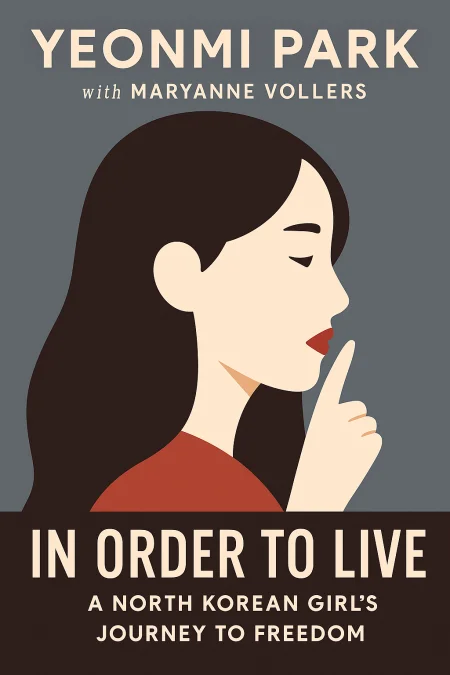
In Order to Live
A North Korean Girl's Journey to Freedom
byYeonmi Park, Maryanne Vollers
Book Edition Details
Summary
A young girl's desperate flight from North Korea transforms into a testament of resilience and courage in Yeonmi Park's gripping memoir, "In Order to Live." At just 13, Park escapes with her mother, only to face a nightmare of betrayal and enslavement in China. Yet, through sheer willpower and a fierce quest for freedom, she reaches South Korea, where the haunting shadows of her past refuse to fade. Determined to shed light on her journey and reunite with her long-lost sister, Park's narrative unfolds as a poignant reminder of the human spirit's indomitable power. Her harrowing story, once a closely guarded secret, now emerges as a beacon of hope for those trapped in silence.
Introduction
Imagine a thirteen-year-old girl weighing barely sixty pounds, stumbling through the frozen darkness of the Gobi Desert, following only the stars toward an uncertain freedom. This was Yeonmi Park in 2007, fleeing not just a country but an entire system designed to crush the human spirit. Born into North Korea's rigid caste system, Park's early years were marked by privilege that quickly crumbled into desperation, forcing her family into impossible choices between survival and dignity. Her story unfolds against the backdrop of one of the world's most secretive and oppressive regimes, where even whispered doubts about the leadership could mean death, and where millions live in a carefully constructed reality of lies and surveillance. Through Park's extraordinary journey, readers will discover how the human spirit can endure unimaginable trauma while maintaining hope, how education and truth can literally rewire a mind conditioned by propaganda, and how one person's courage to speak can illuminate the darkness that shrouds an entire nation. Her transformation from a malnourished refugee to an international human rights advocate reveals not just the horrors hidden behind North Korea's borders, but the universal power of resilience and the profound meaning of true freedom.
Captivity Under the Kim Regime
Park's childhood in Hyesan unfolded in the shadow of towering contradictions that defined life in North Korea. Born prematurely in 1993, she entered a world where her family's status as black market traders provided temporary prosperity amid widespread famine. Her father's success smuggling metals to China afforded luxuries like imported snacks and video games, creating an illusion of normalcy in an abnormal society. Yet even privileged families lived under constant surveillance, where neighbors reported on neighbors and children learned that "even the birds and mice can hear you whisper." The regime's control extended into every aspect of daily existence through mandatory self-criticism sessions and the worship of the Kim dynasty. Park absorbed propaganda that painted North Korea as paradise and the outside world as evil, learning arithmetic through problems about killing American soldiers. The public distribution system's collapse during the 1990s famine transformed survival into a daily struggle, where families fought over scraps and human dignity became a luxury few could afford. Public executions served as brutal reminders of the cost of disobedience, while the regime's songbun caste system determined every citizen's fate from birth. When her father was arrested in 2002 for his smuggling activities, Park's family plummeted from relative comfort into desperate poverty overnight. The eight-year-old girl suddenly became responsible for her family's survival, learning that in North Korea, a single mistake could destroy generations. This harsh education in the regime's cruelty would prove essential preparation for the even greater challenges that lay ahead. The emotional dictatorship that controlled North Korean minds was perhaps more insidious than physical oppression. Citizens learned to live with "doublethink," simultaneously holding contradictory beliefs about their reality while suppressing any thoughts that challenged the official narrative. This psychological conditioning ran so deep that even years after escape, Park would struggle to distinguish between the lies she had been taught and the truth about her own experiences.
Surviving Human Trafficking in China
The frozen Yalu River that Park crossed with her mother in March 2007 marked not an escape to freedom, but entry into a different kind of hell. Within hours of reaching Chinese soil, both mother and daughter were sold into sexual slavery, victims of a vast trafficking network that preyed on North Korean refugees' desperation. The brutal reality shattered any illusions about finding safety across the border, as Park discovered that her youth made her especially valuable in China's underground bride market. At thirteen, Park was forced into a relationship with Hongwei, a Chinese trafficker who had purchased her for nearly two thousand dollars. The psychological manipulation was as devastating as the physical abuse, as she learned to compartmentalize trauma in order to function. Her survival strategy required splitting her consciousness, mentally removing herself from her body during the worst moments while maintaining enough awareness to protect her mother and search for her missing sister. This dissociation became both a coping mechanism and a form of psychological armor. The trafficking network revealed itself as a complex ecosystem of exploitation, where North Korean women were bought and sold like commodities. Park witnessed countless other victims pass through safe houses, each carrying stories of unimaginable suffering. The Chinese government's policy of treating North Korean refugees as illegal immigrants rather than asylum seekers created the perfect conditions for this modern slavery to flourish. Without legal protection, women had no recourse against abuse and lived in constant fear of deportation back to North Korea, where repatriation meant torture, imprisonment, or death. Despite the horror, Park discovered reservoirs of strength she never knew existed. She learned to navigate the criminal underworld, translating for other victims and eventually helping to run trafficking operations herself. These morally complex choices haunted her, but they also demonstrated how survival sometimes requires participating in the very systems that oppress us. Her ability to adapt and endure, even while maintaining her humanity, would become the foundation for everything that followed.
Finding Voice and Purpose in Freedom
The desert crossing into Mongolia in March 2009 marked Park's physical liberation, but true freedom would prove far more elusive. Arriving in South Korea at fifteen with the equivalent of a second-grade education, she faced the daunting task of rebuilding not just her life, but her very identity. The transition revealed how freedom itself could be a burden for someone conditioned to have every decision made by others. Simple choices like selecting a favorite color or describing personal hobbies became overwhelming exercises in self-discovery. Education became Park's pathway to transformation. Driven by a desperate hunger for knowledge, she devoured books with the same intensity she had once reserved for actual food. Reading opened neural pathways long suppressed by propaganda, allowing her to develop critical thinking skills that had been systematically destroyed by the North Korean educational system. Authors like George Orwell provided frameworks for understanding her past, while biographies of civil rights leaders offered models for channeling trauma into purpose. The process of learning to think independently was both liberating and terrifying. Each new piece of knowledge challenged beliefs that had once formed the foundation of her worldview. Discovering that Kim Il Sung had started the Korean War, not ended it, forced her to question everything she thought she knew about history, morality, and truth. This intellectual awakening was accompanied by profound emotional work, as she slowly learned to access feelings that had been frozen by trauma and suppression. Park's academic achievements defied every expert prediction about her potential. Within two years of arriving in South Korea, she had earned her high school equivalency diploma and gained admission to Dongguk University. Her success was driven not just by intelligence, but by an almost supernatural determination to prove wrong those who had written her off as hopeless. Education became both revenge against those who had underestimated her and a form of justice for all the North Korean children denied the opportunity to learn.
Becoming an Advocate for Human Rights
The transformation from survivor to activist began when Park realized that her story could serve others still trapped in darkness. Her appearances on South Korean television initially focused on finding her sister, but gradually evolved into a platform for speaking truth about North Korean realities. The decision to go public required immense courage, as it meant abandoning the anonymity that had allowed her to blend into South Korean society and build a new identity. Speaking out about human trafficking presented the greatest challenge. For years, Park had hidden the most traumatic aspects of her experience, believing that revealing the truth would destroy any chance of acceptance or success. The shame and stigma surrounding sexual violence made disclosure feel impossible, even as she watched other survivors suffer in silence. Her breakthrough came with the recognition that silence served only to protect the perpetrators while abandoning other victims to their fate. Park's emergence as an international human rights advocate coincided with growing global awareness of North Korean atrocities. Her ability to communicate in English, combined with her compelling personal story and articulate analysis, made her an effective spokesperson for the voiceless. She learned to channel her pain into purpose, transforming personal trauma into a powerful weapon against injustice. Speaking to world leaders and international audiences, she discovered that vulnerability could be a source of strength rather than weakness. The North Korean regime's attempts to discredit her through propaganda videos only confirmed the impact of her advocacy. By attacking her credibility and parading relatives to denounce her, the regime revealed its fear of truth-telling and its desperation to control the narrative about conditions inside the country. Park's willingness to endure personal attacks for the sake of bearing witness demonstrated the ultimate victory over the system that had tried to destroy her spirit. Her voice had become unstoppable, carrying the hopes of millions who remained trapped behind the world's most impenetrable borders.
Summary
Park's extraordinary journey from a malnourished child in North Korea's frozen wasteland to an internationally recognized human rights advocate illuminates the indestructible nature of the human spirit when confronted with seemingly insurmountable odds. Her story teaches us that true freedom requires not just physical escape from oppression, but the far more difficult work of liberating our minds from the lies and limitations others have imposed upon us. The courage to speak truth in the face of powerful systems of silence becomes both a personal act of healing and a gift to others still trapped in darkness. For anyone feeling powerless against injustice, Park's example demonstrates that individual voices, no matter how small or wounded, possess the power to shake the foundations of tyranny and inspire others to action. Her continuing advocacy reminds us that freedom is not a destination but a responsibility, and that those who have escaped oppression carry an obligation to extend that same opportunity to others.
Related Books
Download PDF & EPUB
To save this Black List summary for later, download the free PDF and EPUB. You can print it out, or read offline at your convenience.
By Yeonmi Park
