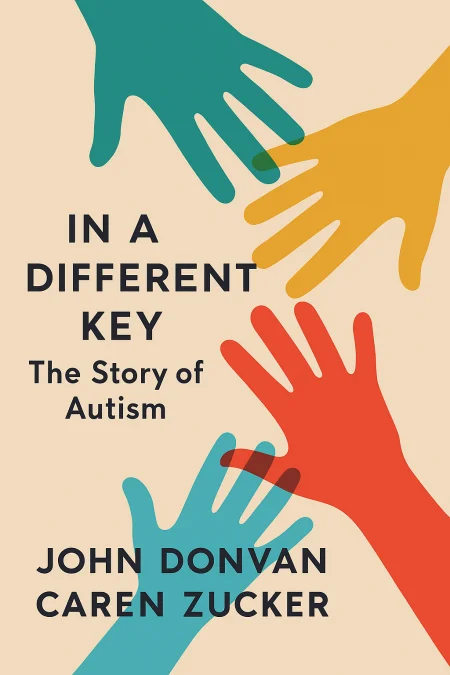
In a Different Key
The Story of Autism
Book Edition Details
Summary
In the quiet town of Forest, Mississippi, a groundbreaking diagnosis set the stage for a revolution. "In a Different Key" uncovers the tangled history of autism, weaving the struggles and triumphs of families into a tapestry of civil rights battles and scientific discovery. This compelling narrative introduces trailblazers like Ruth Sullivan, who defied an accusatory medical establishment, and Temple Grandin, whose voice reshaped the perception of neurodiversity. It dives deep into the controversial waters of misdiagnoses, misguided treatments, and the relentless pursuit of understanding. From legal victories to ethical quandaries, this story challenges societal norms and illuminates the courage it takes to fight for acceptance. Here lies an essential exploration of humanity's quest for compassion and the enduring power of hope.
Introduction
In 1965, a group of desperate parents gathered in a New Jersey living room, united by a shared secret that had isolated them for years. Their children had been labeled with a mysterious condition called autism, and society had convinced these mothers and fathers that they were to blame. The medical establishment told them their coldness had created these withdrawn, difficult children. Schools refused to educate them. Institutions warehoused them. The world seemed determined to make these families disappear. Yet from this moment of collective despair emerged one of the most remarkable transformation stories in modern history. Over six decades, autism evolved from a shameful family secret into a widely recognized condition commanding public attention, research funding, and educational support. This journey reveals profound truths about how scientific understanding develops, how social movements create change, and how society's treatment of its most vulnerable members reflects its deepest values. The story illuminates critical questions that extend far beyond autism itself: How do medical theories gain acceptance, and what happens when they're wrong? What does it take for marginalized communities to claim their rightful place in society? How do we balance the desire to help with respect for human dignity and difference? This narrative will resonate with anyone interested in medical history, social justice, or the power of grassroots advocacy.
Early Discovery and the Refrigerator Mother Era (1940s-1970s)
The story begins in 1938 when Mississippi lawyer Beamon Triplett wrote a thirty-three-page letter to Dr. Leo Kanner at Johns Hopkins Hospital, describing his son Donald's bewildering behaviors. The boy could memorize entire songs and recite all U.S. presidents' names, yet seemed oblivious to other people's existence. He lived in a world of rigid routines and private obsessions, speaking in his own peculiar language of colors and numbers. Kanner had never encountered anything like Donald. Over the next few years, he identified ten other children with remarkably similar patterns. In 1943, he published his groundbreaking paper describing "autistic disturbances of affective contact." These children shared an extreme preference for aloneness and an obsessive need for sameness, possessing islands of remarkable ability floating in seas of profound difficulty. Initially, Kanner believed autism was inborn, writing about "pure-culture examples of inborn autistic disturbances." But as the psychiatric establishment embraced theories blaming parents for children's mental health problems, even Kanner began to waver. By the late 1940s, he was describing the "emotional refrigerators" these children lived in, inadvertently launching decades of parent-blaming that would devastate families. The early decades following autism's discovery were marked by profound misunderstanding. Children like Donald were often institutionalized, their potential dismissed, their families shamed into silence. Yet some found unexpected havens of acceptance in small communities where difference was tolerated. These early cases revealed both the cruelty society could inflict on those who didn't fit conventional molds and the remarkable resilience of the human spirit when given even minimal support and understanding.
Parent Advocacy and Educational Rights Revolution (1970s-1990s)
The 1950s and 1960s became autism's dark age, dominated by the cruel myth of the "refrigerator mother." Bruno Bettelheim, a charismatic Austrian immigrant who had survived Nazi concentration camps, became the most influential voice promoting the theory that cold, rejecting mothers caused their children's autism. His 1967 book "The Empty Fortress" compared autistic children to concentration camp prisoners, arguing both groups had withdrawn from unbearably hostile environments. This theory devastated families already struggling with immense challenges. Mothers like Rita Tepper found themselves in therapy sessions forced to confess their supposed failures, searching memories for moments when they might have damaged their babies. The medical establishment offered no help, only blame, leaving families isolated and desperate. Yet from this darkness emerged organized resistance. Ruth Sullivan, an army nurse turned mother of seven, refused to accept that she had caused her son Joe's autism. Armed with common sense and fierce determination, she began organizing other mothers in Albany, New York. Meanwhile, Bernard Rimland, a Navy psychologist whose son Mark had autism, spent years meticulously researching every published autism case, building an ironclad argument against the refrigerator mother theory. In 1965, these scattered families came together in that New Jersey living room to form the National Society for Autistic Children. For the first time, parents had each other. They shared stories, strategies, and most importantly, hope. This marked the beginning of the end for parent-blaming theories and the start of a movement that would transform not just autism understanding, but the entire landscape of disability rights in America. The passage of the Education for All Handicapped Children Act in 1975 guaranteed disabled children the right to education in the least restrictive environment possible, representing a fundamental shift toward community-based care and recognition that disabled individuals deserved to live among their fellow citizens.
Scientific Breakthroughs and Spectrum Recognition (1990s-2000s)
The final decades of the twentieth century witnessed autism's emergence from shadows into mainstream consciousness. Scientific understanding advanced rapidly as researchers abandoned psychological theories in favor of neurological and genetic investigations. The diagnostic criteria expanded, leading to recognition of an "autism spectrum" that encompassed a much broader range of individuals than Leo Kanner's original narrow definition. Lorna Wing's pioneering work introduced Hans Asperger's forgotten research to the English-speaking world, revealing that autism existed across a wide spectrum of abilities and presentations. Her concept of the "autism spectrum" revolutionized understanding by recognizing that autistic traits appeared in many forms and degrees of severity. This framework allowed many more people to receive appropriate diagnoses and services, challenging stereotypes about what autistic people could accomplish. The expansion of autism diagnosis coincided with improved educational services and early intervention programs. Children who might once have been written off as hopeless began demonstrating remarkable progress when given appropriate support. The success stories challenged long-held assumptions about the limits of human potential and the value of investing in disabled individuals. Behavioral interventions pioneered by researchers like Ivar Lovaas demonstrated that intensive therapy could produce significant improvements, though often through controversial methods that sparked ethical debates. The rise of the internet allowed autism families to connect across geographical boundaries, sharing information and strategies at unprecedented speed. Scientific advances also began revealing autism's biological basis through twin studies demonstrating genetic components and brain imaging showing structural differences. This biological understanding helped finally put to rest the refrigerator mother theory, though it raised new questions about causation and treatment that continue today. By the early 2000s, autism had achieved a level of public visibility unimaginable just decades earlier, representing a fundamental shift from the shame and secrecy that had once surrounded autism families.
Neurodiversity Movement and Self-Advocacy (2000s-Present)
The emergence of the neurodiversity movement marked perhaps the most radical shift in autism's history: the transformation from a medical condition to be cured into a form of human variation to be celebrated. Led by articulate individuals with autism like Ari Ne'eman and supported by online communities, this movement challenged fundamental assumptions about disability, normalcy, and the goals of intervention. The neurodiversity philosophy rested on a revolutionary premise: autism is not a disease to be cured but a neurological difference that brings both challenges and strengths. Advocates argued that society's focus should shift from trying to make autistic people appear normal to creating environments where autistic people could thrive as they are. This perspective gained particular power as more high-functioning individuals received autism diagnoses, creating a visible and vocal constituency that could speak for itself. Self-advocates with autism began finding their voices, challenging the assumption that others should speak for them. Organizations evolved from parent-led groups focused on finding cures to more diverse coalitions emphasizing acceptance, accommodation, and civil rights. The movement's influence extended beyond rhetoric, successfully challenging research priorities, intervention approaches, and diagnostic criteria. When organizations launched campaigns depicting autism as a tragedy, neurodiversity advocates mobilized so effectively that campaigns were withdrawn, demonstrating their growing political power. Yet the neurodiversity movement also exposed deep tensions within the autism community between those who saw autism as a gift and those who experienced it as a profound disability. Parents of severely affected children often felt that neurodiversity advocates, despite good intentions, could not speak for those who would never live independently or communicate their own preferences. The transformation culminated in moments like celebrity performances featuring children with autism being celebrated rather than hidden, symbolizing how far society had traveled from the dark days of refrigerator mother theories and institutional warehousing. These debates continue to shape discussions about autism research, services, and social acceptance, reflecting broader societal struggles over the meaning of disability and difference in the twenty-first century.
Summary
The evolution of autism understanding reveals a profound truth about social change: progress often emerges from the determination of those society has marginalized and dismissed. What began as a medical curiosity described by a single psychiatrist became a powerful movement that transformed not just autism services, but the entire landscape of disability rights and inclusion. The central tension throughout this history has been between viewing autism as a tragedy to be cured and recognizing it as a form of human diversity to be accommodated. The lessons from this transformation extend far beyond autism. They demonstrate that entrenched professional opinions can be wrong, that marginalized communities possess wisdom experts often lack, and that sustained advocacy can move seemingly immovable systems. The parents who refused to accept blame for their children's condition, the advocates who fought for educational rights, and the self-advocates who demanded to speak for themselves all contributed to shifting fundamental paradigms about human worth and potential. Most importantly, this history shows that how we treat our most vulnerable members reveals our deepest values as a society. The journey from shame to acceptance, from exclusion to inclusion, from tragedy to neurodiversity represents not just progress for autism families, but an expansion of our collective understanding of what it means to be human. Today's challenge lies in balancing support for those with significant needs while respecting the autonomy and identity of those who embrace their neurological differences, maintaining focus on what truly improves lives: access to education, employment opportunities, community acceptance, and recognition that human diversity includes many ways of thinking and being in the world.
Related Books
Download PDF & EPUB
To save this Black List summary for later, download the free PDF and EPUB. You can print it out, or read offline at your convenience.
By John Donvan
