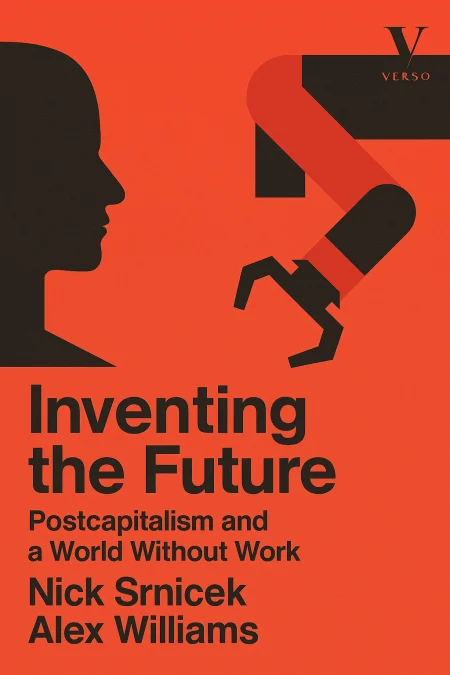
Inventing the Future
Postcapitalism and a World Without Work
Book Edition Details
Summary
In a world where economic structures are fraying at the edges, "Inventing the Future" steps boldly onto the stage as a beacon of visionary thought. Nick Srnicek and Alex Williams craft a compelling narrative that transcends the stale confines of political stagnation, challenging the pervasive grip of neoliberalism. This manifesto does not merely critique; it reimagines a society where technology serves as a liberator, not a tyrant. Imagine a future where full automation and universal basic income are not just possibilities but foundations of a new reality—one that frees humanity from the shackles of labor and poverty. With incisive clarity, Srnicek and Williams dismantle outdated ideologies, advocating for a post-capitalist world that embraces innovation and equality. This book is a call to arms for those daring enough to envision a society where progress is synonymous with freedom.
Introduction
Contemporary leftist movements face a profound strategic crisis, repeatedly mobilizing massive popular support yet failing to achieve lasting structural transformation. Despite decades of protests, occupations, and grassroots organizing, neoliberal capitalism has only deepened its grip on global society. This persistent failure stems not merely from external repression, but from fundamental flaws in how progressive movements conceptualize political change itself. The technological capabilities of the twenty-first century present unprecedented opportunities for human liberation from drudgery and scarcity. Automation could eliminate vast amounts of repetitive labor, while digital networks enable new forms of democratic coordination and economic planning. Yet these liberatory potentials remain trapped within an economic system that demands endless work despite producing chronic unemployment and ecological destruction. The central argument advanced here challenges the dominant assumptions of contemporary left politics, particularly the fetishization of localism, horizontalism, and immediate action over strategic long-term thinking. Through systematic analysis of why current approaches consistently fail, examination of how neoliberalism achieved global hegemony, and detailed proposals for building counter-hegemonic power, this investigation reveals how progressive movements might finally transcend their defensive posture. The analysis proceeds through rigorous critique of folk politics, exploration of automation's transformative potential, and concrete proposals for universal basic income and reduced working hours as pathways toward genuine post-capitalist transformation.
The Failure of Folk Politics and Neoliberal Hegemony
Folk politics represents the intuitive common sense of contemporary leftist movements, characterized by preferences for the local over the global, the immediate over the mediated, and the particular over the universal. This political orientation manifests in the valorization of consensus decision-making, prefigurative politics, and horizontal organizing structures that prioritize process over outcomes. While these approaches may create temporary autonomous zones or express moral resistance, they systematically fail to address the abstract, complex, and globally distributed nature of contemporary capitalism. The Occupy movement exemplifies both the promise and fundamental limitations of folk-political organizing. Despite mobilizing hundreds of thousands across nearly a thousand cities worldwide, the movement's commitment to leaderless horizontalism and rejection of concrete demands ultimately rendered it incapable of scaling beyond local encampments. The fetishization of direct democracy created unsustainable decision-making processes that consumed enormous energy while producing minimal strategic coordination. The insistence on prefigurative politics meant that internal organizational forms took precedence over external political effectiveness. Localist economic alternatives face similar structural limitations when confronting global capitalism. Community gardens, local currencies, and small-scale cooperatives may provide temporary relief from market pressures, but they cannot address the systemic dynamics of international finance, global supply chains, and planetary-scale ecological destruction. The complexity of modern economic systems requires equally complex and coordinated responses that transcend the boundaries of particular communities or bioregions. The persistence of folk politics reflects both a response to overwhelming systemic complexity and a historical reaction to the failures of twentieth-century leftist organizations. Faced with the collapse of social democratic parties, the discrediting of communist states, and the bureaucratization of trade unions, many activists have retreated into defensive positions that prioritize moral purity over strategic effectiveness. This retreat has coincided with neoliberalism's successful demonstration that marginal ideas can achieve global dominance through patient institution-building, intellectual development, and strategic vision that operates across multiple scales and timescales.
Technology, Automation, and the Obsolescence of Work
Contemporary capitalism faces an emerging crisis as technological automation threatens to eliminate vast numbers of jobs across all sectors of the economy. Unlike previous waves of mechanization that primarily affected manual labor, current developments in artificial intelligence, machine learning, and robotics increasingly displace cognitive work, professional services, and creative occupations. This transformation represents a qualitatively different moment in capitalist development that renders traditional employment-based social organization obsolete. Evidence suggests that routine cognitive tasks prove particularly vulnerable to algorithmic replacement, affecting middle-income occupations previously considered secure from technological displacement. Legal research, financial analysis, diagnostic medicine, journalism, and even creative writing now face competition from sophisticated algorithms capable of pattern recognition and content generation. Meanwhile, the jobs being created tend to cluster at the extremes of the skill distribution, offering either highly specialized technical positions requiring extensive education or low-wage service work resistant to automation. The traditional response of education and skills training appears increasingly inadequate to address this structural transformation. The pace of technological change outstrips the ability of educational institutions to prepare workers for emerging occupations, while many skills being taught today will likely become obsolete within a decade. Moreover, the assumption that technological advancement necessarily creates equivalent employment opportunities in new sectors lacks historical precedent at the current scale and speed of change. Rather than defending existing jobs or nostalgically returning to social democratic full employment, progressive politics should embrace the liberatory potential of technological development while ensuring its benefits serve collective flourishing rather than private accumulation. This requires moving beyond the work ethic that treats employment as intrinsically valuable toward a vision of human freedom that prioritizes creativity, care, and social cooperation over wage labor and market competition. The crisis of work creates unprecedented opportunities for postcapitalist transformation, but only if the left abandons defensive strategies in favor of accelerating automation while democratizing its benefits.
Building Counter-Hegemonic Power Through Strategic Universalism
The construction of postcapitalist alternatives requires a comprehensive counter-hegemonic strategy that operates simultaneously across cultural, intellectual, and technological domains. This involves challenging neoliberal common sense through the development of utopian narratives that expand popular imagination beyond capitalist realism while building the material and organizational capacity necessary for systemic transformation. The success of neoliberalism itself demonstrates that marginal ideas can achieve global dominance through patient institution-building and strategic vision. Intellectual transformation requires pluralizing economic education and developing postcapitalist economic models that can guide policy development and popular understanding. The dominance of neoclassical economics in universities and policy circles represents a crucial battleground for any transformative project. Alternative approaches such as modern monetary theory, ecological economics, and complexity economics provide tools for understanding how postcapitalist institutions might function in practice while challenging the theoretical foundations of market fundamentalism. Technological development offers concrete opportunities for prefiguring postcapitalist social relations through the democratic control of innovation processes and the redirection of research priorities away from profit maximization toward social utility. Examples such as the Lucas Plan in 1970s Britain demonstrate how workers can collectively reimagine production toward socially useful goods, while contemporary developments in open-source design, platform cooperatives, and commons-based peer production point toward alternative economic models based on collaboration rather than competition. The construction of counter-hegemonic power requires building diverse organizational ecosystems that can sustain long-term political projects while responding flexibly to changing circumstances. This means moving beyond folk-political fetishization of particular organizational forms toward strategic thinking about how different types of organizations can complement each other in pursuit of shared goals. Successful counter-hegemony combines grassroots mobilization with strategic coordination, local experimentation with global vision, and immediate reforms with long-term revolutionary transformation.
Universal Basic Income as Pathway to Post-Capitalist Transformation
Universal Basic Income represents far more than a simple redistribution mechanism or economic safety net. At its core, UBI constitutes a fundamental challenge to the power relationship between capital and labor by severing the coercive link between work and survival. When workers possess guaranteed access to the means of subsistence independent of employment, the asymmetrical power dynamic that defines capitalist social relations begins to dissolve, creating space for genuine freedom and voluntary association. This transformation manifests through several interconnected mechanisms. UBI effectively tightens labor markets by providing workers with genuine choice about whether to accept employment, fundamentally altering the bargaining position between employers and employees. The threat of unemployment loses its disciplinary power when basic needs are guaranteed, enabling workers to refuse degrading, dangerous, or poorly compensated work while forcing capital to improve conditions or automate such positions entirely. The policy also transforms precarity from a source of anxiety into a form of voluntary flexibility by removing the coercive elements that currently characterize irregular employment. Rather than representing economic insecurity, variable work patterns become expressions of individual autonomy and choice. Most significantly, UBI recognizes and compensates the vast amount of socially necessary labor that occurs outside formal employment relationships, including care work, community building, artistic creation, and other forms of reproductive labor essential for social functioning. When combined with reduced working hours and accelerated automation, UBI creates the material foundation for a postcapitalist society organized around human flourishing rather than capital accumulation. The reduction of the working week distributes available work more equitably while providing the leisure time necessary for democratic participation, cultural development, and social experimentation. Together, these policies point toward a society where technological development serves collective liberation rather than private profit, where human creativity can flourish beyond the constraints of wage labor and market competition.
Summary
The fundamental insight driving this analysis reveals that capitalism's current crisis creates unprecedented opportunities for postcapitalist transformation, but only if progressive movements abandon their attachment to folk-political strategies in favor of ambitious counter-hegemonic organizing that matches the scale and complexity of contemporary challenges. The technological capacity for automated production, combined with capitalism's inability to provide meaningful employment for growing surplus populations, creates objective conditions for moving beyond wage labor toward a society of genuine freedom and abundance, yet realizing this potential requires strategic thinking, patient institution-building, and the construction of alternative common sense capable of competing with neoliberalism's hegemonic dominance while preparing for crisis moments when transformative change becomes possible.
Related Books
Download PDF & EPUB
To save this Black List summary for later, download the free PDF and EPUB. You can print it out, or read offline at your convenience.
By Nick Srnicek
