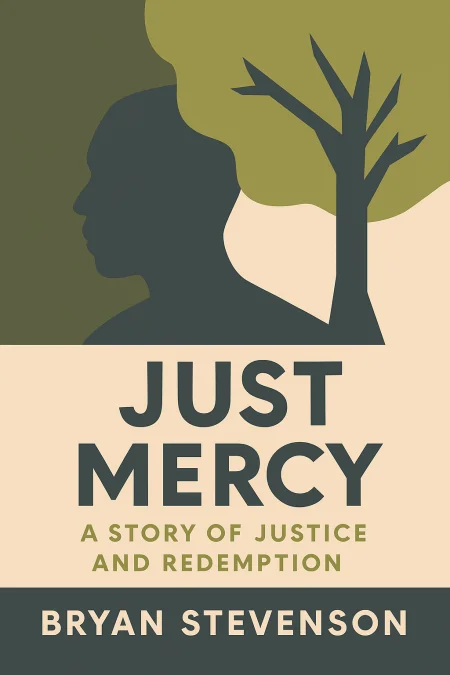
Just Mercy
A Story of Justice and Redemption
Book Edition Details
Summary
In the tangled corridors of America's justice system, a young lawyer named Bryan Stevenson finds his calling. In the crucible of defending the voiceless and the forsaken, Stevenson encounters Walter McMillian—a man ensnared in a nightmare of injustice, sentenced to death for a crime he swears he didn’t commit. Just Mercy chronicles Stevenson’s courageous battle against a system marred by conspiracy and prejudice, unfurling a tapestry of human stories that demand empathy and provoke thought. This poignant narrative not only spotlights the harrowing realities faced by the marginalized but also serves as a clarion call for compassion and reform. It's a journey through legal and moral complexities that reshapes the very notion of justice.
Introduction
America's criminal justice system operates on a fundamental contradiction: while promising equal treatment under law, it consistently delivers outcomes determined more by race, poverty, and social status than by actual guilt or innocence. This systematic examination reveals how prosecutorial misconduct, inadequate legal representation, and deep-seated racial bias create conditions where the innocent face execution while the wealthy escape serious consequences regardless of their crimes. The evidence presented challenges the comfortable assumption that justice is blind, instead demonstrating how fear, prejudice, and political expedience have corrupted the pursuit of truth and fairness. The analysis employs direct case studies and statistical evidence to expose the mechanisms through which injustice operates, from wrongful convictions of innocent individuals to the sentencing of children to life imprisonment without parole. By examining specific instances where the system failed catastrophically, patterns emerge that reveal not isolated mistakes but systematic dysfunction rooted in America's history of racial oppression and economic inequality. The exploration invites readers to confront uncomfortable realities about how justice is administered while considering whether mercy and redemption can coexist with accountability and public safety in a truly just society.
Mass Incarceration and Racial Bias: Evidence of Systematic Inequality
The transformation of American criminal justice over four decades represents one of the most dramatic policy shifts in the nation's history, with prison populations exploding from 300,000 to over 2.3 million. This expansion occurred not because crime increased dramatically, but because political forces converged to make punishment the primary response to social problems previously addressed through education and community support. The statistics reveal profound racial disparities that cannot be explained by differences in criminal behavior: African Americans comprise 13 percent of the population but nearly 40 percent of prisoners, while defendants who kill white victims are eleven times more likely to receive death sentences than those who kill black victims. The war on drugs exemplifies how ostensibly race-neutral policies produce racially biased outcomes. Despite equal drug usage rates across racial lines, black Americans face imprisonment for drug offenses at rates far exceeding their white counterparts. Mandatory minimum sentences and three-strikes laws create situations where minor offenses result in life imprisonment, trapping individuals in cycles that devastate families and communities. The economic incentives driving this system reveal how profit motives corrupt justice, with private prison companies lobbying for harsher sentences while states redirect funds from education to feed an ever-growing correctional apparatus. The systematic devaluation of black lives manifests throughout every stage of legal proceedings, from initial police encounters through jury selection and sentencing. All-white juries in cases involving black defendants create environments where racial prejudices influence verdicts without challenge, while geographic concentration of death sentences in regions with histories of lynching suggests capital punishment serves as legal continuation of earlier forms of racial control. This evidence demonstrates that mass incarceration functions not merely as crime control but as a mechanism for maintaining social hierarchies rooted in America's legacy of racial oppression.
Wrongful Convictions: How System Failures Destroy Innocent Lives
The case of Walter McMillian illuminates how racial prejudice and prosecutorial misconduct converge to condemn innocent individuals to death row. McMillian, convicted of murdering a white woman based entirely on testimony from a career criminal who later admitted to lying under police coercion, spent six years facing execution despite an airtight alibi supported by dozens of witnesses. The investigation revealed systematic corruption extending far beyond a single case: police paid witnesses for false testimony, suppressed exculpatory evidence, and placed McMillian on death row before trial in violation of legal procedures. The systematic suppression of evidence demonstrates how prosecutors sometimes prioritize convictions over truth. Police recordings showed their key witness repeatedly denying knowledge of the crime and expressing reluctance to implicate an innocent man, yet these recordings were never disclosed to the defense. When witnesses confirmed McMillian's alibi, their testimony was ignored or they faced arrest for perjury, revealing how the system protects itself by intimidating those who threaten its narrative. The adversarial system assumes zealous advocacy will produce truth, but this breaks down when defendants cannot afford competent lawyers and prosecutors face political pressure for convictions regardless of guilt. DNA testing has revealed hundreds of wrongful convictions, representing only the tip of the iceberg since genetic evidence exists in merely a fraction of cases. The true number of innocent people in American prisons likely reaches into the thousands, creating a moral catastrophe demanding fundamental reform. The psychological impact extends far beyond eventual exoneration, as years under threat of execution create lasting trauma while wrongfully convicted individuals struggle to rebuild lives without compensation or support from the state that destroyed them. These cases expose fundamental flaws in how the justice system operates, revealing that inadequate representation, prosecutorial misconduct, and racial bias create conditions where innocent people face routine conviction.
Criminalizing Vulnerability: Children and Mental Illness in Adult Courts
The sentencing of children to life imprisonment without parole represents one of America's most extreme punishments, with the United States standing alone among nations in condemning juveniles to die in prison. The cases of thirteen-year-old Joe Sullivan and fourteen-year-old Trina Garnett illustrate how children with histories of severe abuse and neglect enter adult criminal proceedings without adequate consideration of their developmental circumstances. Neuroscience research demonstrates that adolescent brains remain undeveloped in areas responsible for impulse control and decision-making, creating heightened vulnerability to poor judgment that, when combined with environments marked by poverty and trauma, helps explain serious crimes committed by children with enormous potential for rehabilitation. Mandatory life-without-parole sentences eliminate judicial discretion and prevent consideration of individual circumstances, treating children who have experienced horrific abuse identically to career adult criminals. The conditions these juveniles face in adult prisons compound the injustice, with young people five times more likely to suffer sexual assault and facing constant threats from older inmates. Many spend years in solitary confinement, causing severe psychological damage and impeding normal development in a system that becomes a mechanism for creating additional trauma rather than addressing underlying problems. Mental illness has become criminalized as deinstitutionalization policies emptied state hospitals without providing adequate community treatment, leaving over half of all prisoners suffering from mental health conditions while jails serve as de facto psychiatric facilities. The case of Avery Jenkins, who suffered severe schizophrenia and childhood trauma before committing murder during a psychotic episode, demonstrates how the system refuses to acknowledge disability and instead sentences mentally ill individuals to death. The failure to provide adequate mental health services creates a pipeline from crisis to conviction, punishing illness rather than treating it. The treatment of vulnerable populations reveals how the justice system fails to account for developmental differences, mental health needs, and the complex factors contributing to criminal behavior. Children and mentally ill individuals receive punishment designed for fully culpable adults, ignoring scientific understanding of diminished capacity and potential for rehabilitation. This approach wastes human potential while perpetuating cycles of trauma and dysfunction that could be interrupted through more thoughtful and humane responses to crime committed by society's most vulnerable members.
Mercy as Justice: The Case for Redemption-Based Reform
True criminal justice reform requires more than policy changes; it demands fundamental transformation in how society understands human worth and the possibility of redemption. The current system operates on assumptions that some people are irredeemably evil and deserve permanent exclusion from community, ignoring complex factors contributing to criminal behavior and the human capacity for growth. Mercy emerges not as weakness but as a necessary component of justice, acknowledging that each person transcends their worst actions and that circumstances, trauma, and social conditions shape behavior in ways pure punishment cannot address. The concept of mercy does not excuse harmful behavior or eliminate accountability, but recognizes that responses to crime should be proportionate and account for full humanity of both victims and offenders. Effective reform must address root causes rather than symptoms, investing in education, mental health services, and economic opportunity in communities devastated by mass incarceration. Public safety improves more through addressing conditions that lead to crime than through building additional prisons, while the current focus on permanent punishment wastes potential for transformation and perpetuates cycles of harm. Stories of redemption demonstrate possibilities for change even in the darkest circumstances, with individuals who committed serious crimes becoming advocates for victims' rights, mentors for at-risk youth, and voices for reform. Victim families who choose forgiveness over vengeance often find greater peace than those pursuing maximum punishment, while restorative approaches allow healing dialogue that adversarial proceedings cannot provide. Some victims become powerful advocates for mercy, recognizing that executing or permanently imprisoning offenders does not restore what was lost. Systemic transformation requires acknowledging that broken people exist within broken systems, demanding healing that addresses both individual and institutional failures. Communities investing in education and poverty reduction see corresponding decreases in crime, while justice systems prioritizing rehabilitation achieve better public safety outcomes while preserving human dignity. The power of mercy lies not in excusing wrongdoing but in creating possibilities for healing, growth, and restoration that punishment alone cannot achieve, offering hope that a more equitable and humane system remains possible despite current failures.
Summary
The systematic examination of America's criminal justice system reveals a fundamental choice between perpetuating cycles of vengeance and embracing the more challenging path of mercy and redemption. Through analyzing wrongful convictions, excessive sentences, and pervasive bias, the evidence demonstrates that proximity to poverty, mental illness, and racial prejudice often determines outcomes more powerfully than actual guilt or innocence, exposing the gap between constitutional ideals and lived reality. The cases presented challenge comfortable assumptions about blindfolded justice while revealing how fear and prejudice infect institutions designed to protect the innocent and hold the guilty accountable. True reform requires not merely changing laws and procedures but transforming hearts and minds to recognize humanity in every person, including those who have caused great harm, while creating space for healing that punishment alone cannot provide. This analysis serves readers seeking to understand the complex intersection of race, poverty, and punishment in America, offering both sobering realities about systemic dysfunction and inspiring examples of resilience in the face of injustice.
Related Books
Download PDF & EPUB
To save this Black List summary for later, download the free PDF and EPUB. You can print it out, or read offline at your convenience.
By Bryan Stevenson
