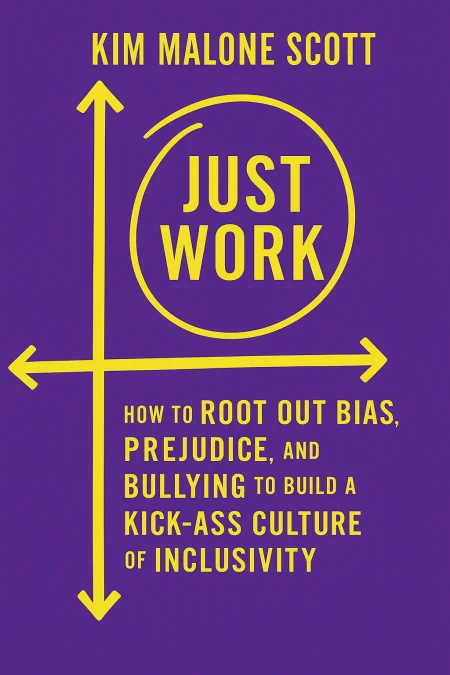
Just Work
How to Root Out Bias, Prejudice, and Bullying to Build a Kick-ass Culture of Inclusivity
Book Edition Details
Summary
In the bustling corridors of corporate life, injustice often lurks unnoticed. Kim Scott, acclaimed author of Radical Candor, returns with Just Work—a powerful manifesto that dismantles the subtle mechanics of workplace bias. It’s more than a book; it’s a call to arms against the silent culprits of inequality that sap innovation and morale. Scott lays bare the uncomfortable truths of exclusion and overestimation, urging leaders and employees alike to forge a new path of equality and respect. With a pragmatic framework that champions individuality and fosters collaboration, Just Work transforms the workplace into a realm where fairness is not just an ideal, but a daily practice. Dive into a narrative that’s as much about personal introspection as it is about collective change, and discover the blueprint for creating an environment where everyone thrives.
Introduction
Workplace injustice operates through sophisticated systems that most organizations fundamentally misunderstand and therefore fail to address effectively. These systems transform individual biases into institutional discrimination, creating environments where talented people cannot perform at their best and collaborative potential remains unrealized. The challenge extends far beyond identifying bad actors or implementing superficial diversity training—it requires recognizing how seemingly neutral policies, unconscious behaviors, and power dynamics combine to create systematic exclusion. The analytical framework presented here distinguishes between different types of harmful workplace dynamics and their underlying mechanisms. By understanding how bias escalates into prejudice and discrimination, how bullying evolves into harassment, we can develop targeted interventions that address root causes rather than symptoms. This approach reveals how conformity pressures and coercive dynamics operate both independently and in combination, creating distinct systems of workplace injustice that require different remedial strategies. The examination proceeds through careful analysis of power structures, institutional responses, and the specific mechanisms by which well-intentioned organizations become complicit in systematic oppression. Rather than relying on traditional approaches that treat these issues as isolated incidents or personal failings, this framework demonstrates how organizational design itself can either perpetuate injustice or create conditions where respect for individuality and genuine collaboration enable both personal fulfillment and exceptional results.
Three Distinct Forms of Workplace Injustice Require Targeted Responses
Workplace injustice manifests through three fundamentally different mechanisms that demand distinct intervention strategies. Bias represents unconscious assumptions—the mind's automatic categorization that operates below conscious awareness. These snap judgments often reflect societal stereotypes rather than individual malice, making them particularly insidious because they feel natural and justified to those exhibiting them. The key insight is that bias responds well to gentle correction and awareness-building, since most people genuinely want to align their actions with their values once inconsistencies are pointed out. Prejudice involves conscious beliefs that rationalize discriminatory attitudes. Unlike bias, prejudice represents deliberate thought processes that maintain and defend stereotypical assumptions. When confronted, prejudiced individuals typically double down rather than reconsider, because they genuinely believe their discriminatory views reflect reality rather than distorted thinking patterns. This distinction proves crucial because prejudice requires firm boundaries rather than education—the goal shifts from changing minds to preventing the imposition of discriminatory beliefs on others. Bullying constitutes intentional harm designed to establish dominance or inflict psychological damage. Bullies understand they are causing pain and often consider that the point of their behavior. This dynamic exploits power differentials or in-group status to intimidate and marginalize targets, creating hostile environments that extend far beyond the immediate victim. Bullying demands immediate consequences, since bullies are motivated by the effectiveness of their intimidation tactics rather than by ignorance or misunderstanding. The framework reveals how these three categories often interact and escalate. Unchecked bias creates vulnerability that prejudiced individuals exploit, while successful prejudice emboldens bullying behavior. Organizations that fail to distinguish between these different forms of injustice typically apply inappropriate responses—attempting to educate bullies who are already acting with full awareness, or imposing harsh consequences on individuals whose biased behavior stems from genuine ignorance rather than malicious intent.
Individual Actions Must Be Coupled with Structural Reform
Individual awareness and good intentions, while necessary, prove insufficient to eliminate workplace injustice without corresponding structural changes. The relationship between personal responsibility and systemic solutions reveals a fundamental tension in how organizations approach these problems. Most default to the individual responsibility model, assuming that bias training, codes of conduct, and punishment of bad actors will solve deeper structural problems. This approach consistently fails because it addresses symptoms while leaving root causes intact. Effective individual action requires understanding one's role in any given situation—whether as someone experiencing harm, witnessing it, causing it, or holding responsibility for preventing it. People experiencing harm must first prioritize their own safety and agency, recognizing that both silence and confrontation carry costs and benefits. The goal involves reclaiming personal power while acknowledging realistic constraints about what individual action can accomplish within existing organizational structures. Those who witness injustice possess unique advantages as upstanders, since they can intervene without the emotional burden carried by those directly targeted. Their neutral position often makes their feedback more credible and less threatening to those causing harm. However, this privilege comes with responsibility—remaining passive in the face of witnessed injustice effectively enables its continuation and compounds the harm experienced by targets. Leaders bear ultimate responsibility for creating systems that prevent injustice from occurring in the first place. This requires moving beyond reactive responses to individual incidents toward proactive design of organizational structures, policies, and cultural norms. The most effective approach combines individual accountability with structural reform, recognizing that neither alone proves sufficient. Personal growth and systemic change must occur simultaneously, each reinforcing the other to create sustainable transformation.
Organizational Design Either Perpetuates or Interrupts Systematic Discrimination
Organizational structures and processes determine whether workplace systems promote justice or perpetuate discrimination through their fundamental design choices. Power concentration creates conditions ripe for abuse, as unchecked authority enables managers to make discriminatory decisions without accountability. Traditional hierarchical structures often give individual supervisors unilateral control over hiring, promotion, compensation, and performance evaluation—creating multiple opportunities for bias to influence critical career outcomes. Distributing decision-making authority across diverse committees and establishing transparent criteria for important choices reduces the impact of any single person's prejudices. Hiring committees make better decisions than individual managers, promotion processes that include peer input reduce favoritism, and compensation systems with clear criteria minimize pay discrimination. These structural interventions prove more effective than relying on individual leaders to self-regulate their use of power. Measurement and transparency serve as powerful correctives to discriminatory practices. Organizations that track demographic patterns in hiring, promotion, and retention can identify problematic trends before they become entrenched. However, data collection alone accomplishes little without commitment to addressing revealed disparities through concrete policy changes and resource allocation. The most sophisticated systems combine quantitative analysis with qualitative feedback to understand both statistical outcomes and lived experiences. Cultural norms around feedback and accountability determine whether discriminatory behavior faces consequences or tacit approval. Environments that normalize bias interruption and reward upstanding behavior create social pressure against injustice. Conversely, cultures that prioritize harmony over equity often enable harmful behavior to persist unchallenged, as the discomfort of confrontation outweighs commitment to fairness. The most effective organizational interventions combine structural changes with cultural transformation, recognizing that policies provide necessary frameworks while lasting change requires shifting underlying assumptions about professional behavior.
Implementation Requires Sustained Leadership Commitment Beyond Surface-Level Changes
Sustainable progress against workplace injustice requires systematic implementation combined with ongoing evaluation, moving far beyond the initial enthusiasm that often characterizes diversity and inclusion initiatives. The transition from recognizing systemic problems to creating lasting change presents numerous practical challenges that frequently derail well-intentioned reform efforts. Organizations consistently underestimate the complexity of cultural transformation, expecting quick fixes to problems that developed over decades. Implementation begins with leadership commitment that extends beyond symbolic gestures to substantive resource allocation and personal accountability. Leaders must model the behaviors they expect from others while creating systems that make discriminatory conduct both visible and costly. This involves redesigning performance evaluation criteria, compensation structures, and advancement opportunities to reward inclusive behavior rather than merely tolerating its absence. Success requires treating justice as core business strategy rather than peripheral social responsibility. Resistance operates at multiple levels, from individual psychological defense mechanisms to institutional inertia that favors existing power arrangements. Those who benefit from current systems may not consciously oppose reform, but their unconscious resistance manifests through skepticism about the need for change, concerns about fairness to dominant groups, or arguments that merit-based systems are inherently neutral. Overcoming this resistance requires persistent education and demonstration of how current systems harm organizational effectiveness. Long-term sustainability depends on embedding anti-discrimination practices into routine organizational operations rather than treating them as special initiatives. When inclusive behavior becomes integral to job performance expectations and career advancement criteria, it shifts from optional good citizenship to essential professional competency. This transformation requires patience and persistence, as cultural change occurs gradually through consistent reinforcement of new norms. The most effective implementations combine top-down structural changes with bottom-up cultural shifts, creating multiple reinforcing mechanisms that support new behaviors while continuously monitoring and adjusting approaches as organizations evolve.
Summary
Workplace injustice persists not because of individual malice, but because of systematic failures to distinguish between different types of harmful behavior and implement appropriate responses for each. The framework demonstrates that bias, prejudice, and bullying require fundamentally different intervention strategies, while organizational structures either enable or interrupt discriminatory patterns through deliberate design choices. Most importantly, sustainable change emerges from coordinated efforts that combine individual accountability with structural reform, immediate interventions with long-term cultural transformation, and top-down leadership commitment with bottom-up employee engagement. This comprehensive approach offers practical tools for creating environments where diverse talents can flourish and collaborative potential can be fully realized, ultimately benefiting both individual careers and collective organizational success through the systematic pursuit of justice.
Related Books
Download PDF & EPUB
To save this Black List summary for later, download the free PDF and EPUB. You can print it out, or read offline at your convenience.
By Kim Malone Scott
