
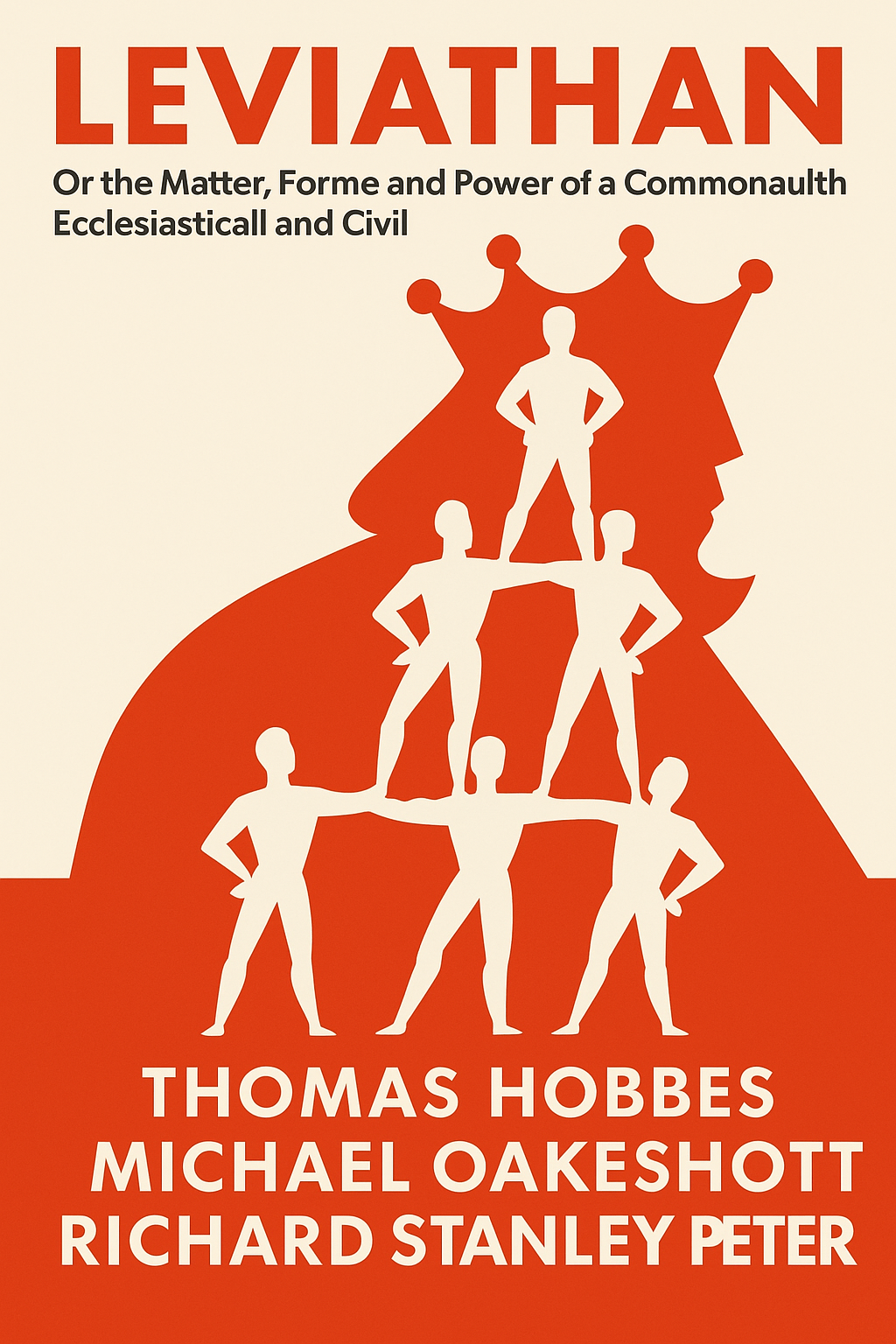
Leviathan
or the Matter, Forme and Power of a Commonwealth Ecclesiasticall and Civil
byThomas Hobbes, Michael Oakeshott, Richard Stanley Peters
Book Edition Details
Summary
In a world teetering on the edge of chaos, where humanity's raw instincts threaten to tear society apart, Thomas Hobbes' "Leviathan" emerges as a beacon of philosophical clarity. Written in the aftermath of a tumultuous era, this seminal work stands as a cornerstone of political thought, probing the essence of power and governance. Hobbes weaves a compelling narrative, positing that only a formidable, centralized authority can quell mankind's innate propensity for conflict. Delving into the intricate tapestry of human nature, politics, and statecraft, "Leviathan" offers a provocative exploration of the social contract and the delicate balance between individual liberty and collective security. As relevant today as it was in the 17th century, Hobbes' insights continue to challenge and inspire, inviting readers to reconsider the foundations of society and the perennial quest for peace.
Introduction
The fundamental challenge of political philosophy lies in explaining how rational, self-interested individuals can legitimately be bound by political authority when those who govern possess no natural superiority over those who obey. This inquiry becomes particularly pressing when we recognize that the very equality of human beings in their essential capacities creates conditions of perpetual conflict and insecurity. The investigation proceeds through a systematic analysis of human nature, tracing the logical progression from individual psychology to the necessity of absolute sovereign power, while addressing the apparent contradiction between unlimited governmental authority and individual liberty. The methodological approach combines rigorous logical deduction with careful examination of historical precedent and scriptural authority, demonstrating how political obligation emerges from rational necessity rather than mere convention or force. This framework proves especially valuable because it grounds legitimate authority in the consent of the governed while simultaneously showing why such consent, once given, cannot be conditionally withdrawn without destroying the very purpose of government. The analysis reveals how questions of sovereignty, religious authority, and constitutional design interconnect to form a comprehensive theory of political legitimacy that speaks directly to contemporary debates about the proper scope and limits of governmental power.
The Necessity of Absolute Sovereign Power
Human equality in fundamental capacities creates the conditions that make political authority both necessary and legitimate. This equality extends beyond physical strength to encompass mental faculties, ensuring that no individual possesses sufficient natural superiority to claim dominance over others. The weakest person retains enough cunning to threaten the strongest, while differences in wisdom prove negligible when measured against the universal human tendency toward self-regard and conflicting judgments about good and evil. The natural condition of humanity without government constitutes a war of every person against every other person, not necessarily involving constant fighting but characterized by the known disposition toward conflict when no common authority exists to resolve disputes. In such circumstances, productive activity becomes impossible since individuals cannot secure the fruits of their labor, culture and learning cannot develop, and life itself becomes solitary, poor, nasty, brutish, and short. No concepts of justice or injustice can exist where no common power establishes enforceable law. The escape from this condition requires a comprehensive transfer of individual rights to a sovereign authority through mutual covenant among subjects themselves. This transfer must be complete and irrevocable, for any reservation of rights or division of authority recreates the original problem of competing claims to legitimate power. The sovereign's authority becomes absolute not through arbitrary assertion but through logical necessity, since subjects who retain the right to judge their sovereign's commands effectively preserve the condition of private judgment that makes civil war inevitable. The objection that absolute power invites tyranny fails to recognize that the alternative is not limited government but the return to natural chaos. The inconveniences that may arise from sovereign power, however severe, cannot compare to the certain miseries of civil war and social dissolution that follow from divided or conditional authority.
Social Contract Foundation and Constitutional Theory
The social contract creates political authority through a covenant among individuals rather than between ruler and subjects, establishing the sovereign as the authorized representative of the unified will of those who created it. This foundational structure means that resistance to sovereign power becomes logically equivalent to self-contradiction, since subjects would be opposing their own authorized representative. The sovereign stands outside the covenant that creates political society, owing no contractual obligations to subjects while possessing unlimited authority derived from their collective authorization. The relationship between natural law and civil law reveals the sophisticated character of legitimate sovereignty. Civil laws do not replace natural law but embody it in specific institutional forms adapted to particular circumstances. The sovereign exercises legitimate authority precisely by translating universal principles of natural law into concrete rules that serve the common good, ensuring that governmental commands derive their binding character not merely from the threat of punishment but from their conformity to rational principles that make peaceful coexistence possible. Constitutional theory emerges from recognizing that sovereign power, while absolute in scope, operates within crucial constraints that distinguish legitimate authority from mere force. The sovereign who violates natural law undermines the foundation of political obligation itself, since subjects originally covenanted only to escape the state of nature, not to enable their own destruction. This integration of natural and civil law provides the theoretical foundation for distinguishing between legitimate sovereignty and tyrannical domination. The indivisibility of sovereign power follows from its essential function of providing final judgment in all disputes. Mixed forms of government that attempt to divide sovereign functions among different institutions inevitably produce conflict when those institutions disagree about the boundaries of their authority, leaving the commonwealth without any final arbiter capable of resolving such disputes and thus recreating the conditions that make civil war possible.
Individual Liberty and Religious Authority Under Sovereignty
Individual liberty under sovereign authority consists in the freedom to act in all matters where the law remains silent, operating within boundaries established by the sovereign's responsibility to maintain peace and security. This understanding resolves the apparent paradox of how free individuals can legitimately be bound by political obligation, since liberty properly means the absence of external impediments to action rather than the presence of a right to act contrary to legitimate authority. The most fundamental limitation on political obligation concerns self-preservation, which no covenant can legitimately require individuals to abandon. Subjects cannot be obliged to kill themselves, to refrain from defending themselves against immediate assault, or to abstain from necessities of life. Political obligation endures only as long as the sovereign retains the capacity to provide protection, since the end of obedience is protection, and subjects naturally transfer their allegiance to whatever power can effectively secure their safety. Religious authority presents particular challenges because competing claims to divine sanction threaten the unity of authority necessary for civil peace. The sovereign must possess authority to regulate public religious doctrine and practice, not to control private belief, which lies beyond human power, but to prevent religious disagreement from spilling over into civil disobedience. This arrangement protects both religious liberty and political stability by ensuring that spiritual and temporal obligations complement rather than compete with each other. The scope of legitimate resistance remains narrowly circumscribed, limited to individual self-defense against immediate threats to life rather than collective resistance to sovereign authority. This distinction preserves the essential function of sovereignty while acknowledging the inalienable character of the natural right to self-preservation that underlies all political obligation and cannot be surrendered through any covenant.
Contemporary Relevance and Theoretical Assessment
The theoretical framework establishes sophisticated criteria for distinguishing legitimate authority from mere domination, revealing complexity in arguments that initially appear to advocate unlimited governmental power. The integration of natural law constraints with absolute sovereign power creates a constitutional theory that addresses both the necessity of effective government and the requirements of legitimate political authority, demonstrating how popular consent can authorize comprehensive governmental power without creating democratic institutions in the modern sense. The analysis of representation shows how the sovereign represents the people not by reflecting their ongoing preferences but by embodying their original agreement to escape the state of nature. This conception explains how absolute authority can derive from popular consent while remaining immune from popular control, providing a foundation for stable government that does not depend on the continuing agreement of subjects who may disagree about particular policies. Contemporary political challenges illuminate the enduring relevance of these insights, particularly the tension between individual liberty and collective security, the difficulty of establishing stable constitutional arrangements, and the persistent threat of political dissolution. The problem of creating effective institutions while maintaining legitimate authority continues to perplex modern democracies, while the challenge of coordinating individual judgment with collective action represents a permanent feature of political life. The diagnostic power of this analysis extends beyond its proposed solutions to encompass its identification of fundamental political problems that retain their force regardless of one's assessment of particular institutional arrangements. The impossibility of binding future generations through present agreements and the inherent instability of political arrangements created by fallible human beings represent enduring challenges that any adequate political theory must address.
Summary
The theoretical framework demonstrates that legitimate political authority must be both absolute in scope and constrained by natural law principles, resolving the apparent contradiction between unlimited governmental power and individual rights through a sophisticated analysis of consent, representation, and the foundations of political obligation. The enduring insight lies in showing that genuine liberty emerges only within the framework of effective government, and that the alternative to absolute sovereignty is not constitutional government but the return to natural chaos, making this work essential reading for anyone seeking to understand the logical structure of political authority and the enduring challenges of constitutional design in modern democratic societies.
Related Books
Download PDF & EPUB
To save this Black List summary for later, download the free PDF and EPUB. You can print it out, or read offline at your convenience.
By Thomas Hobbes
