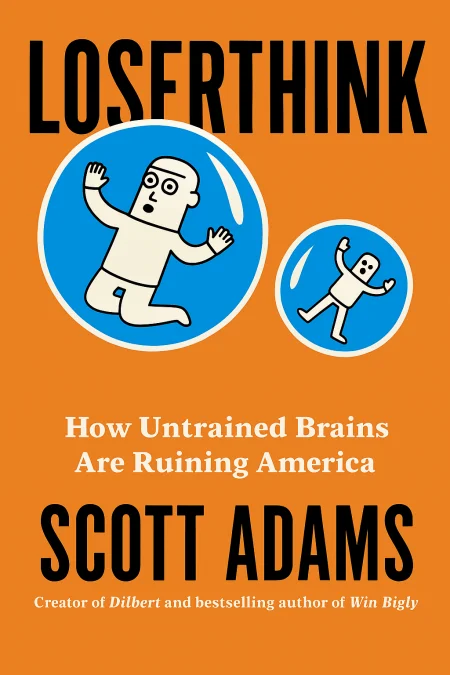
Loserthink
How Untrained Brains Are Ruining America
Book Edition Details
Summary
Tired of the mind-numbing echo chambers dominating today's discourse? Enter a world where "loserthink" ensnares even the sharpest minds, blinding them to reality with stubborn misconceptions and lazy logic. Scott Adams, the genius behind *Dilbert* and *Win Bigly*, dismantles these mental traps with wit and precision, unveiling the sneaky habits that cloud our judgment. Armed with humor and sharp insights, this book equips you with the tools to challenge shallow arguments, whether they come from well-meaning friends or the nightly news. Dive into an enlightening journey that not only shatters your cognitive confines but also elevates you to become a beacon of clarity in a sea of confusion. Here lies the antidote to today's intellectual chaos—your guide to clearer, more powerful thinking awaits.
Introduction
Most people believe they think clearly and logically about the world around them, yet consistently fall into predictable mental traps that limit their ability to solve problems effectively. The widespread prevalence of unproductive reasoning patterns across politics, business, and personal relationships reveals a fundamental gap in how humans approach complex decisions. Rather than being about intelligence or access to information, these thinking failures stem from a lack of exposure to the diverse analytical frameworks developed across different professional disciplines. The systematic examination of these flawed thinking patterns demonstrates how engineers, economists, scientists, psychologists, and other specialists have developed specific cognitive tools that allow them to navigate complexity more successfully. When individuals remain confined to single-domain thinking, they become vulnerable to a range of cognitive errors that produce consistently poor outcomes. By identifying these patterns and understanding the disciplinary thinking methods that can counter them, it becomes possible to break free from the mental constraints that prevent clear analysis and effective action in an increasingly complex world.
The Nature of Loserthink: Identifying Unproductive Mental Patterns
Unproductive thinking represents a fundamental disconnect between how people believe they process information and how they actually make decisions. This gap creates systematic errors that persist regardless of intelligence level or educational background. The core issue lies not in lacking facts or having insufficient cognitive ability, but in applying inappropriate mental frameworks to complex situations that require specialized analytical approaches. These thinking failures manifest most clearly when individuals attempt to understand multifaceted problems through oversimplified lenses. The tendency to rely on pattern recognition in situations where patterns may not exist, to assume causation where only correlation appears, or to apply moral frameworks to technical problems creates a cascade of poor decisions. Such approaches work adequately for routine daily tasks but break down completely when addressing the complex challenges that define modern life. The persistence of these patterns stems from their invisibility to those who employ them. Unproductive thinking feels identical to clear reasoning from the inside, creating a confidence that masks fundamental analytical errors. This confidence becomes particularly problematic when combined with the human tendency to seek confirming evidence while dismissing contradictory information, creating self-reinforcing cycles of flawed reasoning. Breaking these patterns requires first recognizing their existence and understanding how they operate. The identification process involves stepping outside familiar analytical comfort zones and examining thinking processes through frameworks developed in fields where clear reasoning carries immediate practical consequences. Only through this external perspective can the walls of mental limitation become visible and ultimately permeable.
Thinking Tools Across Disciplines: Psychology, Economics, Science, and Leadership
Professional disciplines have evolved distinct approaches to handling uncertainty, complexity, and decision-making under pressure. Psychology provides frameworks for understanding human bias and the systematic ways people misinterpret social situations and their own motivations. The field reveals how confidence often inversely correlates with accuracy, how memory reconstruction creates false certainties, and how emotional states influence supposedly rational decisions in predictable ways. Economic thinking emphasizes the systematic comparison of alternatives and the careful weighing of costs against benefits across different time horizons. This disciplinary approach reveals how seemingly obvious solutions often ignore crucial opportunity costs or fail to account for unintended consequences. Economic frameworks also illuminate how individual rational behavior can produce collective irrationality, and how incentive structures shape outcomes more powerfully than stated intentions or moral exhortations. Scientific methodology provides tools for distinguishing correlation from causation, for testing hypotheses systematically, and for maintaining skepticism in the face of appealing but unverified explanations. The scientific approach emphasizes reproducibility, peer review, and the provisional nature of all conclusions, creating mental habits that resist the human tendency toward premature certainty and confirmation bias. Leadership thinking focuses on managing complexity through systems rather than goals, understanding that most significant outcomes emerge from processes rather than individual decisions. This perspective emphasizes the importance of creating conditions for good decisions rather than trying to predict specific outcomes, and recognizes that direction often matters more than precision when navigating uncertain environments.
Common Loserthink Traps: Mind Reading, Word Games, and False Patterns
The illusion of understanding others' motivations represents one of the most pervasive forms of unproductive thinking. People consistently overestimate their ability to discern the intentions, thoughts, and character of others, particularly strangers or those with whom they disagree politically or socially. This false confidence in mind-reading abilities creates elaborate interpretations of behavior that often bear little relationship to actual motivations, leading to unnecessary conflicts and missed opportunities for cooperation. Word-focused arguments represent another common trap where debates center on definitions rather than solutions or outcomes. When discussions devolve into disputes about whether something constitutes "socialism," "racism," or "fairness," they typically abandon any attempt to address underlying problems or evaluate proposed solutions. This pattern allows participants to feel intellectually engaged while avoiding the more difficult work of comparing alternatives or considering unintended consequences. Pattern recognition failures manifest when people identify meaningful connections in coincidental events or assume that historical analogies predict future outcomes. The human brain's tendency to see patterns everywhere becomes problematic when applied to complex systems with multiple variables, where apparent similarities mask fundamental differences. These false pattern recognitions create compelling narratives that feel explanatory but lack predictive power. The tendency to judge entire groups by their most extreme members represents a systematic analytical error that prevents accurate assessment of political movements, professional communities, or social groups. This pattern becomes particularly destructive in political contexts, where media incentives amplify the most dramatic examples while ignoring more representative but less newsworthy behaviors. Such thinking creates false certainties about large populations based on unrepresentative samples.
Breaking Free: Escaping Mental Prisons and Helping Others Think Better
Personal liberation from unproductive thinking patterns begins with developing intellectual humility and systematic self-awareness. Tracking the accuracy of personal predictions over time reveals the gap between confidence and competence, creating the foundation for more realistic self-assessment. This process requires deliberately exposing oneself to potentially embarrassing situations and discovering that temporary discomfort carries no lasting consequences, thereby reducing the fear-based thinking that constrains bold action and clear analysis. The development of ego as a tool rather than identity allows for strategic confidence when situations require bold action, combined with appropriate humility when evidence contradicts preferred beliefs. This flexibility requires practice in both directions: learning to project confidence even when uncertain, and learning to acknowledge error and change direction when evidence demands it. Such emotional regulation becomes particularly crucial when dealing with complex problems that require sustained effort despite uncertain outcomes. Helping others escape their own analytical limitations requires different strategies than personal development. Direct confrontation of flawed reasoning typically triggers defensive responses that strengthen rather than weaken problematic thinking patterns. More effective approaches involve asking questions that reveal contradictions within existing belief systems, focusing on procedural rather than substantive disagreements, and creating opportunities for face-saving belief revision. The most powerful technique for assisting others involves demonstrating rather than arguing for better thinking approaches. When people observe consistently superior results from different analytical methods, they become naturally curious about the underlying processes. This indirect approach bypasses the ego-protection mechanisms that typically resist direct challenges to established beliefs, creating genuine openings for intellectual growth and improved decision-making capabilities.
Summary
The systematic application of professional thinking tools to everyday decisions and social problems offers a pathway beyond the intellectual constraints that limit individual effectiveness and social cooperation. Rather than accepting flawed reasoning as inevitable, the recognition that clear thinking represents a learnable skill set opens possibilities for significant personal and collective improvement. The evidence suggests that most analytical failures stem not from insufficient intelligence but from incomplete exposure to the diverse problem-solving approaches that different disciplines have refined through practical necessity. When individuals begin incorporating multiple analytical frameworks into their decision-making processes, they gain access to more accurate assessments of complex situations and more effective strategies for navigating uncertainty.
Related Books
Download PDF & EPUB
To save this Black List summary for later, download the free PDF and EPUB. You can print it out, or read offline at your convenience.
By Scott Adams
