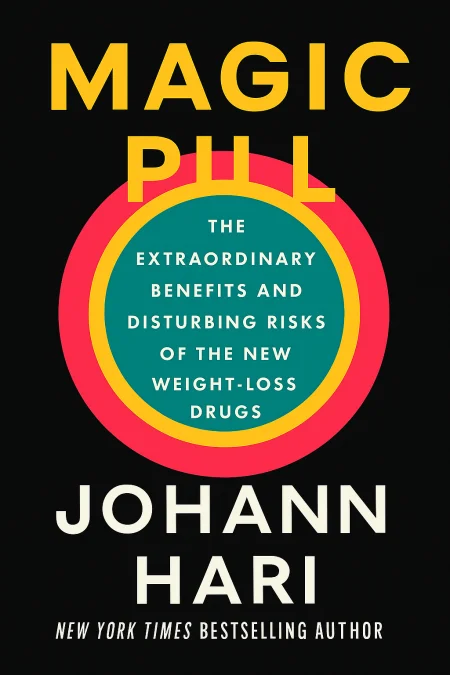
Magic Pill
The Extraordinary Benefits and Disturbing Risks of the New Weight-Loss Drugs
Book Edition Details
Summary
In a world teetering on the edge of a health revolution, Johann Hari stands at the crossroads, syringe in hand. His latest endeavor, "Magic Pill," is not just a book—it's a clarion call to rethink our tangled relationship with food, weight, and societal norms. When Hari injects himself with Ozempic, a groundbreaking weight-loss drug, he sets off on a deeply personal and scientific exploration that challenges the very fabric of our dietary dilemmas. With obesity rates soaring due to addictive foods and unwalkable cities, Hari questions whether pharmaceuticals are truly the answer or a band-aid on a festering wound. As he navigates the tumultuous waters of modern health crises, "Magic Pill" probes the heart of our cultural psyche, daring readers to confront the uncomfortable truths about our collective quest for the ideal body. Prepare for a mind-bending journey that scrutinizes the promises and pitfalls of a medical marvel poised to redefine our future.
Introduction
The emergence of revolutionary weight-loss medications has ignited one of the most consequential debates in modern medicine, forcing society to confront fundamental questions about human biology, pharmaceutical intervention, and collective responsibility for health. These drugs promise to solve what has been humanity's most intractable health challenge through weekly injections that can reduce body weight by unprecedented amounts, yet their arrival coincides with growing recognition that the obesity epidemic stems from systematic environmental manipulation rather than individual failings. The central tension lies not simply in evaluating medical benefits against potential risks, but in determining whether pharmaceutical solutions represent genuine progress or sophisticated forms of treating symptoms while ignoring root causes. This analysis employs a rigorous framework that examines scientific evidence, historical precedent, and societal implications to navigate beyond simplistic narratives of miracle cures or dangerous experiments. The investigation proceeds through multiple analytical lenses, challenging readers to consider how individual treatment decisions intersect with broader questions about food systems, healthcare equity, and the appropriate role of medical technology in addressing problems created by environmental factors. The evidence demands moving beyond initial emotional reactions toward nuanced understanding of choices that will reshape medical practice and social policy for generations.
The Medical Revolution: Unprecedented Weight Loss Through Hormonal Intervention
The scientific breakthrough underlying these medications emerged from decades of research into human appetite regulation and metabolic signaling pathways. Researchers discovered that hormones produced in the intestine, particularly GLP-1, play crucial roles in communicating satiety to the brain, but these natural systems become disrupted in many individuals struggling with obesity. The pharmaceutical innovation involved creating synthetic versions of these hormones that remain active for extended periods, effectively restoring and amplifying the body's natural appetite control mechanisms. Clinical evidence demonstrates results that surpass all previous weight-loss interventions in medical history. Large-scale trials involving thousands of participants show average weight reductions of 15-20% over 68 weeks, with some individuals achieving losses exceeding 25% of their initial body weight. These outcomes far exceed what traditional diet and exercise programs typically accomplish, where sustained weight loss rarely exceeds 5-10% of body weight. The mechanism operates by slowing gastric emptying, reducing appetite signals, and fundamentally altering neural responses to food cues throughout the brain's reward systems. The medical implications extend far beyond cosmetic concerns into life-threatening health conditions. Obesity contributes directly to type 2 diabetes, cardiovascular disease, certain cancers, and numerous other conditions that represent leading causes of mortality in developed nations. Preliminary cardiovascular outcome studies suggest these medications may reduce heart attacks and strokes by approximately 20% within five years, while producing dramatic improvements in diabetes management and blood pressure control. Perhaps most significantly, these drugs appear to address not just physical hunger but the psychological compulsions that drive overeating behaviors. Users report profound shifts in their relationship with food, describing the disappearance of constant thoughts about eating and reduced cravings for both food and other potentially addictive substances including alcohol and nicotine.
The Safety Paradox: Historical Precedents and Unknown Long-Term Risks
The history of weight-loss medications provides sobering context for evaluating current enthusiasm about breakthrough treatments. The fen-phen disaster of the 1990s exemplifies how initial confidence in pharmaceutical safety can prove catastrophically misplaced when serious adverse effects emerge only after widespread use. These previously approved diet drugs caused heart valve damage and pulmonary hypertension that killed numerous patients before being withdrawn from the market, illustrating the inherent challenges of predicting long-term consequences from short-term clinical trials. Current GLP-1 medications have undergone more extensive testing than their predecessors, yet fundamental limitations remain in understanding their long-term safety profile. Most clinical trials follow participants for one to two years, providing insufficient data about effects over the decades these medications would likely be used. Documented side effects range from common gastrointestinal issues including nausea and constipation to more serious complications such as gastroparesis, pancreatitis, and potential increases in thyroid cancer risk flagged by European regulatory agencies. The biological complexity of appetite regulation means these drugs affect multiple physiological systems simultaneously, creating both therapeutic opportunities and unpredictable complications. Muscle mass loss accompanies fat reduction in many users, potentially increasing frailty and mortality risk especially in older adults. Additionally, these medications require lifelong use to maintain benefits, meaning patients commit to decades of exposure to unknown long-term consequences while serving essentially as unwitting participants in a massive real-world experiment. The risk-benefit calculation becomes further complicated by economic and accessibility factors. At current prices exceeding $1,000 monthly, these treatments risk creating a two-tiered healthcare system where wealthy individuals access potentially life-saving interventions while others cannot, raising profound questions about equity and resource allocation in addressing what may eventually affect 70% of adults in some developed nations.
The Societal Dilemma: Treating Symptoms While Ignoring Environmental Causes
The widespread adoption of pharmaceutical weight-loss solutions raises fundamental questions about addressing symptoms versus underlying causes of the obesity epidemic. The dramatic increase in obesity rates over the past 50 years coincides with systematic changes in food production, processing, and marketing rather than genetic shifts in human populations. Ultra-processed foods engineered to maximize palatability and consumption now dominate diets in developed nations, creating what researchers describe as an obesogenic environment that actively promotes overconsumption regardless of individual willpower or knowledge. Comparative international evidence suggests that environmental and policy interventions could address obesity at its roots without requiring pharmaceutical intervention. Japan maintains obesity rates below 4% through comprehensive cultural approaches emphasizing fresh food preparation, portion control, regular physical activity, and social norms that discourage overeating. Their success demonstrates that systematic environmental modifications can prevent obesity more effectively than treating it after it develops, yet such approaches require coordinated social and political commitment that pharmaceutical solutions circumvent. The pharmaceutical approach may inadvertently reduce pressure for necessary food system reforms by providing technological fixes that allow problematic environmental conditions to persist. If medications can effectively manage obesity's health consequences, food companies face diminished incentive to reformulate products or modify marketing practices that contribute to overconsumption. This dynamic risks creating a cycle where increasingly sophisticated medical interventions become necessary to counteract increasingly problematic food environments, potentially establishing permanent pharmaceutical dependency for problems that could be prevented through environmental changes. Furthermore, widespread medication use may exacerbate existing health inequalities by providing wealthy individuals with significant health and social advantages while those unable to afford treatments continue facing obesity-related discrimination and health complications. The societal implications extend beyond individual health outcomes to questions of fairness, resource allocation, and whether advanced medical technology should substitute for addressing fundamental environmental causes of disease.
The Evidence Gap: What We Know, Don't Know, and Need to Decide
The current evidence base, while substantial in some areas, contains significant gaps that complicate definitive recommendations about widespread medication use. Individual variation in response appears considerable, with some people experiencing dramatic benefits while others see minimal weight loss or cannot tolerate side effects. Genetic factors, gut microbiome composition, psychological relationships with food, and underlying medical conditions all influence outcomes in ways that current research cannot fully predict or explain. The decision-making framework must also consider opportunity costs and alternative interventions that might achieve similar health benefits with different risk profiles. Resources devoted to pharmaceutical treatments might alternatively support comprehensive lifestyle interventions, food system reforms, or addressing social determinants of health that contribute to obesity. Some evidence suggests that intensive behavioral programs, while less convenient than medication, can achieve meaningful weight loss with fewer unknown risks, particularly when combined with environmental modifications that support healthy choices. The temporal dimension adds another layer of complexity to evidence evaluation. Long-term safety and effectiveness data remain unavailable for medications that would likely be used for decades, while the urgency of obesity-related health crises demands immediate intervention for many individuals. This creates a challenging situation where patients and healthcare providers must make consequential decisions based on incomplete information about both benefits and risks. Perhaps most importantly, the evidence reveals that these medications, regardless of their individual merits, cannot address the systematic environmental factors that created the obesity epidemic and continue affecting new generations. The most comprehensive approach would likely involve using pharmaceutical interventions strategically while simultaneously pursuing food system reforms and environmental modifications that could eventually reduce dependence on medical solutions.
Summary
Revolutionary weight-loss medications represent both remarkable scientific achievement and complex societal challenge that extends far beyond individual treatment decisions. The evidence reveals drugs capable of producing unprecedented weight loss with significant health benefits, accompanied by meaningful but incompletely understood risks and broader implications for healthcare equity and social policy. The fundamental insight emerging from rigorous analysis is that pharmaceutical solutions, while potentially transformative for many individuals facing immediate health threats, cannot substitute for addressing the environmental and systematic factors that created the obesity epidemic and continue affecting entire populations. The most thoughtful approach recognizes these medications as valuable tools within a comprehensive strategy that simultaneously pursues food system reform, environmental modifications, and policies supporting healthy choices for all members of society, rather than relying solely on technological fixes for problems rooted in environmental design.
Related Books
Download PDF & EPUB
To save this Black List summary for later, download the free PDF and EPUB. You can print it out, or read offline at your convenience.
By Johann Hari
