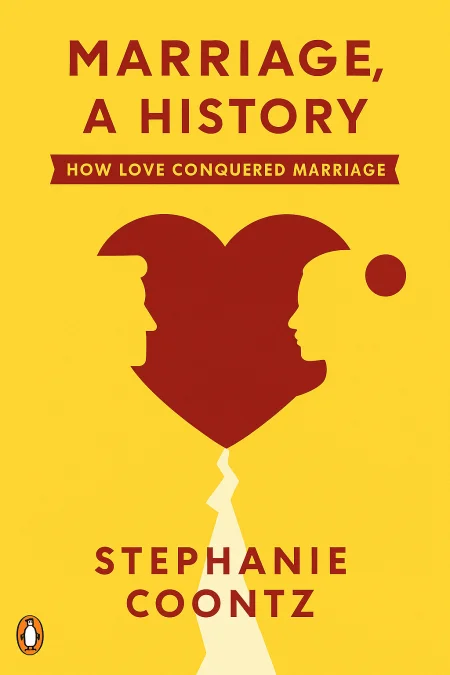
Marriage, a History
How Love Conquered Marriage
Book Edition Details
Summary
In an era where "traditional" marriage is a hotly debated topic, Stephanie Coontz's "Marriage, a History" dares to ask if such a tradition ever truly existed. With a historian’s insight and a storyteller’s flair, Coontz whisks readers through time—from the strategic unions of ancient Babylon to the passionate yet tortured romances of the Victorian age—revealing how the concept of marrying for love is a recent innovation that would have baffled our ancestors. By the nineteenth century, marriage shifted from a societal contract to an emotional endeavor, sparking its evolution as both an institution in crisis and a flourishing personal bond. This book is a witty, illuminating exploration of marriage’s transformation, offering fresh perspectives on a timeless institution and inviting readers to reconsider what "traditional" really means.
Introduction
Picture a medieval princess being escorted to her wedding by hundreds of armed knights, knowing she'll never see her homeland again. Fast-forward to a Victorian bride fainting with romantic passion at the altar. Then imagine a modern couple debating whether to sign a prenuptial agreement. These scenes capture one of history's most dramatic transformations: how marriage evolved from a cold political transaction into the deeply personal, love-based institution we know today. For most of human history, marriage had little to do with romance and everything to do with survival, power, and property. Kings sealed peace treaties through strategic weddings. Peasant families arranged matches to combine farmland. Parents viewed their children's marriages as investments in the family's future prosperity and security. Love, if it developed at all, was considered a pleasant bonus rather than the foundation of the union. This exploration reveals how a revolutionary idea emerged in the 18th century that would forever change human relationships: the radical notion that people should marry for love. This seemingly simple concept unleashed forces that continue to reshape society today, creating both unprecedented opportunities for personal fulfillment and new challenges for marital stability. Understanding this transformation helps explain everything from modern divorce rates to contemporary debates about gender roles, offering invaluable insights for anyone seeking to navigate the complexities of modern relationships.
Ancient Foundations: Marriage as Political and Economic Strategy
In the ancient world, marriage was the ultimate diplomatic tool, wielding more power than armies or gold. When King Zimri-lim of Mari married off eight daughters to neighboring rulers around 1800 BCE, he wasn't playing matchmaker—he was building an empire. Each wedding ceremony was essentially a treaty signing, each bride a living guarantee of her father's political promises. The stakes were breathtakingly high. A princess who failed to produce an heir might find herself divorced, exiled, or worse. When one Syrian princess complained to her father that her husband's first wife had relegated her to sitting "in a corner holding my head in my hands like any idiot woman," she wasn't just expressing hurt feelings—she was reporting a diplomatic crisis that could trigger war between kingdoms. These ancient marriage systems served crucial functions that modern romantic ideals obscure. Marriage created kinship networks that extended cooperation beyond immediate families, turning strangers into relatives and enemies into allies. In societies without banks, police forces, or international law, these personal bonds provided the only reliable framework for trade, justice, and peace. The Luo of Kenya captured this perfectly in their saying: "They are our enemies, we marry them." The ancient world's approach to marriage established patterns that would dominate human civilization for millennia. Marriage became the primary mechanism for transferring wealth, establishing legitimacy, and organizing political power. These foundations were so strong that even as empires rose and fell, the basic understanding of marriage as a public institution serving collective interests remained virtually unchanged until the revolutionary upheavals of the 18th century.
Medieval Revolution: Church Authority and the Birth of Romantic Love
Medieval Europe witnessed an unprecedented power struggle over marriage that would reshape Western civilization. When the Catholic Church began asserting control over matrimony in the 12th century, it wasn't simply claiming religious authority—it was challenging the very foundations of political power. The church's radical doctrine that marriage required only the mutual consent of the bride and groom, spoken in the present tense, created chaos in royal courts across Europe. The marriage scandal of King Lothar II in the 9th century perfectly illustrates these tensions. When Lothar tried to divorce his barren wife Theutberga to marry his fertile mistress Waldreda and legitimize his heir, he triggered a seven-year international crisis involving popes, archbishops, and rival kings. The struggle ended with Lothar's defeat and death, demonstrating that even monarchs could no longer manipulate marriage at will when the church opposed them. Yet medieval nobles found creative ways to work within—and around—church restrictions. The church's extraordinarily broad definition of incest, which prohibited marriage up to the seventh degree of kinship, became a convenient escape clause. When Eleanor of Aquitaine wanted to divorce King Louis VII of France in 1152, they suddenly "discovered" they were related within the prohibited degrees, despite this being common knowledge at their wedding. Simultaneously, the culture of courtly love emerged, celebrating passionate devotion between men and women as a noble ideal. Though these romances typically occurred outside marriage, they planted revolutionary seeds in European consciousness. The tales of Lancelot and Guinevere, Tristan and Isolde established a new cultural template that would eventually challenge marriage's purely strategic foundations. Medieval Europe had inadvertently created the intellectual and emotional framework for the love revolution that would transform the world centuries later.
Industrial Transformation: The Rise of Companionate Marriage (1750-1920)
The Industrial Revolution unleashed forces that would fundamentally transform marriage within just a few generations. For the first time in human history, large numbers of people could earn independent wages and establish households without waiting for inheritance or parental approval. Young men and women working in factories and commercial enterprises gained unprecedented freedom to choose their own partners based on personal attraction rather than family strategy. The economic foundations of this transformation were profound. When a young woman could support herself through factory work or domestic service, she no longer needed to marry for survival. When a young man could earn steady wages without inheriting land, he could court whomever captured his heart. These new economic realities reduced parental leverage over children's marriage choices and created space for individual preference to flourish. Victorian society embraced the ideal of companionate marriage with remarkable enthusiasm. The home became idealized as a sanctuary where husband and wife would find emotional fulfillment and moral renewal after engaging with the harsh realities of industrial capitalism. Popular literature, advice manuals, and religious teachings all promoted the revolutionary idea that successful marriages required not just economic cooperation, but genuine affection, shared values, and emotional intimacy between partners. Yet this transformation contained inherent contradictions that would drive future changes. The same emphasis on emotional fulfillment that made marriages more personally satisfying also made them more fragile. When marriages were primarily economic arrangements, they could survive the absence of love. But once emotional satisfaction became the primary goal, marriages became vulnerable to the inevitable fluctuations of human feeling. The Victorian era had created the template for modern marriage while simultaneously introducing the instabilities that continue to challenge the institution today.
Modern Evolution: From Institution to Individual Choice (1920-Present)
The twentieth century completed marriage's transformation from social institution to personal relationship, culminating in today's emphasis on individual choice, emotional fulfillment, and gender equality. This final phase of evolution, accelerating dramatically after 1960, dismantled the last remaining barriers to purely voluntary marriage while simultaneously creating alternatives that previous generations could never have imagined. The convergence of reliable birth control, women's economic independence, and changing social values fundamentally altered the marriage landscape. For the first time in human history, women could control their reproductive lives, support themselves economically, and choose whether, when, and whom to marry based entirely on personal preference. The sexual revolution separated romantic relationships from marriage, while the women's movement challenged traditional gender roles that had structured matrimonial arrangements for millennia. Legal and social changes reinforced these personal transformations. No-fault divorce laws made it possible to end unsatisfying marriages without proving wrongdoing, while the elimination of legal disabilities for unmarried women removed many practical incentives for marriage. Same-sex marriage rights, cohabitation acceptance, and single parenthood normalization created a marketplace of relationship options that would have been inconceivable to earlier generations. Today's marriage culture represents both the fulfillment and the crisis of historical trends toward individual choice. Modern marriages, when they work, offer unprecedented levels of personal satisfaction, emotional intimacy, and gender equality. Partners choose each other freely, negotiate their roles consciously, and can leave if the relationship fails to meet their needs. Yet this freedom comes with new challenges: higher expectations, greater instability, and the constant pressure to justify marriage's continued relevance in a world of expanded options. The institution that once provided clear scripts for behavior now requires constant negotiation, making successful marriages both more rewarding and more difficult to achieve than ever before.
Summary
The history of marriage reveals a fundamental tension between collective needs and individual desires that continues to shape our lives today. For millennia, marriage served as society's primary mechanism for organizing politics, economics, and social order, with personal happiness considered a luxury that few could afford. The revolutionary shift toward love-based marriage in the 18th and 19th centuries promised to resolve this tension by making personal fulfillment the foundation of social stability, but instead created new contradictions that we're still working to resolve. The Victorian attempt to balance romantic love with social order through rigid gender roles ultimately failed because it was built on an impossible premise: that two people could achieve perfect intimacy while living in completely separate spheres. As women gained education and men became more emotionally invested in family life, the artificial barriers between masculine and feminine domains became increasingly difficult to maintain. The same idealization of marriage that was supposed to strengthen the institution by making it more personally fulfilling also made it more fragile by raising expectations that were difficult to meet. Understanding this historical trajectory offers crucial insights for navigating modern relationships. First, recognize that our contemporary struggles with work-life balance, gender roles, and marital expectations are not personal failures but the natural result of historical forces that transformed marriage faster than we could adapt our institutions and expectations. Second, embrace the ongoing evolution of marriage rather than mourning the loss of some imagined golden age—every era has had to negotiate the tension between individual fulfillment and social stability in its own way. Finally, remember that the greatest strength of modern marriage lies not in returning to past models but in consciously creating new forms of partnership that honor both personal autonomy and mutual commitment, drawing wisdom from history while remaining open to continued change.
Related Books
Download PDF & EPUB
To save this Black List summary for later, download the free PDF and EPUB. You can print it out, or read offline at your convenience.
By Stephanie Coontz
