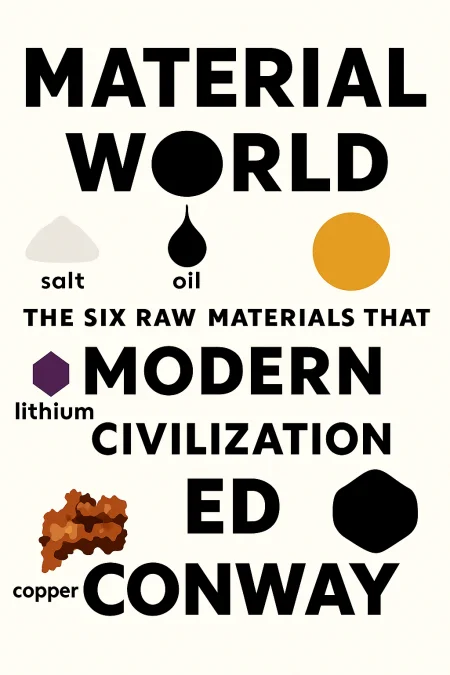
Material World
The Six Raw Materials That Shape Modern Civilization
Book Edition Details
Summary
Deep beneath the surface of our modern lives lies an untold story, one etched in the elemental forces of sand, salt, iron, copper, oil, and lithium. In "Material World," Ed Conway uncovers the hidden power of these raw materials that have sculpted our civilization, from the ancient empires they built to the technological wonders they enable today. Journey with Conway from the blistering heat of European mines to the precision of Taiwan’s chip factories, as he illuminates the intricate dance of human ambition and the earth’s bounty. This narrative doesn't just chronicle a historical saga; it reveals the pulse of human progress and the relentless drive to master the elements that shape our very existence. This is not merely a book—it's an awakening to the forces that have crafted our past and are defining our future.
Introduction
Standing in the Nevada desert, watching explosives detonate to extract precious metals from an entire mountain, a profound realization emerges: we inhabit two worlds simultaneously. There's the ethereal realm of digital apps and financial transactions that dominates our consciousness, and then there's the Material World—the hidden foundation of everything we touch, use, and depend upon. This invisible realm shapes our lives more profoundly than most realize, determining which civilizations rise and fall, which nations control global trade routes, and how billions of people live and work. Throughout history, six fundamental materials have quietly orchestrated human progress: sand, salt, iron, copper, oil, and lithium. These substances don't merely fill our buildings or power our devices—they reveal the hidden architecture of human development, from ancient salt routes that sparked the first trade networks to modern semiconductor supply chains reshaping geopolitical power. Understanding their stories uncovers how material abundance or scarcity continues to influence everything from individual prosperity to international relations, offering crucial insights into the physical foundations of our seemingly digital age. This exploration appeals to anyone curious about how our modern world actually functions beneath its technological veneer, revealing the extraordinary human ingenuity required to transform raw earth into the materials that define civilization itself.
Ancient Foundations: Sand, Salt and Early Trade Networks (Pre-1400 CE)
The story of human civilization begins not with grand conquests or noble ideas, but with the discovery of how to manipulate humble materials scattered across ancient landscapes. Between 6000 and 1000 BCE, grains of sand and crystals of salt sparked humanity's first great transformation from hunter-gatherers to manufacturers and traders. On the cliffs of Boulby, England, archaeologists uncovered something remarkable: a 6,000-year-old salt factory, complete with ovens, production lines, and evidence of cheese-making. This wasn't a small family operation but an industrial-scale enterprise that predated Stonehenge by a millennium. Neolithic communities had mastered the art of turning seawater into precious white crystals, creating one of humanity's first manufactured products designed for trade rather than mere survival. Meanwhile, in the deserts of Egypt and Libya, ancient peoples discovered that certain sands possessed almost magical properties. When heated to extreme temperatures, these silica-rich grains transformed into glass—humanity's first synthetic material. The pure yellow glass found in Tutankhamun's jewelry, created by a meteor strike 29 million years earlier, represented nature's own demonstration of this alchemical process. Phoenician merchants recognized glass's revolutionary potential, establishing workshops along the Syrian coast while jealously guarding their techniques. These early material innovations fundamentally altered human society. Salt routes crisscrossed continents, connecting distant communities and establishing the first global trade networks. Glass-making centers became hubs of technological innovation, their craftsmen holding secrets that could determine the fate of empires. The control of these materials began shaping political power structures that would persist for millennia, establishing patterns of resource dominance that echo in today's global economy.
Industrial Revolution: Iron, Coal and Mass Production (1400-1850)
Around 1400 BCE, the discovery of iron smelting triggered a revolution that would reshape civilization itself. Unlike previous metals, iron was abundant, strong, and could be fashioned into tools that dramatically increased human productivity and military capability. The transformation was swift and decisive—steel ploughs reduced the time needed to prepare a hectare of farmland from 20 hours to just three hours, freeing vast populations from agricultural labor and enabling the rise of cities and specialized crafts. The marriage of iron and coal during Britain's Industrial Revolution created an entirely new paradigm of human capability. As forests dwindled and charcoal became scarce, innovative smelters turned to fossil fuels, unknowingly launching the carbon-intensive economy that would dominate the next three centuries. Abraham Darby's breakthrough in 1709, successfully smelting iron with coke instead of charcoal, didn't just solve England's deforestation crisis—it unleashed manufacturing on a scale previously unimaginable. This coal-and-iron partnership created a feedback loop of innovation that would define the modern world. Steam engines, forged from abundant iron, could pump water from deeper coal mines. Better iron tools could extract more coal. Henry Bessemer's steel converter in the 1850s completed this revolution, turning iron into steel in minutes rather than hours, enabling the construction of railways, bridges, and skyscrapers that would reshape entire landscapes. The social implications were equally profound. Steel became the backbone of modern infrastructure, and nations began measuring their power not just in territory or population, but in tonnes of steel production. This material determinism reached its extreme in Mao's Great Leap Forward, where obsession with steel output led to catastrophic famine, demonstrating how deeply these materials had become embedded in political ideology and national identity.
Electric Age: Copper, Oil and Global Transformation (1850-1950)
The late 19th and early 20th centuries witnessed an unprecedented scramble for materials that would define industrial supremacy. Copper emerged as the nervous system of the electrical age, while oil became the lifeblood of mechanized civilization. Thomas Edison's vision of electric lighting depended entirely on copper's unique properties as a conductor, but early supplies were inadequate for his ambitious plans until the development of electrolytic refining produced copper pure enough to carry electrical current efficiently across vast distances. The discovery of massive oil fields in Pennsylvania, Texas, and the Middle East triggered a global resource race that redrew political maps. John D. Rockefeller's Standard Oil empire demonstrated how control of a single material could create unprecedented wealth and power. Oil didn't just fuel vehicles—it became the feedstock for plastics, pharmaceuticals, and fertilizers that would reshape daily life. The War of the Pacific saw Chile seize vast territories rich in nitrates and copper, transforming a small nation into a resource superpower. These materials created entirely new forms of international dependency. Nations found themselves locked into complex supply chains spanning continents. The British Empire's control of copper mines, American dominance of oil refining, and Germany's chemical innovations created a web of material relationships that often proved more durable than political alliances. The combination of electricity and petroleum created the foundation for mass communication, mass transportation, and mass production on an unprecedented scale. The deeper transformation was cultural and economic. Oil enabled the mass production revolution, from Henry Ford's assembly lines to the suburbanization of entire societies. Copper made possible the electrical grid, telecommunications, and eventually the digital revolution. Yet this material abundance came with hidden costs—environmental degradation, resource conflicts, and the growing realization that these finite materials could not sustain infinite growth.
Digital Future: Silicon, Lithium and Sustainable Materials (1950-Present)
As the world grapples with climate change and seeks alternatives to fossil fuels, new materials have emerged as keys to our technological future. Ultra-pure silicon, extracted from common sand through processes requiring unprecedented precision, became the foundation of the digital revolution. Impurities measured in parts per billion could render computer chips useless, yet mastering these techniques enabled the creation of transistors, microprocessors, and smartphones that now connect billions of people. Lithium's journey from psychiatric medication to battery technology illustrates how materials can find unexpected applications. The development of lithium-ion batteries required decades of patient experimentation to tame this highly reactive metal. When commercialized in the 1990s, these batteries enabled the portable electronics revolution while positioning lithium as central to humanity's next great transition away from fossil fuels. The lithium revolution reveals how quickly material dependencies can shift. Countries that seemed peripheral to global power structures—Chile, Argentina, Australia—suddenly find themselves at the center of the clean energy transition. China's early investment in lithium processing and battery manufacturing has given it commanding advantages in electric vehicles and renewable energy storage, demonstrating how control of critical materials continues to determine geopolitical influence. Yet this transition also exposes persistent challenges of the Material World. Lithium extraction requires enormous quantities of water in some of the world's driest regions, threatening indigenous communities and fragile ecosystems. The semiconductor industry, built on ultra-pure silicon from a handful of quarries worldwide, illustrates how our most advanced technologies remain utterly dependent on basic materials. A single mine in North Carolina provides quartz needed for crucibles enabling global chip production, while Taiwan's semiconductor dominance has become a critical factor in international relations.
Summary
Throughout human history, the control of six fundamental materials—sand, salt, iron, copper, oil, and lithium—has determined which societies prosper and which struggle. This pattern reveals a central paradox of modern life: as our economy appears increasingly digital and dematerialized, our dependence on physical materials has actually intensified. Today's smartphones contain more elements from the periodic table than any previous human creation, while the infrastructure supporting our cloud-based services requires vast quantities of steel, copper, and rare earth elements. The lessons from this material history offer crucial insights for navigating current challenges. First, resource abundance is never permanent—what seems infinite today may become scarce tomorrow, requiring constant innovation and adaptation. The same human ingenuity that turned sand into computer chips and brine into batteries must now solve the puzzle of meeting growing material needs without destroying the planet that provides them. Second, the geopolitical implications of material control remain as relevant today as they were in ancient salt-trading civilizations, suggesting that energy security and supply chain resilience deserve the same attention as traditional military concerns. Finally, understanding these material foundations empowers more informed decisions about technology adoption, environmental policy, and international cooperation. The materials that built our civilization now hold the key to its survival, demanding that we learn from history's lessons about material exploitation while building a sustainable future. This requires investing heavily in recycling and circular economy approaches, developing more sustainable extraction techniques, and remembering that every material choice is ultimately a moral choice about what kind of world we want to leave behind.
Related Books
Download PDF & EPUB
To save this Black List summary for later, download the free PDF and EPUB. You can print it out, or read offline at your convenience.
By Ed Conway
