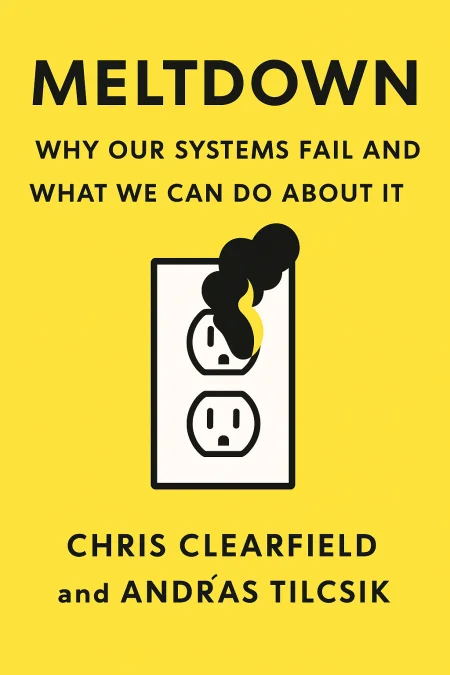
Meltdown
Why Our Systems Fail and What We Can Do About It
byChris Clearfield, András Tilcsik
Book Edition Details
Summary
In a world where complexity is both a marvel and a menace, "Meltdown" dares to unravel the chaos lurking beneath our polished systems. Picture this: a mishap on the bustling D.C. metro, an unexpected overdose in a high-tech hospital, even a burnt holiday feast—all seemingly unrelated, yet bound by the invisible threads of systemic failure. Chris Clearfield and Andras Tilcsik take you on an electrifying journey through gripping real-world tales, from the enigmatic depths of the Gulf of Mexico to the dizzying heights of Mount Everest. With each story, they expose the paradox of modern progress—how the very intricacies that empower us also set the stage for spectacular downfalls. But fear not, for "Meltdown" is a beacon of hope, revealing ingenious strategies to outsmart failure. Whether you're steering a corporate ship or navigating daily life, this book promises to transform your understanding of complexity with its fresh insights and captivating narrative.
Introduction
Contemporary society operates through increasingly sophisticated systems that promise unprecedented efficiency and control, yet these same systems regularly produce catastrophic failures that seem to emerge without warning. The fundamental paradox of modern technological civilization lies in this contradiction: as our systems become more capable and interconnected, they simultaneously become more vulnerable to spectacular breakdown. These failures share common characteristics that transcend industry boundaries, revealing predictable patterns in how complex systems behave under stress. The analysis presented here challenges conventional approaches to risk management by demonstrating that certain types of failures are not aberrations to be prevented, but inevitable consequences of system design. Two critical factors interact to create what can be termed the "danger zone": complexity, which obscures understanding of how systems actually function, and tight coupling, which accelerates problem propagation beyond human response capabilities. This framework provides a systematic method for identifying where organizations are most vulnerable and why traditional safety measures often prove inadequate or counterproductive. The implications extend far beyond obvious high-risk domains like nuclear power or aviation. Financial markets, healthcare systems, social media campaigns, and corporate decision-making processes all exhibit similar vulnerabilities when complexity and coupling intersect. Understanding these dynamics becomes essential as organizations continue evolving toward greater interdependence and sophistication, requiring new approaches that embrace uncertainty rather than pursuing the illusion of complete control.
The Danger Zone: How Complexity and Coupling Generate Inevitable Failures
Complex systems resist direct observation and comprehension through intricate webs of interconnection that obscure cause-and-effect relationships. Unlike simple mechanical devices where problems manifest obviously and locally, complex systems distribute their symptoms across multiple subsystems, making accurate diagnosis extremely difficult. Nuclear power plants exemplify this challenge perfectly: operators cannot directly observe reactor conditions but must infer system states through indirect measurements and computer displays that may provide contradictory or misleading information during emergencies. Tight coupling eliminates the slack that might otherwise contain failures within manageable boundaries. In tightly coupled systems, components depend on each other with minimal buffering time, few alternative pathways, and little tolerance for delay or substitution. When problems arise, they cascade rapidly through interconnected processes before human operators can understand what is happening, much less intervene effectively. The combination creates a danger zone where minor perturbations can trigger massive failures through unexpected interactions that spread faster than human comprehension. The Three Mile Island nuclear accident demonstrates this dynamic with devastating clarity. A routine maintenance problem triggered a cascade of failures that operators misunderstood for hours while their instruments provided contradictory signals. The complexity made it impossible to grasp actual reactor conditions, while tight coupling ensured that each well-intentioned intervention accelerated progression toward potential catastrophe. The accident revealed how systems can fail not through dramatic external shocks or obvious incompetence, but through inherent characteristics of their design. This framework applies across domains where complexity and coupling intersect. Financial trading algorithms, hospital medication systems, and even organizational decision-making processes exhibit similar vulnerabilities. Recognition of danger zones requires abandoning the search for single root causes in favor of understanding system characteristics that make certain types of failures mathematically inevitable regardless of individual competence or equipment reliability.
Human Cognitive Limits: Why Traditional Management Approaches Backfire
Human cognitive architecture evolved for environments vastly simpler than modern organizational systems, creating systematic blind spots that become dangerous when managing complex coupled processes. Conformity pressures literally alter perception at neurological levels, with brain imaging revealing that group consensus changes what individuals actually see rather than merely what they report. This creates organizational blindness where warning signs become invisible when they contradict prevailing assumptions or challenge established hierarchies. Authority structures compound these limitations through predictable patterns of deference that filter critical information precisely when organizations most need diverse perspectives. Research demonstrates that even minimal power differences cause people to dismiss contrary evidence while making those in authority positions less capable of processing dissenting information. Subordinates become reluctant to voice concerns that might challenge superiors, creating systematic information distortion that increases with organizational hierarchy. Traditional management approaches based on command-and-control assumptions become counterproductive in complex systems where no individual can comprehend all relevant interactions. Attempts to increase control through additional rules, procedures, and oversight often add complexity without reducing risk, creating new failure modes while providing false confidence that problems have been addressed. Safety systems themselves become sources of vulnerability when they increase interdependencies or encourage complacency about underlying risks. The paradox of expertise emerges when deep specialized knowledge creates blind spots about system-wide interactions that transcend any single domain. Expert-dominated decision-making processes may miss critical perspectives and fail to recognize when specialized knowledge becomes irrelevant or counterproductive during system-wide emergencies. This suggests fundamental limits on hierarchical control that require alternative approaches designed around human cognitive constraints rather than idealized assumptions about rational decision-making.
Beyond Control: Building Resilient Systems Through Warning Signs and Diversity
Complex systems continuously generate weak signals that reveal emerging problems long before they manifest as catastrophic failures, but these warning signs typically appear as minor anomalies that organizations dismiss as acceptable costs of doing business. Learning to recognize and act on these signals requires systematic approaches that overcome natural tendencies to focus only on successful outcomes while ignoring near-misses and small failures that provide crucial intelligence about system vulnerabilities. Aviation demonstrates how systematic attention to warning signs can dramatically improve safety outcomes despite increasing complexity. The industry's reporting systems collect thousands of incident reports monthly, treating pilot reports of near-misses and procedural confusion as valuable data about potential failure modes rather than isolated problems. This approach requires cultural changes that encourage reporting without blame and analytical processes that identify system-level patterns rather than individual errors. Diversity in backgrounds, perspectives, and expertise introduces productive friction that forces groups to examine their reasoning more carefully and consider alternative explanations for complex phenomena. Research demonstrates that diverse groups outperform homogeneous ones on complex tasks not because minorities contribute unique insights, but because diversity makes everyone more skeptical and thorough in their analysis. When group members cannot assume shared understanding, they must articulate reasoning explicitly and defend conclusions more rigorously. Outsider perspectives provide particularly valuable insights because they are not constrained by organizational assumptions and established practices that insiders have learned to accept as normal. However, organizations typically resist external criticism and may actively suppress inconvenient observations about system vulnerabilities. Harnessing outsider insights requires institutional commitment to seeking uncomfortable truths and systematic processes for integrating external perspectives into internal decision-making, even when those perspectives challenge fundamental assumptions about how systems should work.
Practical Framework: Managing Uncertainty Instead of Eliminating Risk
Effective management of complex systems requires abandoning illusions of complete control in favor of building adaptive capacity that can function safely despite incomplete information and imperfect decisions. Structured decision-making processes help counteract cognitive biases and group dynamics that lead to poor choices under pressure, including techniques like premortems that systematically imagine failure scenarios before they occur and predetermined criteria that reduce emotional and political influences during critical moments. Transparency and slack represent fundamental design principles for safer complex systems that appear inefficient under normal conditions but prove essential during stress. Transparency makes system states visible to multiple observers, reducing likelihood that problems remain hidden until they become catastrophic. Slack provides buffering capacity that allows systems to absorb perturbations without cascading failures through redundant systems, longer time horizons, or excess capacity that creates room for error and recovery. Warning sign detection and response systems must assume that early indicators will be ambiguous and potentially contradictory, requiring processes for gathering weak signals, sharing information across organizational boundaries, and taking action based on incomplete information. This demands cultural changes that reward reporting problems and uncertainties rather than punishing messengers or demanding certainty before action, along with systematic analysis of close calls that reveals patterns predicting where major failures are most likely to occur. Building resilience requires accepting that perfect prediction and control are impossible in complex systems, shifting focus from preventing all possible failures to rapid detection and effective response when problems inevitably arise. Simple tools like checklists and structured communication protocols can prevent many routine failures, while systematic learning processes help organizations adapt to new challenges and changing conditions that cannot be anticipated through traditional planning approaches.
Summary
The fundamental insight emerging from this analysis reveals that system failures in complex organizations follow predictable patterns created by the interaction between complexity and tight coupling, making certain types of catastrophic breakdowns not merely possible but mathematically inevitable. This understanding provides both sobering recognition of organizational vulnerabilities and practical guidance for building more resilient systems through systematic attention to warning signs, cultivation of diverse perspectives, and design approaches that embrace uncertainty rather than pursuing impossible dreams of complete control. Rather than seeking to eliminate all risks through better planning or more detailed procedures, effective management of complex systems requires building adaptive capacity that can function safely when problems inevitably emerge, accepting fundamental limits on predictability while developing systematic approaches to learning from small failures before they become catastrophic disasters.
Related Books
Download PDF & EPUB
To save this Black List summary for later, download the free PDF and EPUB. You can print it out, or read offline at your convenience.
By Chris Clearfield
