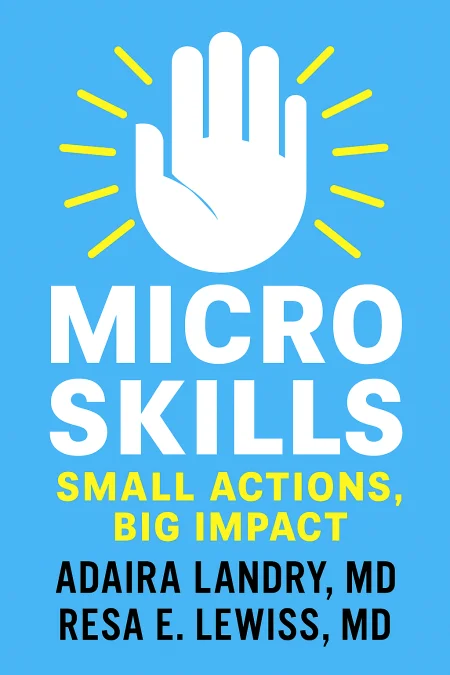
MicroSkills
The Tiny Steps That Lead to the Biggest Accomplishments
byAdaira Landry, Resa E. Lewiss
Book Edition Details
Summary
What if mastering your career could be as simple as learning to tie your shoes? "MicroSkills" unravels the mystery of professional success, offering a treasure trove of practical insights from award-winning mentors. This isn't just another self-help book—it's your personal guide to transforming lofty ambitions into achievable milestones. Through the art of dissecting challenges into bite-sized, actionable steps, this book empowers you to revolutionize your work life. Imagine cultivating resilience without burnout, honing your expertise with ease, and forging networks that thrive. Each page is a revelation, delivering the tools you wish you'd had from day one. Whether you're climbing the corporate ladder or refining your craft, "MicroSkills" is the essential companion to propel you towards excellence.
Introduction
The modern workplace can feel like a maze without a map. You arrive each day knowing you want to succeed, but the unwritten rules, hidden expectations, and complex dynamics often leave you wondering what separates those who thrive from those who merely survive. The gap isn't usually about raw talent or technical skills—it's about the seemingly small behaviors, communication patterns, and strategic choices that compound over time to create extraordinary results. Success in today's professional environment requires more than just showing up and doing good work. It demands an understanding of how to navigate relationships, manage your reputation, build expertise, and create opportunities for yourself. These capabilities aren't innate gifts that some people possess and others don't. They're learnable skills that can be broken down into manageable, actionable components—what we call MicroSkills. The challenge is that most professional development advice assumes you already have certain advantages: established networks, mentors who guide you, or insider knowledge about how things really work. This book takes a different approach. It recognizes that you're the primary architect of your own success and provides concrete tools to help you build the career you want, regardless of your starting point.
Master Your Foundation: Self-Care and Communication Excellence
Self-care in the workplace isn't about bubble baths and spa days—it's about creating the conditions that allow you to perform at your best while maintaining your health and sanity. True professional self-care means recognizing that your job will never love you back with the same intensity you bring to it, so you must be deliberate about protecting your energy, time, and well-being. Dr. Resa Lewiss learned this lesson during her emergency medicine residency when she realized she was surviving on room-temperature bagels grabbed between patients, never taking proper meal breaks during ten-hour shifts. The culture normalized self-sacrifice to the point where basic human needs like eating and resting were seen as weakness. This experience taught her that sustainable success requires setting boundaries and taking care of yourself first. The transformation came when she began treating self-care as a strategic necessity rather than a luxury. She started blocking time for meals, establishing sleep routines, and creating systems to manage her personal finances and calendar. These weren't selfish acts—they were professional investments that improved her patient care, decision-making, and overall performance. Begin by identifying your personal board of directors: trusted individuals who can provide honest feedback and emotional support during challenging times. Schedule regular check-ins with these people and don't wait until crisis moments to reach out. Next, audit your current self-care practices. Are you protecting your sleep, maintaining your physical health, and managing your finances responsibly? Create systems that automate or streamline routine tasks that drain your energy without adding value. Set clear boundaries around your time, including limits on meetings and after-hours communication. Remember that saying no to one thing means saying yes to something else that might be more important. The goal isn't perfection—it's sustainability. You're building a career that spans decades, not months, so invest in practices that will serve you long-term rather than burning out early in pursuit of short-term gains.
Build Your Professional Brand: Reputation and Expertise Development
Your reputation is the sum of countless small interactions, decisions, and behaviors that others observe over time. It's not something you can manufacture overnight, but it can be damaged quickly if you're not intentional about how you show up professionally. Building a strong reputation requires consistency in your actions and a commitment to continuous learning and growth. Dr. Adaira Landry discovered the power of reputation management during her medical training when she realized that being competent wasn't enough—she needed to be known for her competence. She started sharing her failures openly in professional settings, not to appear vulnerable, but to demonstrate her commitment to learning and improvement. This approach made her more relatable and trustworthy to colleagues. Her breakthrough came when she began actively building expertise in areas beyond her clinical work. She started writing, speaking, and teaching, which positioned her as a thought leader in her field. She learned to document her accomplishments, ask for recognition, and advocate for herself in ways that felt authentic rather than boastful. Start by conducting an honest assessment of your current reputation. Ask trusted colleagues how they perceive your strengths and areas for improvement. Identify the expertise you want to develop and create a learning plan that includes multiple formats: books, podcasts, courses, and conversations with experts in that field. Set measurable benchmarks for your growth and track your progress regularly. Apply for stretch opportunities even if you don't meet all the stated qualifications—competence is often developed on the job rather than prerequisite to it. Draft your own letters of recommendation to help supporters advocate for you effectively. Building expertise is not a solo endeavor. Collaborate with others, share your knowledge generously, and create content that demonstrates your thinking. Your professional brand should reflect not just what you know, but how you think and the unique perspective you bring to challenges in your field.
Navigate Workplace Dynamics: Culture, Teamwork and Conflict Resolution
Every workplace has its own culture, spoken and unspoken rules, and power dynamics that determine how things really get done. Success requires reading these dynamics accurately and adapting your approach accordingly, while still maintaining your authentic self and values. Dr. Lewiss encountered this challenge when working with a colleague who consistently exhibited problematic behavior toward team members. The individual would lose their temper, make inappropriate comments, and create an atmosphere of tension that affected everyone's ability to do their best work. For years, the behavior was tolerated because leadership avoided difficult conversations. The situation improved only when someone finally documented the pattern, addressed it directly with leadership, and created accountability. This experience taught the importance of recognizing when cultural problems need intervention rather than accommodation. Learn your organization's formal structure by requesting organizational charts and understanding reporting relationships. But pay equal attention to informal power structures—who really makes decisions, whose opinions carry weight, and how conflicts typically get resolved. Introduce yourself to people across different levels and departments, remembering names and showing genuine interest in their work. Create psychological safety for others by speaking up when you witness disrespectful behavior or exclusion. Build your skills in having difficult conversations by practicing beforehand and focusing on specific behaviors rather than character judgments. When conflicts arise, acknowledge your role while also addressing the substantive issues that need resolution. Document important conversations and decisions to protect yourself and maintain clarity about commitments. Understand that Human Resources serves the organization's interests, not necessarily yours, so be strategic about when and how you involve them in workplace issues.
Accelerate Your Growth: Networking and Opportunity Creation
Opportunity creation is an active process, not a passive hope that good things will happen to you eventually. It requires building genuine relationships, staying visible in your field, and positioning yourself for possibilities that may not even exist yet. Dr. Landry learned this lesson when she realized that many of her colleagues were getting interesting opportunities not because they were more talented, but because they were more intentional about networking and self-advocacy. She started reaching out to people whose work she admired, offering to help with their projects, and sharing her own expertise more broadly. Her approach transformed when she shifted from thinking about networking as using people to viewing it as creating mutual value. She began hosting events, making introductions between colleagues, and actively promoting others' work. This generosity created a network of people who were equally invested in her success. The results compounded over time. Opportunities began coming to her because people knew what she was working on and what kind of projects would interest her. She started receiving invitations to speak, write, and collaborate that aligned with her goals and values. Begin by clarifying what kinds of opportunities you want to create for yourself. Are you looking for new collaborations, speaking opportunities, board positions, or career transitions? Once you're clear on your goals, identify people who are doing the kind of work that interests you. Approach networking as relationship-building rather than transaction-seeking. Offer help before asking for it. Share others' work, make introductions, and contribute to conversations in your field. Use social media strategically to demonstrate your expertise and connect with like-minded professionals. Remember that networking is not about collecting contacts—it's about building genuine relationships that create mutual benefit over time. Be patient with the process and focus on giving value to others. The opportunities will follow naturally from the relationships you build.
Summary
The path to professional success is not mysterious or reserved for a chosen few. It's built through deliberate practice of small, strategic actions that compound over time to create significant impact. As the authors emphasize throughout their work, "you are completely responsible for the health of your career" because no one else is losing sleep over your professional development or staying awake worrying about your next promotion. The MicroSkills approach recognizes that sustainable success comes from mastering foundational elements like self-care and clear communication, then building outward to develop expertise, navigate workplace dynamics, and create opportunities for growth. Each skill builds upon the others, creating a comprehensive toolkit for professional advancement that works regardless of your industry or starting point. The most powerful insight from this framework is that you already possess the capability to implement these changes. You don't need permission, additional credentials, or perfect conditions to begin. Start by choosing one MicroSkill that resonates with your current situation and commit to practicing it consistently for the next month. Success is built one small action at a time, and your career transformation begins with the next decision you make.
Related Books
Download PDF & EPUB
To save this Black List summary for later, download the free PDF and EPUB. You can print it out, or read offline at your convenience.
By Adaira Landry
