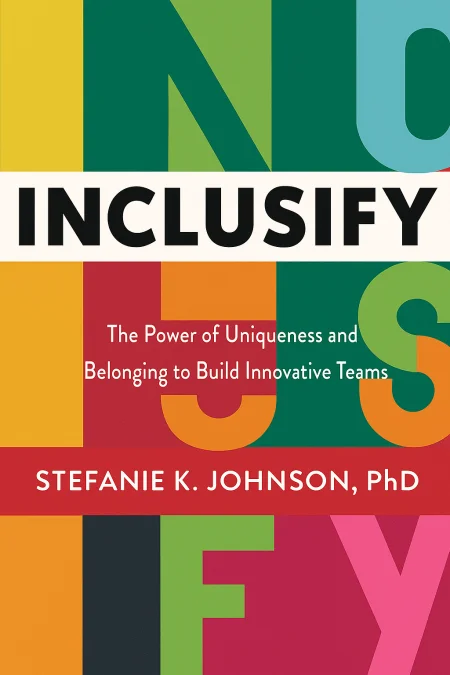
Inclusify
The Power of Uniqueness and Belonging to Build Innovative Teams
Book Edition Details
Summary
In a world of businesses caught between the desire for individuality and the necessity of belonging, "Inclusify" by Stefanie Johnson emerges as a beacon for visionary leaders. This isn't just another management guide—it's a manifesto for crafting teams that thrive on diversity without sacrificing cohesion. Johnson's pioneering approach goes beyond mere inclusion; it champions a dynamic ethos of continuous engagement and empowerment. She reveals the subtle pitfalls even well-meaning leaders face and offers a roadmap to transform workplaces into melting pots of innovation. By balancing the delicate dance between standing out and fitting in, "Inclusify" equips leaders with the tools to unleash the full potential of every voice, driving creativity and profit to unprecedented heights. Here, unity and uniqueness are not at odds but are the dual engines propelling success.
Introduction
Why do so many diversity initiatives fail despite genuine good intentions and substantial investment? The answer lies in a fundamental misunderstanding of human psychology and leadership dynamics. Most leaders operate under the assumption that creating diverse teams automatically leads to inclusive environments, yet research reveals a more complex reality. This work introduces a groundbreaking framework that addresses the dual human needs for uniqueness and belonging, demonstrating how effective leaders can harness these psychological drivers to create truly inclusive organizations. The theory centers on the recognition that individuals simultaneously seek to express their authentic selves while feeling connected to a larger group purpose. This tension between standing out and fitting in creates the foundation for understanding why traditional diversity approaches often fall short. The framework reveals six distinct leadership archetypes that emerge from how leaders navigate this tension, each with specific blind spots that limit their effectiveness. Through systematic analysis of leadership behaviors and organizational outcomes, we discover that true inclusion requires intentional actions that validate individual differences while building cohesive team identity.
The Uniqueness-Belonging Framework for Inclusion
The core theoretical foundation rests on the principle that human beings possess two fundamental psychological drives that must be simultaneously satisfied for optimal engagement and performance. The uniqueness drive compels individuals to express their authentic identity, skills, and perspectives without constraint or conformity pressure. The belonging drive motivates people to feel valued, connected, and integral to group success and mission. This framework operates on multiple interconnected levels. At the individual level, it explains why people experience stress when forced to choose between authenticity and acceptance. At the team level, it illuminates how group dynamics either enhance or diminish collective performance based on how these needs are managed. At the organizational level, it reveals why structural systems and cultural norms either facilitate or impede inclusive environments. The tension between these drives creates four possible states of experience. When both needs are met, individuals feel genuinely included and perform at their highest capacity. When uniqueness is suppressed but belonging is present, people feel incomplete and constrained. When uniqueness is acknowledged but belonging is absent, individuals feel isolated and tokenized. When neither need is satisfied, people become invisible and disengaged. Understanding these states allows leaders to diagnose team dynamics and implement targeted interventions that restore balance and enhance collective effectiveness.
Six Leadership Archetypes and Their Follies
The research reveals six distinct leadership patterns that emerge from how leaders approach the uniqueness-belonging dynamic. Each archetype represents a well-intentioned but incomplete approach that creates predictable blind spots and limitations. The Meritocracy Manager focuses exclusively on objective performance criteria while ignoring how bias influences evaluation systems. The Culture Crusader prioritizes team cohesion through similarity, inadvertently excluding diverse perspectives that drive innovation. Team Players, often from underrepresented groups themselves, distance from their identity groups to gain acceptance, thereby limiting their ability to support others facing similar challenges. White Knights attempt to protect and advocate for diverse team members but create paternalistic relationships that undermine competence perceptions. Shepherds, typically women or people of color in leadership roles, face unique scrutiny when supporting others from their background groups, creating appearance of favoritism even when actions are merit-based. Optimists represent perhaps the most common archetype, believing that good intentions and time will naturally resolve inclusion challenges without requiring systematic intervention or behavior change. Each pattern reflects genuine commitment to team success but operates from incomplete understanding of psychological and systemic factors that influence group dynamics. Consider a technology team where the leader genuinely values diverse perspectives but consistently interrupts women during meetings while encouraging men to elaborate on similar points. The leader's conscious intention conflicts with unconscious behavioral patterns, creating an environment where belonging feels conditional on conformity to dominant group communication styles. Recognizing these patterns allows leaders to identify their default approaches and develop more comprehensive strategies that address both conscious intentions and unconscious behaviors.
The SELF-TEAM Model for Inclusifying
The practical application of uniqueness-belonging theory manifests through eight specific leadership behaviors organized into two complementary frameworks. The SELF model addresses uniqueness through four key actions. Support requires publicly advocating for diverse perspectives and creating visible sponsorship for underrepresented talent. Empathy involves actively seeking to understand different lived experiences and the unique challenges various team members face. Learn encompasses cultivating genuine curiosity about alternative approaches and creating systems that surface diverse viewpoints during decision-making processes. Fair means establishing equitable rather than merely equal treatment, providing individuals with resources and opportunities tailored to their specific circumstances and barriers. The TEAM model creates belonging through four corresponding behaviors. Transparency involves aggressive communication about decision-making processes, criteria, and organizational changes to eliminate speculation and build trust. Empower means delegating meaningful authority and accountability while providing necessary support for success. Align focuses on creating shared commitment to inclusive values across all team members, including majority group allies. Motivate encompasses building collective energy and enthusiasm around diversity and inclusion as core organizational values rather than compliance requirements. These behaviors function synergistically rather than independently. A leader might demonstrate empathy by learning about a team member's cultural background while simultaneously aligning other team members to appreciate that perspective's value to collective problem-solving. The framework provides a diagnostic tool for assessing current leadership effectiveness and a development roadmap for enhanced inclusion capabilities. Organizations implementing this model report measurable improvements in employee engagement, retention rates, innovation metrics, and financial performance as teams access previously untapped intellectual and creative resources.
Practical Strategies for Inclusive Leadership
Implementation requires systematic attention to both individual behavior change and structural system modifications. Leaders begin by conducting honest self-assessment to identify their dominant archetype and associated blind spots. This awareness enables targeted development activities such as reverse mentoring relationships, perspective-taking exercises, and feedback collection from diverse team members about their experience of inclusion. Structural interventions complement individual development through changes to talent management systems. Anonymous resume reviews eliminate initial bias in hiring processes. Diverse interview panels and standardized evaluation criteria reduce subjective judgments that favor similar-to-self candidates. Clear advancement pathways with transparent criteria and regular progress discussions help all team members understand how to achieve career goals. Office housework distribution ensures that administrative tasks don't disproportionately burden underrepresented groups. The transformation process requires consistent measurement and accountability mechanisms. Organizations track diversity metrics across all levels and functions while simultaneously assessing inclusion through employee surveys, focus groups, and retention analysis by demographic groups. Leaders receive regular feedback on their inclusive behaviors and participate in ongoing skill development. Consider a financial services firm that implemented monthly inclusion check-ins where team members anonymously share their sense of belonging and uniqueness. The data revealed that remote workers felt disconnected from informal decision-making conversations, leading to virtual coffee chats and structured online brainstorming sessions that enhanced both participation and innovation. Success emerges from sustained commitment to behavioral practice rather than one-time training events, creating cultural norms where inclusion becomes automatic rather than effortful.
Summary
True inclusion emerges from the delicate balance between honoring individual authenticity and fostering collective belonging, requiring leaders to simultaneously embrace differences and unite diverse perspectives toward shared purpose. This framework transcends traditional diversity approaches by addressing fundamental human psychology, offering practical tools for creating environments where all individuals can contribute their highest capabilities. The long-term implications extend beyond organizational effectiveness to societal progress, as inclusive leadership models become catalysts for broader cultural transformation toward equity and mutual understanding.
Related Books
Download PDF & EPUB
To save this Black List summary for later, download the free PDF and EPUB. You can print it out, or read offline at your convenience.
By Stefanie K. Johnson
