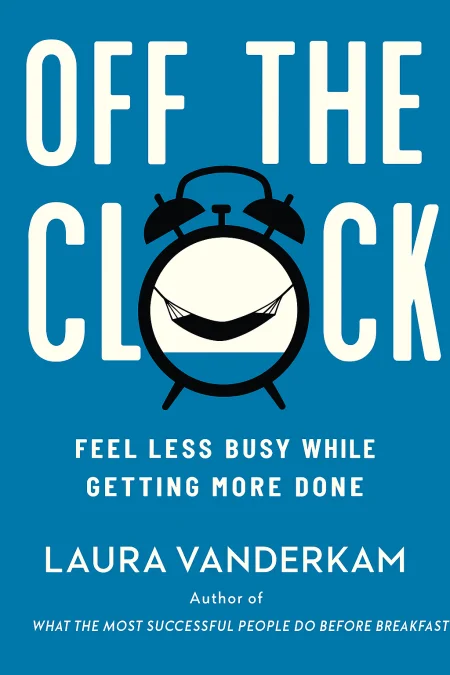
Off the Clock
Feel Less Busy While Getting More Done
Book Edition Details
Summary
In a world where time slips through our fingers like grains of sand, Laura Vanderkam presents a revolutionary mindset shift: the secret to conquering time isn't in cramming more into your day, but in feeling as though you have all the time you need. Through "Off the Clock," Vanderkam unveils the hidden strategies of those who seem to wield time with ease, drawing you into the lives of a diverse cast of characters—a school principal, a globe-trotting executive, a CEO at a Waffle House, and an artist rediscovering her muse. These tales of time mastery will resonate with anyone who feels overwhelmed by the ticking clock. With keen insights and practical wisdom, Vanderkam's book isn't just about productivity; it's about transforming your relationship with time, making each moment not only productive but joyously lived.
Introduction
In our hyperconnected world, time seems to slip through our fingers like sand, leaving us perpetually behind and breathlessly chasing the next deadline. We wear our busyness like a badge of honor, yet deep down, we crave something different—those magical moments when time feels abundant, when we're truly present, when we feel genuinely in control of our hours rather than controlled by them. The secret isn't about cramming more into each day or finding mystical time-management hacks. It's about fundamentally shifting how we perceive and interact with time itself. When we learn to tend our schedules like a master gardener tends their plot, when we invest strategically in what brings us joy, and when we create space for what truly matters, something remarkable happens. We discover that time isn't scarce at all—it's abundant, rich with possibility, waiting for us to step off the hamster wheel and into a more intentional way of living.
Tend Your Garden: Mindful Time Awareness
True time freedom begins with awareness, much like a gardener who must first understand their plot of earth before planting anything meaningful. This foundational principle involves tracking where your hours actually go, not where you think they go, because the gap between perception and reality is often startling. Robert Kauffman discovered this truth when he became principal of Hillside Elementary School in Michigan. Despite twenty-one years of experience, he felt overwhelmed by the constant demands—broken pipes, late buses, and administrative chaos that pulled him away from his real work of supporting teachers and improving student outcomes. When he signed up for the National SAM Innovation Project, a mysterious observer followed him for an entire week, documenting how he spent every five-minute block of his day. The results were eye-opening. Kauffman was spending only 39 percent of his time on instructional leadership—the high-value work that actually moved the school forward. The rest was consumed by what he called "weeds"—paperwork that could be delegated, constant email checking, and excessive lunchroom supervision. Armed with this data, Kauffman began redesigning his schedule like a landscape architect. He created "Teaching Tuesdays" to model techniques for his staff, designated specific times for giving positive feedback, and most importantly, he built in thirty minutes daily for personal matters so they wouldn't bleed into his professional priorities. The transformation was remarkable. Within six months, Kauffman increased his instructional leadership time to 51 percent—essentially gaining twelve additional days of high-impact work. His students' math proficiency scores rose by 4.2 percentage points, and reading showed similar gains. Even more powerful was the mental shift. By knowing exactly where his time went and making intentional choices about where it should go, Kauffman felt less scattered and more in control, even when unexpected crises arose. To begin tending your own garden, start tracking your time for at least one week, noting activities in broad categories every few hours. Then ask yourself three crucial questions: What do I like about my schedule? What would I like to spend more time doing? What would I like to spend less time doing? Design your "realistic ideal day" and work backwards to make it happen. Remember, mindfulness gives you time, time gives you choices, and skillfully made choices lead to freedom.
Make Life Memorable: Adventures and Experiences
The secret to making time feel abundant lies in understanding a fundamental truth about memory and perception: when people say they want more time, what they really want is more memories. Our brains telescope routine experiences—a thousand identical commutes become one commute in memory—while novel and emotionally intense experiences expand our sense of time. Dorie Clark, a personal branding expert living in expensive New York City, realized she had fallen into this memory trap. Despite building a successful business, when people asked what she liked to do besides work, she had no answer. She was living in one of the world's most vibrant cities but experiencing none of it. Her days blurred together in an unmemorable haze of productivity that ultimately felt empty. Clark decided to commit to one uniquely New York adventure each week throughout 2016. She documented everything in her phone—tours of Hasidic Brooklyn, visits to the Lower East Side Tenement Museum, comedy shows at Upright Citizens Brigade, and an unexpected encounter with Jerry Seinfeld at a small club. She biked the West Side Highway, ate at the Rainbow Room, and explored authentic Asian cuisine in a Queens food court at the end of the 7 line. What started as fifty-two planned adventures became far more as the project gained momentum. The results extended beyond simple enjoyment. Clark became more mindful about choosing how to spend her free time, actively seeking experiences rather than letting them happen by chance. She started privileging activities that were uniquely New York—choosing a museum exhibit over a movie because she could see a movie anywhere. Most importantly, her perception of time transformed. New York became a rich landscape of memories and associations instead of just an expensive place to work. Each neighborhood held stories, each street corner triggered recollections of adventures shared with friends. To create your own memory-rich life, ask yourself daily: "Why is today different from all other days?" Plan one small adventure each week—it might be trying a new restaurant, taking a different route to work, or calling an old friend. Remember that conscious fun takes effort, but it's the effortful experiences that make today memorable and prevent us from asking where the time went. The goal isn't to fill every moment with novelty, but to create enough unique experiences that your weeks and months feel textured rather than smooth.
Invest in Your Happiness: Strategic Choices
Happiness isn't a luxury when it comes to time management—it's a strategic investment that fundamentally changes how we experience our hours. When we deliberately structure our days to include more activities that bring us joy and fewer that drain us, time itself feels more abundant and less rushed. Chris Carneal, CEO of Boosterthon, discovered this principle through his demanding schedule managing 600 employees while raising four young children. Initially, he felt constantly pulled in different directions, distracted during meetings because he was thinking about problems he still needed to solve, always wondering when conversations would end so he could tackle his growing to-do list. The pressure of trying to fit everything into a conventional workday left him feeling frazzled and ineffective. Carneal's breakthrough came when he decided to invest his best hours in his own priorities first. He began waking at 4:55 AM for a 5:15 CrossFit class, followed by focused work time at a local Waffle House. Between 6:05 and 7:20 AM, he would pray, reflect, and tackle his biggest strategic challenges in complete quiet. This wasn't about grinding harder—it was about using his peak energy when his mind was clearest and before anyone else needed his attention. The transformation was remarkable. By the time Carneal arrived at his office around 9:30 AM, he had already put in 2.5 highly productive hours and completed more meaningful work than he used to accomplish in entire days. More importantly, he felt free to be fully present with his team. Instead of rushing through conversations while mentally juggling other problems, he could walk slowly through the halls, engage genuinely with employees, and handle interruptions with grace because his most important work was already done. To invest in your own happiness, first identify your peak energy hours and protect them fiercely for your most important work. Look at your schedule for activities that consistently drain you—perhaps a terrible commute or tasks that could be outsourced—and invest money or time in solutions. Build small treats into your days without guilt, whether that's higher-quality coffee or time for a favorite hobby. Remember that paying yourself first with time and attention isn't selfish; it's strategic, creating the mental space and energy needed to show up fully for everything else in your life.
People Are a Good Use of Time
In our quest for productivity, we often treat relationships as something we'll get to when we have time left over, but this approach guarantees that our most meaningful connections get shortchanged during busy seasons. The truth is that people don't just help us pass time—they can make our hours come alive and create the off-the-clock moments we crave most. Elisabeth McKetta and Cathy Doggett discovered this when their mothers encouraged them to meet as young professionals in Boston twenty-five years ago. Doggett, the more organized of the two, suggested they meet every Monday to cook dinner together, complete with planned recipes and wine. When careers and families later moved them to different cities—McKetta to Boise, Doggett to Austin—they maintained their connection through deliberate weekly phone calls, despite neither particularly enjoying phone conversations. Their friendship weathered natural tensions that arise in any long relationship. McKetta's naturally flakier personality clashed with Doggett's high standards—once McKetta even rented out her house to a jazz band when Doggett was scheduled to visit. But instead of letting these differences erode their bond, Doggett addressed issues directly. She held McKetta accountable to their plans, explaining that she'd purchased food and made time that couldn't easily be rescheduled. Rather than feeling criticized, McKetta felt chosen and rose to meet Doggett's expectations. Over the decades, their friendship deepened into something irreplaceable. They talk deliberately about their lives, discuss books they've chosen to read together, and serve as witnesses to each other's adult evolutions. As McKetta puts it, having someone who has seen all your changes and growth makes life "less lonely and more meaningful." Their relationship creates its own momentum—disagreements with colleagues can be put in perspective because they've both seen similar situations before, and sharing ongoing experiences doubles the richness of individual moments. To make people a priority in your own life, treat relationships with the same intentionality you bring to work. Include relationship goals in your weekly planning alongside career and personal objectives. Create recurring commitments like monthly dinner dates or weekly phone calls that don't require constant rescheduling. Look for ways to align your existing activities with friend time—exercise together, commute together, or tackle volunteer projects as a team. Most importantly, be selective about where you invest your relationship energy, going deep with people who truly deepen your spirit rather than trying to maintain surface-level connections with everyone you meet.
Summary
The path to feeling less busy while getting more done isn't about finding more hours in the day—it's about fundamentally changing how we inhabit the hours we have. As we've discovered, true time freedom comes from tending our schedules with the same care a master gardener brings to their plot, investing strategically in experiences and relationships that bring joy, and learning to let go of the perfectionist expectations that keep us perpetually behind. When we track our time mindfully, create memorable moments deliberately, and prioritize people and experiences over endless productivity, something magical happens. We begin to live with what one wise observer called "all the time in the world"—not because we have endless hours, but because we've learned to make our hours feel endless through intention, presence, and conscious choice. Start today by choosing just one small change: track how you spend your morning hours, plan a tiny adventure for this weekend, or reach out to one person who matters to you. Time is finite, but within that finite container lies infinite possibility for richness, connection, and genuine satisfaction.
Related Books
Download PDF & EPUB
To save this Black List summary for later, download the free PDF and EPUB. You can print it out, or read offline at your convenience.
By Laura Vanderkam
