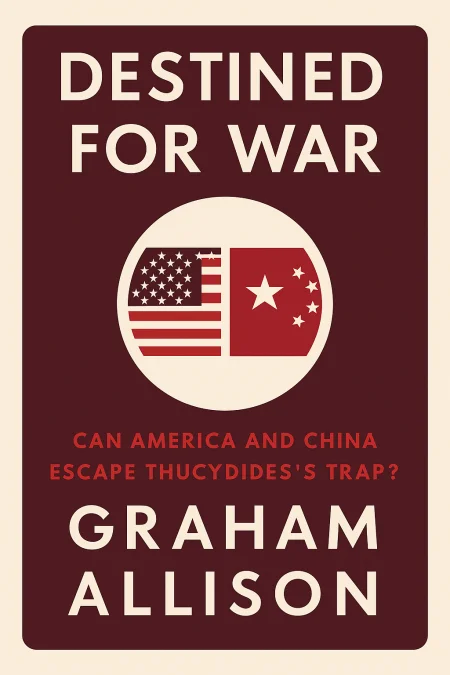
Destined for War
Can America and China Escape Thucydides's Trap?
Book Edition Details
Summary
In a world teetering on the brink of conflict, the shadow of Thucydides’s Trap looms ominously over the globe's two superpowers. As China rises with unstoppable momentum and America stands its ground with unyielding resolve, the echoes of ancient rivalries resound. Graham Allison's "Destined for War" deftly unravels the intricate dance of power between these giants, drawing from the well of history to reveal the dire consequences of unchecked ambition. Through a tapestry of historical analogies and strategic foresight, Allison not only warns of the perilous path ahead but also illuminates the delicate art of peacekeeping. This gripping narrative challenges leaders and citizens alike to ponder: can the lessons of the past steer us away from an inevitable clash, or are we fated to repeat history's gravest mistakes?
Introduction
In the summer of 431 BCE, two mighty civilizations stood at the precipice of a war that would consume the ancient world for nearly three decades. Athens, a rising maritime empire flush with democratic ideals and unprecedented prosperity, faced Sparta, the established military hegemon whose disciplined warriors had long maintained order across the Greek peninsula. The historian Thucydides, witnessing this epic confrontation unfold, identified a pattern that would echo through the corridors of history: "What made war inevitable was the growth of Athenian power and the fear which this caused in Sparta." This ancient observation reveals one of humanity's most dangerous recurring dynamics—the structural tension that emerges when a rising power threatens to displace an established one. Across five centuries of global politics, this pattern has repeated with alarming frequency, from the collision between Habsburg Spain and Renaissance France to the naval rivalry between Britain and Germany that helped ignite the twentieth century's catastrophic world wars. Yet understanding this trap also illuminates those rare moments when great powers have managed to navigate these treacherous waters without resorting to devastating conflict. For policymakers grappling with contemporary geopolitical challenges, students seeking to understand the forces that shape international relations, and citizens concerned about global stability, these historical patterns offer both sobering warnings and hopeful possibilities. The stories ahead reveal how rational leaders, acting to protect their nations' vital interests, have repeatedly created outcomes that served no one's purposes—and how extraordinary statesmanship has occasionally broken this cycle to forge peaceful transitions that benefited all parties involved.
Ancient Origins: Athens vs Sparta and the Classical Pattern
The collision between Athens and Sparta in the fifth century BCE established the archetypal template for understanding how rising powers challenge established orders. Athens had emerged from the Persian Wars transformed, its naval victories and democratic innovations creating a dynamic maritime empire that stretched across the Mediterranean. The city's unprecedented prosperity flowed from trade networks that connected distant shores, while its cultural achievements in philosophy, theater, and architecture proclaimed a new model of civilization based on individual excellence and collective participation. Sparta represented the antithesis of this Athenian revolution—a conservative land-based power whose military discipline and aristocratic values had long maintained stability throughout the Greek world. The Spartan system, built on rigid social hierarchy and warrior culture, had proven its effectiveness through centuries of successful warfare and diplomatic leadership among the Greek city-states. Yet this very success made Spartan leaders acutely sensitive to any challenge to their traditional supremacy. The deeper forces driving this conflict extended far beyond territorial disputes or commercial rivalry. Athens embodied a revolutionary vision of power based on innovation, trade, and democratic participation, while Sparta defended an older aristocratic order rooted in land ownership and military tradition. These competing models of civilization made accommodation increasingly difficult, as each side viewed the other's success as an existential threat to their fundamental way of life. The Athenian expansion through the Delian League, transforming defensive alliances into tribute-paying dependencies, convinced Spartan leaders that their rival sought nothing less than total domination of the Greek world. The Peloponnesian War that erupted consumed both powers in a struggle that lasted nearly three decades and devastated Greek civilization. Neither Athens nor Sparta emerged victorious in any meaningful sense—their mutual exhaustion opened the door for Macedonian conquest and eventual Roman domination. This outcome demonstrated the tragic irony that would characterize many subsequent power transitions: the collision between rising and ruling powers often destroys both competitors, creating vacuums that entirely different forces rush to fill.
European Precedents: Habsburg Rivalry to World Wars (1500-1945)
The European experience from the Renaissance through the mid-twentieth century witnessed an escalating series of power transitions, each more destructive than the last as military technology and state capacity expanded exponentially. The Habsburg-Valois rivalry established the pattern, as Charles V's vast inheritance spanning Spain, Austria, and the Holy Roman Empire created a continental empire that threatened French security and ambitions. This competition drew in the Ottoman Empire, various German princes, and Italian city-states, transforming local disputes into continent-wide conflicts that raged for generations. The rise of Britain as a global maritime power introduced new dimensions to great power competition, extending rivalry beyond European boundaries to encompass worldwide trade routes, colonial territories, and the fundamental question of whether land-based or sea-based power would dominate international affairs. British leaders mastered the art of coalition warfare, using their naval advantages and financial resources to sustain prolonged conflicts against continental rivals like Louis XIV's France and Napoleon's empire. These struggles established the principle that rising powers must often fight not just the established hegemon but entire coalitions determined to preserve the existing balance. The most catastrophic manifestation of this historical pattern emerged with Germany's rise in the late nineteenth and early twentieth centuries. German unification under Prussian leadership created a power whose industrial capacity, military efficiency, and geographic position threatened the entire European order. Kaiser Wilhelm II's decision to challenge British naval supremacy through massive fleet construction exemplified how rising powers often trigger exactly the encirclement they seek to avoid. The resulting arms races and alliance systems created a powder keg that exploded into unprecedented destruction. The two world wars represented the ultimate failure of traditional diplomacy to manage power transitions peacefully. Germany's attempts to achieve what its leaders saw as rightful recognition twice plunged the world into conflicts that consumed entire civilizations, ultimately leading to German devastation and the emergence of entirely new superpowers. These catastrophes demonstrated how the collision between rising and ruling powers could now threaten not merely regional stability but the survival of human civilization itself, setting the stage for fundamentally different approaches to managing great power competition.
Nuclear Exception: Cold War Competition Without Catastrophe (1945-1991)
The emergence of nuclear weapons fundamentally transformed the dynamics of great power rivalry, creating what scholars would later call the "long peace" between superpowers possessing the ability to destroy human civilization. The Soviet Union's rapid recovery from World War II and development of nuclear capabilities created classic conditions for Thucydides's Trap, as American policymakers watched with alarm while Soviet influence expanded across Eastern Europe, Asia, and the developing world. Moscow's impressive economic growth rates in the 1950s and 1960s suggested it might eventually surpass American prosperity and technological leadership. Yet both superpowers recognized that traditional great power war had become obsolete when victory could mean mutual annihilation. Instead of direct military confrontation, they developed elaborate rules of engagement that allowed intense competition while avoiding escalation to nuclear conflict. This "Cold War" manifested through proxy battles in Korea, Vietnam, and Afghanistan, technological races from space exploration to weapons development, and ideological competition for influence among non-aligned nations throughout the developing world. The peaceful resolution of this rivalry through Soviet internal collapse rather than external military defeat offered profound lessons about alternative paths for power transitions. The United States ultimately prevailed not through battlefield victory but by demonstrating the superiority of its economic and political systems over several decades of sustained competition. This outcome suggested that patient containment and competitive coexistence might provide viable alternatives to the catastrophic wars that had previously characterized such transitions. The Cold War experience proved that rising and ruling powers could maintain their rivalry without destroying each other, provided they shared an understanding of ultimate limits and developed institutional mechanisms for managing their competition. Both sides learned to communicate clearly about vital interests, avoid actions that might trigger uncontrollable escalation, and recognize that their fundamental survival depended on preventing the very conflicts their military preparations were designed to win.
Contemporary Challenge: US-China Relations and Peaceful Transition
The rise of China since 1978 represents perhaps the most significant power transition in modern history, compressing what historically took centuries into mere decades of unprecedented economic growth and military modernization. China's transformation from an impoverished developing nation to the world's second-largest economy has lifted hundreds of millions from poverty while challenging American predominance in manufacturing, technology, and increasingly in military capabilities throughout the Asia-Pacific region. The contemporary challenge involves managing this transition without falling into the historical pattern of conflict that has characterized most such power shifts. Chinese leaders emphasize their peaceful intentions and commitment to mutual benefit, promoting concepts like "win-win cooperation" and "peaceful rise" to reassure international audiences. American policymakers debate whether accommodation or containment offers the better path forward, recognizing that both approaches carry significant risks in an interconnected global economy where the two nations remain deeply interdependent. The complexity of modern power transitions extends beyond traditional military and economic measures to encompass technological innovation, cyber capabilities, space exploration, and influence over global governance institutions. China's Belt and Road Initiative represents an ambitious attempt to reshape international economic architecture, while American responses through alliance strengthening and technology restrictions reflect efforts to maintain existing advantages. These maneuvers occur against a backdrop of growing nationalism in both countries and domestic political pressures that complicate diplomatic solutions. Cultural and ideological differences between the two civilizations add additional layers of complexity absent from previous cases where rising and ruling powers shared common values or historical experiences. The challenge of building mutual understanding between American democratic capitalism and Chinese authoritarian socialism requires bridging gaps that extend far beyond policy disagreements to fundamental questions about human nature, social organization, and the proper relationship between individual freedom and collective welfare. Successfully navigating this transition will require unprecedented wisdom, restraint, and creative diplomacy from leaders who understand that the stakes have never been higher.
Summary
The historical pattern revealed through five centuries of great power competition demonstrates that while the rise of new powers inevitably creates dangerous tensions with established hegemonies, war between them is not inevitable. The core dynamic involves rising powers seeking recognition and influence commensurate with their growing capabilities, while ruling powers fear losing the privileged position that provides their security and prosperity. This collision of legitimate ambitions and understandable anxieties has repeatedly pushed nations toward conflicts that often destroyed both competitors while creating opportunities for entirely different forces to emerge. The key insight from both historical failures and successes lies in recognizing that traditional approaches to resolving power transitions through military confrontation have become obsolete in an age of nuclear weapons and economic interdependence. The Cold War demonstrated that ideological adversaries possessing ultimate destructive power can compete intensely while avoiding direct military confrontation, provided they develop shared understandings about limits and maintain communication channels during crises. Contemporary leaders must build upon these lessons while adapting to new challenges posed by technological change, global interconnectedness, and the compression of historical timescales. Moving forward requires patient diplomacy, creative institutional arrangements, and the wisdom to distinguish between vital interests that must be defended and peripheral concerns that can be negotiated. Success demands that both rising and ruling powers focus primarily on domestic renewal rather than external dominance, recognizing that their ultimate security depends on managing their competition without destroying the global systems that provide prosperity for billions of people. The stakes of getting this right extend far beyond the immediate competitors to encompass the survival and flourishing of human civilization in an interconnected world where the consequences of great power war would be truly global and potentially irreversible.
Related Books
Download PDF & EPUB
To save this Black List summary for later, download the free PDF and EPUB. You can print it out, or read offline at your convenience.
By Graham Allison
